Z-Score: Definition, Formula, and Practical Applications
Master Z-scores: Statistical tool measuring data deviation from the mean in standard deviations.
What Is a Z-Score?
A Z-score is a statistical measurement that describes a value’s relationship to the mean of a group of values, expressed in terms of standard deviations. In simpler terms, it tells you how many standard deviations away from the mean a particular data point lies. The Z-score serves as a crucial tool in statistics and finance, helping analysts and investors understand whether a data point is typical or unusual within a given dataset.
The concept originated from the need to standardize different datasets so that comparisons could be made on a level playing field. When you have raw scores from different distributions or scales, converting them to Z-scores allows for meaningful comparisons. A positive Z-score indicates that a value is above the mean, while a negative Z-score indicates that a value is below the mean. A Z-score of zero means the value is exactly at the mean.
Understanding Z-scores is fundamental to various fields including quality control, academic testing, financial analysis, and scientific research. They provide a standardized way to identify outliers and assess the probability of observing certain values in a distribution.
The Z-Score Formula and Calculation
The basic formula for calculating a Z-score is straightforward and elegant. When you have access to population data, the formula is:
Z = (X – μ) / σ
Where:
X = the raw score or individual data point
μ = the population mean
σ = the population standard deviation
To calculate a Z-score manually, first determine the mean of your dataset by adding all values and dividing by the number of values. Next, calculate the standard deviation, which measures how spread out the data is from the mean. Finally, subtract the mean from your individual data point and divide the result by the standard deviation.
In situations where you only have sample data rather than the entire population, you can use the sample mean and sample standard deviation as estimates:
Z = (X – x̄) / S
Where:
x̄ = the sample mean
S = the sample standard deviation
Let’s consider a practical example. Suppose you’re analyzing student test scores where the mean score is 75 and the standard deviation is 10. If a student scored 85, their Z-score would be (85 – 75) / 10 = 1.0. This means the student’s score is one standard deviation above the mean, indicating above-average performance.
Understanding Z-Score Values
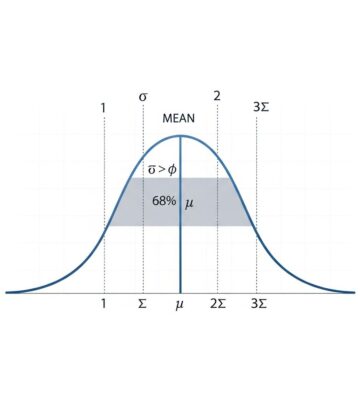
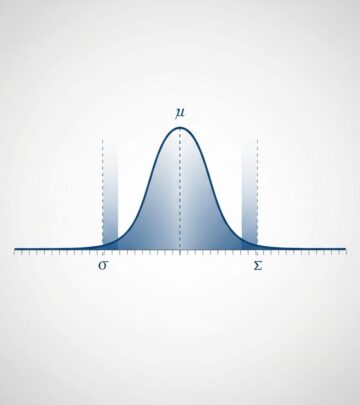
Z-score values follow a predictable pattern based on the normal distribution, also known as the bell curve. Most values in a normal distribution fall within three standard deviations of the mean:
Between -1 and +1 standard deviations: Approximately 68% of all observations
Between -2 and +2 standard deviations: Approximately 95% of all observations
Between -3 and +3 standard deviations: Approximately 99.7% of all observations
A Z-score of 2 or higher (or -2 or lower) is generally considered statistically significant, suggesting the data point is unusual or an outlier. Values beyond ±3 are extremely rare and may warrant further investigation.
Practical Applications of Z-Scores
Academic Testing and Standardization
Z-scores are widely used in educational assessment to compare student performance across different tests. When comparing scores from different standardized tests like the SAT and ACT, which use different scales, Z-scores provide a fair comparison method. For instance, if a student scored 1800 on the SAT (where the mean is 1500 and standard deviation is 300) and another student scored 24 on the ACT (where the mean is 21 and standard deviation is 5), converting both to Z-scores reveals that the first student performed relatively better. The first student’s Z-score would be 1.0, while the second student’s would be 0.6.
Financial Analysis and Risk Assessment
In finance, Z-scores help investors and analysts assess the riskiness of investments and detect anomalous price movements. Financial institutions use Z-scores to analyze stock performance, bond yields, and portfolio returns. A stock that rises significantly higher than its historical average (high positive Z-score) might indicate unusually strong performance, while one that drops far below average (negative Z-score) might signal weakness or a buying opportunity depending on the investor’s strategy.
Quality Control and Process Monitoring
Manufacturing and production facilities use Z-scores as part of statistical process control to monitor whether operations are running smoothly. When a process parameter generates a Z-score outside the acceptable range (typically ±3), it signals that the process has drifted off target and corrective action may be needed. This helps maintain consistent product quality and minimizes defects.
Medical and Scientific Research
Researchers use Z-scores to identify outliers in experimental data and to standardize measurements across different studies. In medical research, Z-scores help identify patients whose lab values deviate significantly from normal ranges, which can indicate health issues requiring attention.
Outlier Detection
One of the most valuable applications of Z-scores is identifying outliers in datasets. Values with Z-scores greater than 3 or less than -3 are considered extreme outliers, while values between 2 and 3 (or -2 and -3) are considered mild outliers. This helps analysts distinguish between normal variation and genuinely unusual data points that may warrant investigation.
Z-Score vs. Other Statistical Measures
While Z-scores are powerful tools, they’re not the only way to standardize data. The t-statistic serves a similar purpose but is used when population parameters are unknown and sample sizes are small. The Altman Z-score, a different application, predicts business bankruptcy by combining multiple financial ratios. Percentiles and quartiles offer alternative ways to understand data distribution.
The primary advantage of Z-scores is their simplicity and the direct interpretation they provide regarding how many standard deviations a value is from the mean. This makes them particularly useful in fields requiring quick statistical assessments.
Interpreting Z-Scores in Context
When interpreting Z-scores, context is crucial. A Z-score of 2 in a medical setting might indicate a concerning deviation from normal, while the same Z-score in a financial market analysis might be considered typical market volatility. The field of study, the nature of the data, and the specific application all influence how to interpret and act upon Z-score values.
Additionally, Z-scores assume your data follows a normal distribution. When data is skewed or has other non-normal characteristics, Z-score interpretation becomes less reliable, and alternative methods may be more appropriate.
Advantages and Limitations of Z-Scores
Advantages:
– Provides standardized measurement across different scales
– Easy to calculate and interpret
– Useful for identifying outliers
– Applicable across numerous fields and industries
– Enables meaningful comparison of different datasets
Limitations:
– Requires knowledge of population parameters or reliable estimates
– Assumes normal distribution of data
– Can be misleading with small sample sizes
– May not capture non-linear relationships
– Sensitive to extreme outliers that affect mean and standard deviation calculations
Real-World Example: SAT vs. ACT Comparison
To illustrate Z-score application in educational testing, consider this scenario:
| Test | Score | Mean | Standard Deviation | Z-Score |
|---|---|---|---|---|
| SAT | 1800 | 1500 | 300 | 1.0 |
| ACT | 24 | 21 | 5 | 0.6 |
Although the SAT score of 1800 appears higher than the ACT score of 24 in absolute terms, the Z-scores reveal that the SAT test-taker performed better relative to other test-takers. This comparison would be impossible without converting to Z-scores, demonstrating why this tool is invaluable for cross-dataset analysis.
Frequently Asked Questions
Q: What does a Z-score of 0 mean?
A: A Z-score of 0 indicates that the data point is exactly at the mean of the distribution. It represents the central tendency with no deviation.
Q: Can Z-scores be negative?
A: Yes, Z-scores can be negative. A negative Z-score indicates that the value is below the mean, with the magnitude showing how many standard deviations away it is.
Q: How do I know if a Z-score is statistically significant?
A: Generally, Z-scores greater than 2 or less than -2 are considered statistically significant at the 0.05 significance level. Z-scores beyond ±3 are extremely significant.
Q: What’s the difference between a Z-score and a T-score?
A: Z-scores use population parameters while T-scores use sample parameters. T-scores are typically used with smaller samples where population parameters are unknown.
Q: Can I use Z-scores with any dataset?
A: Z-scores work best with normally distributed data. For non-normally distributed data, alternative standardization methods may be more appropriate.
References
- Standard Score — Wikipedia Contributors. Retrieved from https://en.wikipedia.org/wiki/Standard_score
- Normal Distribution and Standard Deviation — Khan Academy. Retrieved from https://www.khanacademy.org/math/statistics-probability
- Statistical Process Control Methods — American Society for Quality (ASQ). Retrieved from https://asq.org
- Z-Score Applications in Finance — CFA Institute. Retrieved from https://www.cfainstitute.org
- Educational Testing Standards — National Association for College Admission Counseling. Retrieved from https://www.nacacnet.org
Similar Articles








Read full bio of medha deb