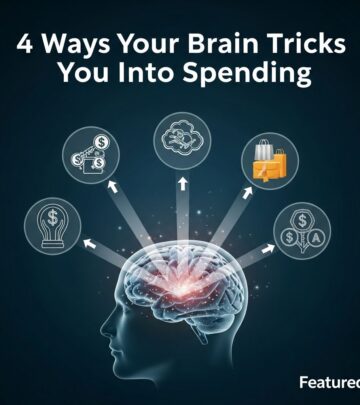
Your Brain Is Keeping You in Debt (And How to Fix It)
Discover how your brain's wiring leads to debt traps and practical neuroscience-backed strategies to overcome them and achieve financial freedom.

Household debt in the U.S. has skyrocketed to over $12 trillion, fueled not just by economic pressures but by fundamental wiring in our brains that prioritizes instant gratification over long-term stability. Neuroscience reveals how consumer culture exploits our reward circuitry, leading to impulsive spending and poor debt management. This article breaks down the brain mechanisms keeping you in debt and provides actionable, research-backed strategies to fix it.
How Your Brain Betrays You With Debt
Our brains evolved for survival in scarcity, not abundance. The limbic system, responsible for emotion and reward, lights up intensely for immediate pleasures like a new purchase on credit, overriding the prefrontal cortex’s rational planning. Peter Whybrow, director of UCLA’s Semel Institute for Neuroscience, explains that easy credit creates a ‘positive-feedback loop’ distorting self-regulation, as seen in the $11.83 trillion U.S. household debt reported by the Federal Reserve Bank of New York.
Temporal discounting is a key culprit: people prefer $80 now over $100 later, even if illogical. MRI studies show the limbic system activates for immediate rewards, quieting for delayed ones, making credit card swipes feel painless. Consumerism amplifies this, with marketing focusing on debt’s ‘benefits’ rather than burdens, normalizing overspending.
The Debt Snowball: Why Your Brain Loves Small Wins
Recent research highlights how brains favor quick victories. When tackling multiple debts, people naturally pay off smallest balances first—the ‘debt snowball’ method—not because it’s mathematically optimal, but because clearing tiny debts triggers dopamine hits, motivating continuation.
Psychologist B.J. Fogg’s tiny habits research supports this: small successes build momentum. However, for high-interest debt, this can cost more overall. Balance brain satisfaction with strategy: list debts by size and interest rate.
| Method | Pros | Cons | Best For |
|---|---|---|---|
| Debt Snowball | Quick wins boost motivation; brain-friendly | Higher total interest paid | Those needing psychological momentum |
| Debt Avalanche | Saves most money; targets high interest first | Slower visible progress | Math-focused, disciplined payers |
Impulse Buying: The Brain’s Reward Trap
Retail therapy hijacks the nucleus accumbens, the brain’s pleasure center. Easy credit masks pain, creating addiction-like cycles. Studies show shoppers underestimate spending by 20-30% due to ‘pain of paying’ being deferred.
- Track triggers: Note emotions before purchases—stress, boredom?
- Wait rule: Delay non-essentials 72 hours; prefrontal cortex regains control.
- Cash only: Physical money activates loss aversion more than plastic.
Cognitive Biases Fueling Your Debt
Several biases keep debt cycles spinning:
- Optimism bias: ‘I’ll pay it off next month’ ignores statistics—credit card debt rose $20B quarterly.
- Present bias: Favors now over future, per temporal discounting.
- Anchoring: First price seen skews value perception.
- Loss aversion: Fear of missing deals prompts buys.
Counter with mindfulness: Daily 10-minute meditation strengthens prefrontal control, reducing impulsivity by 25% in studies.
Why Bankruptcy Isn’t the Quick Fix Your Brain Craves
Buried in debt, the brain seeks instant relief, eyeing bankruptcy. Yet Harvard’s Bankruptcy Data Project shows 25% of filers struggle with bills one year post-filing, 33% worse off financially. It ignores root causes like spending habits.
Slow repayment builds lasting change. Author of a $20K debt payoff story took 4.5 years, emphasizing behavioral shifts over shortcuts. Bankruptcy damages credit for 7-10 years, limiting flexibility.
Practical Fixes: Rewire Your Brain for Financial Freedom
1. Build a Cash Flow Plan (Budget)
List income vs. expenses. Apps like YNAB (You Need A Budget) gamify tracking, leveraging brain’s reward for progress.
2. Emergency Fund First
Aim for 3-6 months’ expenses in liquid savings. This prevents new debt from surprises, restoring brain’s security instincts.
3. Automate Payments
Set auto-payments for minimums, freeing mental bandwidth. Add extra to highest interest.
4. Attitude Shift: Own Your Debt
Acknowledge personal role—no blame game. This fosters responsibility, key to heart change. Journal: ‘How did attitudes contribute?’
5. Slow and Steady Mindset
Debt freedom is a marathon. Reflect during repayment: understand entry points to avoid repeats.
Advanced Strategies: Leverage Neuroscience
Peter Whybrow advises pausing big buys for days, letting deliberative cortex dominate. Use implementation intentions: ‘When tempted, I will…’ e.g., ‘When seeing a sale, I will check my debt list.’
Increase ‘pain of paying’: Review statements weekly, visualizing interest as lost opportunities.
Case Study: From $20K Debt to Freedom
One individual faced $20K credit card debt, resisted bankruptcy, and paid off over 4.5 years via budgeting, snowball, and attitude shifts. Key: Accepting responsibility, no overnight fixes.
Frequently Asked Questions (FAQs)
What causes most people to accumulate debt?
Brain reward systems exploited by easy credit and marketing, prioritizing short-term pleasure.
Is debt snowball or avalanche better?
Snowball for motivation via quick wins; avalanche saves money. Hybrid: Snowball small, switch to avalanche.
How long to pay off debt?
Varies; $20K at $500/month takes ~4 years. Consistency beats speed.
Can meditation help with debt?
Yes, strengthens impulse control, reducing spending by enhancing prefrontal activity.
Why avoid bankruptcy?
Short-term relief, long-term regret: 1/4 filers still struggle post-filing.
Long-Term Prevention: Tune Your Brain for Wealth
Maintain progress with annual financial audits, community accountability (e.g., debt-free forums), and education on behavioral finance. Over time, prudent habits rewire neural pathways, making frugality rewarding.
Achieving debt freedom demands overriding ancient instincts with modern tools. By understanding your brain, you reclaim control.
References
- Neuroscience helps explain American households’ $12 trillion debt — UCLA Health / Peter Whybrow. 2010-05-10. https://www.uclahealth.org/news/release/ucla-faculty-voice-neuroscience-helps-explain-american-households-12-trillion-debt
- Your Brain Is Keeping You in Debt (And How to Fix It) — Wise Bread. Accessed 2026. https://www.wisebread.com/your-brain-is-keeping-you-in-debt-and-how-to-fix-it
- Slow and Steady Wins the Debt Race — Wise Bread. Accessed 2026. https://www.wisebread.com/slow-and-steady-wins-the-debt-race
- Recent comments on Shadow Statistics — Wise Bread. Accessed 2026. https://www.wisebread.com/comments/Shadow%20Statistics?page=2759
Similar Articles








Read full bio of medha deb