Yield to Call vs. Yield to Worst: Key Differences
Master the crucial differences between yield to call and yield to worst for smarter bond investing decisions.
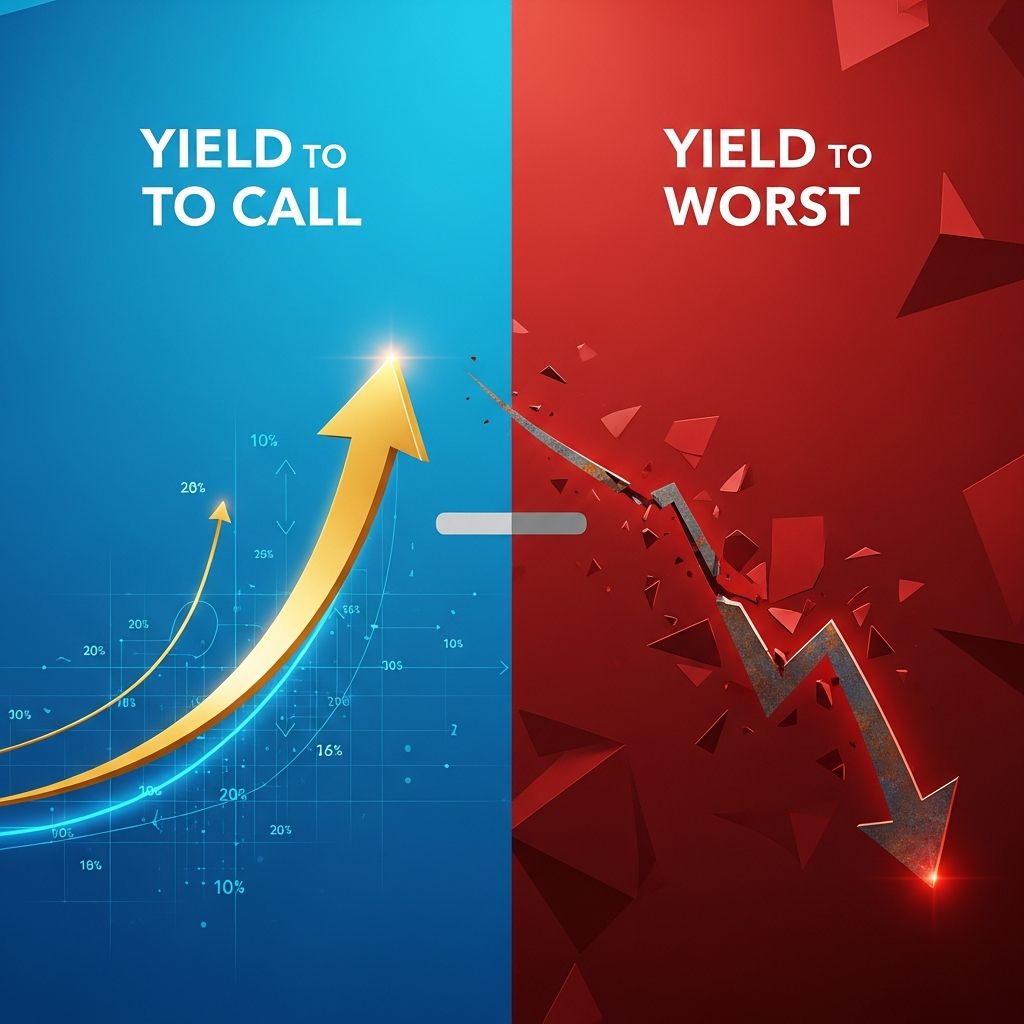
Understanding Yield to Call vs. Yield to Worst: A Comprehensive Guide for Bond Investors
When evaluating callable bonds or bond funds, investors face a critical decision: which yield metric should guide their investment choices? Two measurements frequently discussed in fixed-income investing are yield to call (YTC) and yield to worst (YTW). While these terms may sound similar, they represent fundamentally different approaches to assessing bond returns. Understanding their distinctions is essential for making informed investment decisions and managing portfolio risk effectively.
Bonds are debt instruments that provide regular income through coupon payments, but callable bonds introduce complexity into the return calculation. A callable bond grants the issuer the right to repurchase or “call” the bond before its maturity date, typically when interest rates decline. This embedded option significantly impacts the potential returns an investor might receive, making traditional yield-to-maturity calculations insufficient for callable bonds.
What is Yield to Call?
Yield to call represents the annualized rate of return an investor will receive if they purchase a bond at its current market price and hold it until the issuer calls the bond on a specific call date. It operates similarly to yield-to-maturity calculations but uses the call date and call price instead of the maturity date and par value.
The yield to call calculation accounts for several critical factors. First, it considers the current market price of the bond—what an investor actually pays to purchase it. Second, it incorporates the coupon payments the investor will receive before the call date. Third, it factors in the call price, which is typically the bond’s par value but may include a call premium or penalty fee paid by the issuer for the early repayment privilege.
To illustrate, consider a bond with a par value of $1,000 issued with a 20-year maturity that becomes callable after 10 years. If the bond was issued at par with a 3% coupon and market interest rates subsequently decline to 2%, the bond’s market price rises to approximately $1,129. An investor considering purchasing this bond in the secondary market must evaluate the yield to call, which would be considerably lower than the yield to maturity—potentially as low as 0.39%—because the issuer is likely to call the bond when interest rates fall.
What is Yield to Worst?
Yield to worst represents the lowest potential yield an investor could receive from a bond, assuming the bond issuer acts rationally to minimize its borrowing costs. YTW is calculated by taking the minimum of all potential yield-to-call measurements and the yield-to-maturity figure.
The term “worst-case scenario” in YTW refers specifically to the worst outcome for the investor assuming the issuer continues to make all scheduled interest and principal payments on time. It does not account for default risk, which represents the true worst-case scenario of not receiving payments at all.
YTW serves as a conservative measure that protects investors from unpleasantly surprises. When a bond has multiple call dates, it will have multiple yield-to-call figures in addition to a single yield-to-maturity. The yield to worst simply identifies which of all these potential outcomes would produce the lowest return for the bondholder.
Key Differences Between Yield to Call and Yield to Worst
Calculation Methodology
The fundamental difference between YTC and YTW lies in their calculation approach. Yield to call focuses on a single, specific call date—typically the next or earliest call date when the issuer can repurchase the bond. The calculation assumes the investor holds the bond until that predetermined call date and receives the associated call price.
Yield to worst, by contrast, evaluates all possible outcomes across every call date plus maturity and then selects the scenario producing the lowest return. This comprehensive approach requires calculating multiple yield-to-call figures and comparing them against yield-to-maturity, then identifying the minimum value.
Relationship to Bond Price
The relationship between a bond’s market price and par value significantly influences these metrics. When a bond trades at or below its par value (a discount bond), the yield to worst equals the yield to maturity. In this scenario, investors face the worst outcome if the issuer waits until maturity to repay the bond, making YTW equivalent to YTM.
When a bond trades at a premium to par value (above its par value), the situation reverses. The yield to worst becomes less than the yield to maturity because the worst-case scenario for investors involves early repayment by the issuer. Premium bonds present this paradox because while investors paid extra for the bond’s higher coupon rate, early redemption at par value prevents them from collecting all the expected coupon payments that justified the premium price.
Risk Perspective
Yield to call represents a more optimistic but less comprehensive view of potential returns. It examines what happens if the bond is called on one specific date, which may or may not occur depending on market conditions and the issuer’s financial decisions. An investor focusing solely on yield to call might overestimate returns if the issuer calls the bond or underestimate returns if rates rise and the issuer allows the bond to mature.
Yield to worst adopts a risk-management perspective by assuming the worst plausible scenario and calculating returns accordingly. This conservative approach appeals to investors with specific income requirements who need to determine the absolute minimum they can expect to receive from their bond investment.
Why These Metrics Matter for Investors
The Limitation of Yield to Maturity
Traditional yield-to-maturity calculations assume investors will receive all coupon payments through the bond’s maturity date. However, this assumption breaks down with callable bonds because the issuer can cut short the payment stream by exercising its call option. Bond issuers rationally exercise their call rights when it serves their financial interests—typically when market interest rates decline below the bond’s coupon rate. When this occurs, investors’ expected returns plummet because they lose the opportunity to collect all remaining coupon payments.
Imagine purchasing a bond yielding 5% when market rates have fallen to 3%. You might congratulate yourself on securing a above-market return. However, if the bond is callable, the issuer will almost certainly call it to issue new debt at the lower 3% rate. You would receive your principal back early, forcing you to reinvest at the lower prevailing rates—hardly the windfall you anticipated.
When to Use Yield to Call
Yield to call is most useful when investors have a specific timeframe and want to understand the potential return if the bond gets called on a particular date. This metric helps answer the question: “If my bond gets called on this specific date, what return will I have earned?” Investors with particular income goals or those analyzing bonds with near-term call dates might find YTC particularly relevant.
Additionally, yield to call can provide useful comparative information when evaluating bonds with similar call schedules, as it shows the immediate return available under a likely scenario.
When to Use Yield to Worst
Yield to worst is essential for investors who need a reliable minimum-return estimate and those managing bond funds containing multiple callable securities. Financial advisors often recommend using YTW when comparing callable bonds or bond funds because it provides a conservative baseline that accounts for the worst plausible scenario.
YTW proves particularly valuable for retirees and other income-focused investors who depend on predictable returns from their investments. By understanding the worst-case yield, these investors can better plan their cash flow and ensure their portfolio can support their financial needs even if bonds are called and forced reinvestment occurs at lower rates.
Practical Example: Discount vs. Premium Bonds
A Discount Bond Scenario
Consider a bond trading at $950 (below par value of $1,000) with a 4% coupon, maturing in 10 years but callable in 5 years at par. The yield to maturity might be 4.5%, while the yield to call could be 5.2%. Because this bond trades at a discount, the issuer would not call it—they would let it mature and the bondholder would receive $1,000 at maturity. The yield to worst equals the yield to maturity of 4.5%, as the worst scenario involves holding until maturity.
A Premium Bond Scenario
Now consider a bond trading at $1,050 (above par value) with a 5% coupon, maturing in 10 years but callable in 5 years at par plus a 2% premium. The yield to maturity might be 4.6%, while the yield to call would be 2.8%. In this premium situation, the issuer would likely call the bond because they could refinance at lower rates. The yield to worst equals the yield to call of 2.8%, as the worst scenario involves early redemption.
Multiple Call Dates and Complexity
Many bonds feature multiple call dates, each potentially associated with different call prices (often declining as maturity approaches). These bonds generate multiple yield-to-call calculations, one for each possible call date. Evaluating such bonds manually becomes tedious and error-prone. A bond might have call dates every six months for five years, followed by no-call protection thereafter. This creates numerous potential yield scenarios the investor must compare.
Yield to worst simplifies this complexity by automatically identifying which call date (or maturity) produces the lowest return. Rather than laboriously calculating and comparing dozens of yield figures, investors can focus on the single YTW number, confident they understand their minimum potential return under any realistic scenario.
How Bond Issuers Influence These Metrics
Bond issuers strategically structure call provisions and call prices to minimize their borrowing costs while remaining attractive to investors. When market interest rates fall, issuers find refinancing opportunities and will likely call bonds paying above-market coupon rates. This behavior creates the inverse relationship between bond prices and yields that challenges investors relying on yield-to-maturity calculations for callable securities.
Investors should recognize that they and the bond issuer have conflicting interests regarding calls. Issuers benefit from calling bonds when rates decline; investors suffer because they must reinvest at lower rates. Understanding yield to worst helps investors acknowledge this fundamental conflict and price bonds more realistically.
Comparing Bond Funds Using These Metrics
When selecting bond funds or comparing callable bond portfolios, financial professionals often recommend using yield-to-worst basis rather than yield-to-maturity for more accurate comparisons. A bond fund showing a 4% yield-to-maturity but a 2.8% yield-to-worst reveals that significant call risk exists within the portfolio. This transparency helps investors make better decisions about expected income streams and risk exposure.
Comparing multiple funds using YTW levels the playing field by ensuring all calculations account for call risk consistently. A fund manager might improve the stated yield-to-maturity metric through strategic buying of premium, callable bonds, but the yield-to-worst metric would accurately reflect the true risk these positions introduce.
Integration with Overall Investment Strategy
Sophisticated investors integrate both metrics into their decision-making framework. Yield to call provides useful information about likely returns in common scenarios, while yield to worst establishes the minimum acceptable floor. Together, these metrics bracket the probable range of returns an investor might experience.
Market conditions influence which metric becomes more relevant. In high-interest-rate environments where bonds trade at discounts, the distinction between YTC and YTW diminishes because calls become unlikely. In low-rate environments where bonds trade at significant premiums, YTW typically falls well below YTM, highlighting substantial call risk.
Frequently Asked Questions (FAQs)
Q: Can yield to worst ever exceed yield to maturity?
A: No, yield to worst by definition cannot exceed yield to maturity because it represents the minimum of all possible yields, including the yield to maturity. YTW will either equal YTM (for discount bonds) or be lower than YTM (for premium bonds).
Q: How does reinvestment risk factor into these calculations?
A: Both yield to call and yield to worst calculations implicitly assume investors reinvest coupon payments at the calculated yield rate. In reality, reinvestment rates may differ, creating additional uncertainty in actual returns. This reinvestment risk increases for longer-duration bonds and when yields decline after purchase.
Q: Should I always choose bonds with the highest yield to worst?
A: Not necessarily. While YTW helps identify the minimum expected return, other factors matter: credit quality, duration, tax treatment, and portfolio diversification. A lower-YTW bond from a highly creditworthy issuer might be preferable to a higher-YTW bond facing greater default risk.
Q: How frequently do bond issuers actually call their bonds?
A: Issuers call bonds opportunistically when market conditions become favorable. When interest rates decline sufficiently below the bond’s coupon rate, the issuer can refinance at lower cost by calling the existing bonds. The frequency varies with economic conditions and interest rate trends.
Q: Why do bond prices rise when interest rates fall?
A: Bond prices and yields move inversely because fixed coupon payments become more valuable when new bonds offer lower rates. Investors seeking a higher-coupon bond will pay a premium price for the extra income, driving existing bond prices upward.
Q: Do all bonds have call provisions?
A: No. Many bonds, particularly U.S. Treasury securities and some corporate bonds, are non-callable. Non-callable bonds eliminate the need for YTC and YTW calculations; yield to maturity becomes the primary relevant metric. However, many corporate and municipal bonds do include call provisions.
Q: How should I adjust my bond portfolio strategy for callable bonds?
A: Focus on yield to worst when building callable bond positions to ensure expected income aligns with your needs even in worst-case scenarios. Diversify across call dates and issuers to reduce concentration risk. Monitor interest rate forecasts, as declining rates increase call probability.
References
- Considering Yield to Worst — Dimensional Fund Advisors. 2024. https://www.dimensional.com/us-en/insights/considering-yield-to-worst
- Yield to Worst (YTW): Definition, Intuition, and Excel Calculation Examples — Breaking Into Wall Street. 2024. https://breakingintowallstreet.com/kb/debt-equity/yield-to-worst/
- Understanding Bond Yield Measurements — Charles Schwab. 2024. https://www.schwab.com/learn/story/understanding-bond-yield-measurements
- Yield to Worst (YTW) – Definition, Formula, Why’s Important — Corporate Finance Institute. 2024. https://corporatefinanceinstitute.com/resources/fixed-income/yield-to-worst/
- Understanding Bond Yield and Return — Financial Industry Regulatory Authority (FINRA). 2024. https://www.finra.org/investors/insights/bond-yield-return
Similar Articles








Read full bio of medha deb