Year-Over-Year: Definition, Calculation & Use
Master year-over-year analysis: Learn how YoY comparisons measure financial performance growth.
Year-Over-Year (YoY): Complete Guide to Definition and Application
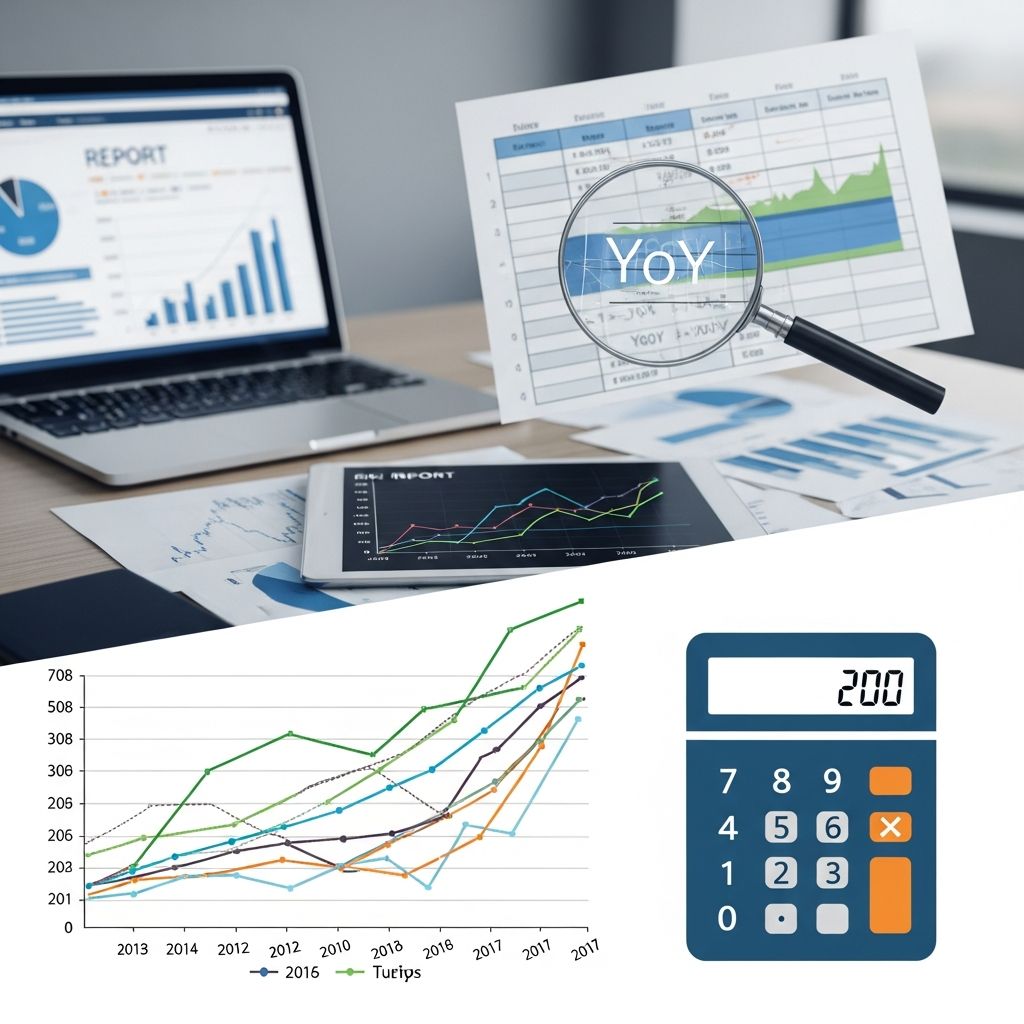
Year-over-year (YoY) is a widely used financial metric that compares performance data from a specific period to the same period in the previous year. This comparison method eliminates seasonal variations and provides a clearer picture of long-term trends and growth patterns. Whether analyzing revenue, sales, earnings, or other key performance indicators, YoY analysis helps businesses, investors, and analysts understand actual performance improvements or declines by accounting for seasonal factors that might otherwise skew the data.
The YoY metric is particularly valuable for financial professionals who need to make informed decisions based on meaningful comparisons rather than raw numbers that may be affected by seasonal business cycles. By comparing identical time periods across different years, stakeholders can better identify whether performance improvements are sustainable or temporary fluctuations.
What Does Year-Over-Year Mean?
Year-over-year refers to the comparison of a financial or operational metric from one specific period to the same period twelve months earlier. This measurement technique accounts for seasonal variations that naturally occur in business cycles, providing a more accurate assessment of actual growth or decline.
For example, if a retail company generated $5 million in sales during the fourth quarter of 2023 and $6 million during the fourth quarter of 2024, the year-over-year growth would be 20%. This comparison makes sense because retail typically experiences similar seasonal patterns in both years, making a direct comparison meaningful.
YoY analysis is superior to month-over-month (MoM) comparisons for identifying trends because it minimizes the impact of predictable seasonal patterns. While a business might see a 15% increase from November to December due to holiday shopping, the YoY comparison reveals whether this seasonal uptick is growing, shrinking, or remaining stable compared to the previous year’s holiday season.
Key Characteristics of Year-Over-Year Analysis
- Eliminates Seasonality: By comparing the same months or quarters across different years, YoY analysis removes the distortion caused by seasonal business cycles.
- Identifies True Growth: YoY metrics reveal whether a company’s actual performance is improving or declining, separate from predictable fluctuations.
- Standardized Comparison: Using a consistent 12-month period allows for apples-to-apples comparisons across different companies and industries.
- Long-Term Perspective: YoY analysis provides insights into sustained trends rather than temporary variations.
- Investor Confidence: Companies often highlight strong YoY growth to demonstrate business health and attract investors.
How to Calculate Year-Over-Year Growth
Calculating year-over-year growth is straightforward and involves a simple mathematical formula. Understanding this calculation is essential for anyone involved in financial analysis or business decision-making.
The YoY Growth Formula
The basic year-over-year growth formula is:
YoY Growth (%) = [(Current Year Value – Previous Year Value) / Previous Year Value] × 100
Step-by-Step Calculation Example
Consider a software company with the following quarterly revenue figures:
- Q1 2023 Revenue: $2.5 million
- Q1 2024 Revenue: $3.1 million
Using the formula:
- YoY Growth = [($3.1 million – $2.5 million) / $2.5 million] × 100
- YoY Growth = [$0.6 million / $2.5 million] × 100
- YoY Growth = 0.24 × 100
- YoY Growth = 24%
This result indicates that the company’s Q1 revenue grew by 24% compared to the same quarter in the previous year.
Handling Negative Values
When calculating YoY changes with negative numbers, the same formula applies. If a company had losses or negative growth, the calculation would reflect that decline appropriately, showing negative YoY growth percentages.
Real-World Applications of Year-Over-Year Analysis
Year-over-year analysis serves multiple critical functions across various industries and stakeholder groups:
Investment Decision-Making
Investors use YoY comparisons to evaluate whether publicly traded companies are delivering sustained growth. Strong year-over-year revenue and earnings growth often signal a healthy, expanding business, making the company more attractive to investors. Conversely, declining YoY metrics might indicate underlying problems requiring further investigation.
Corporate Performance Evaluation
Executive management teams analyze YoY results to assess whether strategic initiatives are yielding desired outcomes. Department heads use these metrics to justify budgets and demonstrate accountability for their organizational units.
Retail and E-Commerce
The retail sector heavily relies on YoY analysis because seasonal patterns are predictable and significant. Comparing same-period sales across years reveals whether a retailer is gaining or losing market share and whether sales strategies are effective.
Employment and Economic Indicators
Government agencies and economists use year-over-year comparisons to track employment rates, inflation, and other macroeconomic indicators. The Bureau of Labor Statistics, for instance, regularly publishes YoY unemployment changes and wage growth metrics.
Consumer Pricing Analysis
Inflation is often measured using year-over-year price comparisons. When the Consumer Price Index (CPI) shows a 3% YoY increase, it means consumer prices have risen 3% compared to the same month the previous year.
Advantages of Using Year-Over-Year Metrics
- Seasonal Adjustment: Automatically controls for predictable seasonal fluctuations without requiring complex statistical adjustments.
- Simplicity: The calculation method is straightforward and easily understood by non-technical audiences.
- Consistency: Using the same methodology across different periods and companies enables meaningful comparisons.
- Relevance: YoY comparisons provide information most relevant to stakeholders by isolating actual performance changes.
- Time-Sensitive Insights: The metric quickly highlights whether recent changes represent genuine improvements or concerning trends.
Limitations and Considerations
While powerful, year-over-year analysis has certain limitations that analysts should consider:
- Doesn’t Show Short-Term Trends: YoY analysis may miss important developments occurring over shorter periods, such as quarterly or monthly trends.
- Historical Anomalies: Unusual events in the previous year can distort comparisons, making YoY results misleading if not properly contextualized.
- Limited Context: YoY growth alone doesn’t explain the reasons behind changes or whether the growth is sustainable.
- Doesn’t Replace Other Metrics: YoY should be used alongside other analytical tools like quarter-over-quarter comparisons and trend analysis.
- Industry Variations: Different industries have different seasonal patterns, so YoY comparisons are most meaningful within the same industry.
Year-Over-Year vs. Other Comparison Methods
| Comparison Method | Time Frame | Best Use Case | Advantage |
|---|---|---|---|
| Year-Over-Year (YoY) | 12 months apart | Identifying annual trends and growth | Eliminates seasonality |
| Quarter-Over-Quarter (QoQ) | 3 months apart | Tracking short-term performance changes | Shows immediate trends |
| Month-Over-Month (MoM) | 1 month apart | Monitoring rapid business changes | Captures quick shifts |
| Sequentially | Variable periods | Analyzing specific business cycles | Flexible timeframes |
Examples of Year-Over-Year Comparisons Across Industries
Technology Sector
Tech companies frequently report YoY user growth, subscription increases, and cloud service revenue expansion. A cloud computing company might announce a 35% YoY increase in annual recurring revenue (ARR), signaling strong market demand and customer retention.
Financial Services
Banks and insurance companies use YoY analysis to compare lending volumes, insurance premiums, and investment portfolio performance. A significant YoY decline in mortgage applications might indicate rising interest rates or economic uncertainty.
Manufacturing
Industrial companies track YoY production volumes and sales figures. A manufacturer might report that automotive parts sales grew 12% year-over-year, reflecting increased vehicle production or market share gains.
Healthcare
Pharmaceutical and medical device companies analyze YoY revenue by product line. A pharmaceutical company might highlight a drug’s 45% YoY sales increase to demonstrate market adoption and success in clinical applications.
Why Companies Emphasize Year-Over-Year Results
During earnings announcements and investor presentations, companies prominently feature year-over-year comparisons because they provide compelling evidence of business performance. A company experiencing strong YoY growth can demonstrate to investors, customers, and employees that the business is thriving and moving in the right direction.
However, it’s important to note that companies may selectively highlight YoY comparisons when results are favorable and emphasize other metrics when YoY results disappoint. Sophisticated investors and analysts recognize these tactics and examine multiple performance indicators before reaching conclusions.
Frequently Asked Questions (FAQs)
Q: What is the difference between year-over-year and year-to-date?
A: Year-over-year (YoY) compares the same period across two different years, while year-to-date (YTD) compares cumulative results from the beginning of the current year to a specific point in time, compared to the same cumulative period from the previous year.
Q: Can year-over-year analysis be applied to declining metrics?
A: Yes, YoY analysis works for any metric, including declining ones. Negative YoY growth percentages indicate that performance has worsened compared to the previous year, helping identify problematic trends.
Q: Why is year-over-year better than month-over-month comparison?
A: YoY analysis eliminates seasonal variations that typically occur within a year, providing a clearer picture of genuine growth or decline. Month-over-month comparisons can be distorted by predictable seasonal patterns.
Q: How do companies use year-over-year data in strategic planning?
A: Companies use YoY trends to forecast future performance, identify which business units are thriving, allocate resources more effectively, and evaluate the success of strategic initiatives implemented over the past year.
Q: What factors can distort year-over-year comparisons?
A: One-time events, acquisitions, divestitures, significant policy changes, and major economic disruptions can all distort YoY comparisons, potentially making them less meaningful without proper context and explanation.
Q: Is a 10% year-over-year growth rate considered good?
A: Whether 10% YoY growth is good depends entirely on the industry, economic conditions, and company expectations. Tech companies typically aim for higher growth rates, while mature industries may consider 10% excellent.
Conclusion
Year-over-year analysis represents one of the most fundamental and practical tools in financial analysis, offering stakeholders a method to understand genuine business performance trends while accounting for predictable seasonal variations. By comparing identical periods across consecutive years, investors, business leaders, and analysts can make more informed decisions based on meaningful data rather than temporary fluctuations.
Understanding how to calculate and interpret YoY metrics is essential for anyone involved in finance, investing, or business evaluation. While YoY analysis shouldn’t be used in isolation, it provides valuable context when combined with other analytical methods, helping organizations and investors identify sustainable growth, evaluate strategic effectiveness, and position themselves for future success.
References
- Understanding Financial Reporting and Analysis — U.S. Securities and Exchange Commission (SEC). 2024. https://www.sec.gov/investor/pubs/begininvest.htm
- Consumer Price Index: Frequently Asked Questions — U.S. Bureau of Labor Statistics. 2025. https://www.bls.gov/cpi/questions-and-answers.htm
- Financial Analysis and Metrics Guide — FINRA Financial Industry Regulatory Authority. 2024. https://www.finra.org/investors/insights
- The Fundamentals of Financial Statement Analysis — CFA Institute. 2024. https://www.cfainstitute.org
- Employment Data and Analysis Methods — U.S. Bureau of Labor Statistics. 2025. https://www.bls.gov/employment/
Similar Articles








Read full bio of medha deb