Y2K Bills: How Much Bills Have Risen Since 2000
Compare your monthly bills today to Y2K era costs and discover smart strategies to slash expenses in 2026.
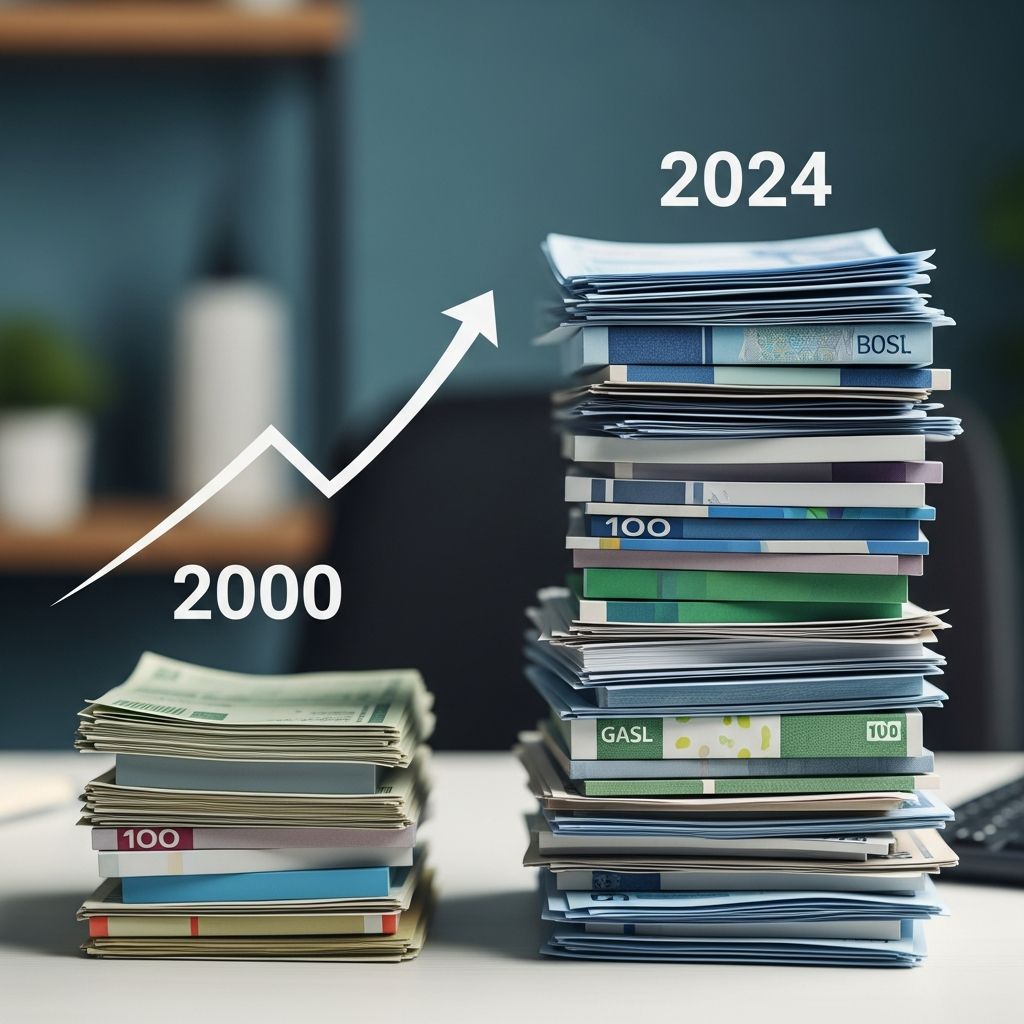
Remember the turn of the millennium? The Y2K bug had everyone worried about computers crashing, but life was otherwise simpler—especially when it came to paying bills. Fast forward to 2026, and monthly expenses have ballooned due to inflation, supply chain issues, and lifestyle changes. This article breaks down how key household bills compare from 2000 to now, using official data from the U.S. Bureau of Labor Statistics (BLS) and other credible sources. We’ll also share proven strategies to trim costs today.
Housing Costs: The Biggest Jump
Housing remains the largest expense for most Americans. In 2000, the median home price was about $119,600, according to the Federal Housing Finance Agency (FHFA). By Q3 2025, it had surged to $419,200—a 251% increase. Rent hasn’t fared better: average monthly rent was $602 in 2000 (BLS data), compared to $1,709 in 2025 per the latest BLS Consumer Price Index (CPI) reports.
Mortgage payments reflect this too. A 30-year fixed-rate mortgage in 2000 averaged 8.05% interest, but principal and interest for a median home was around $884 monthly (adjusted for rates). Today, with rates hovering at 6.5-7%, payments exceed $2,800 for similar homes. Why the spike? Limited supply, high demand, and post-pandemic shifts.
- Average rent 2000: $602/month
- Average rent 2025: $1,709/month (183% increase)
- Median home price 2000: $119,600
- Median home price 2025: $419,200 (251% increase)
How to Save on Housing
Refinance if rates drop below 6%; consider house hacking by renting a room; or downsize. Tools like the Penny Hoarder’s auto insurance comparator can indirectly free up housing budget by saving $500/year on premiums.
Utilities: Power, Water, and Internet Bills Explode
Utilities were a steal in 2000. Electricity cost about 8.2 cents per kWh (U.S. Energy Information Administration, EIA), or $90/month for an average household. Today, it’s 16.2 cents/kWh, pushing monthly bills to $140. Natural gas jumped from $0.60/therm to $1.50/therm. Water/sewer averaged $30/month then; now $75.
Don’t forget internet and cable: Dial-up was $20/month in 2000; broadband now averages $70 for 100Mbps, per FCC reports. Streaming services add $50-100 more.
| Utility | 2000 Monthly Avg | 2025 Monthly Avg | % Increase |
|---|---|---|---|
| Electricity | $90 | $140 | 56% |
| Natural Gas | $45 | $110 | 144% |
| Water/Sewer | $30 | $75 | 150% |
| Internet/Cable | $20 | $120 | 500% |
Saving Tips
Switch to LED bulbs and smart thermostats to cut energy 20-30% (EIA recommendations). Bundle internet/phone for discounts; audit usage with apps like Upside for related savings.
Groceries and Food: From $272 to $500+
The average family of four spent $272/month on groceries in 2000 (BLS). By 2025, it’s $512—a 88% rise driven by food inflation outpacing general CPI. Eggs were $0.91/dozen; now $3.50. Ground beef: $2.19/lb to $5.50/lb.
Dining out? A fast-food meal cost $5 in 2000; now $12-15. Overall food-at-home CPI rose 67% since 2000, per BLS.
- Grocery basket 2000: $272/month
- Grocery basket 2025: $512/month
- Key items up 200-300%: Coffee, dairy, meats
Budget Hacks
Shop sales, use apps like Ibotta for cashback, buy generics. The 52-week challenge from Penny Hoarder can build a $1,378 emergency fund for food shocks.
Transportation: Gas, Cars, and Insurance
Gas was $1.46/gallon in 2000 (EIA); now $3.40 (110% up). New car price: $21,850 to $48,000 (120% increase, Kelley Blue Book). Insurance: $672/year to $2,000+ (198% jump, per Insurance Information Institute).
Public transit fares doubled in many cities.
| Item | 2000 Avg | 2025 Avg | % Increase |
|---|---|---|---|
| Gas/gallon | $1.46 | $3.40 | 133% |
| New Car | $21,850 | $48,000 | 120% |
| Car Insurance/year | $672 | $2,000 | 198% |
Cut Transport Costs
Carpool, use gas apps like Upside ($40/month savings), shop insurance quotes—save $500/year via Penny Hoarder’s tool.
Healthcare: Premiums Triple
Family health insurance cost $6,438/year in 2000 (Kaiser Family Foundation); now $24,000 (273% increase). Doctor visit: $48 to $150. Prescription drugs up 250%.
Medicare Part B: $45.50/month to $185.00.
Savings Strategies
HSAs, generic meds, telehealth. Compare plans annually.
Education and Childcare: Skyrocketing
Public college tuition: $3,500/year in-state 2000 to $11,000 (214% up, College Board). Childcare: $211/week to $800 (279% increase).
Tips
Scholarships, community college, employer childcare aid.
Entertainment and Misc: Streaming vs. Blockbuster
Movie ticket: $5.50 to $10.50. But streaming: $0 to $100/month bundle.
Overall Inflation Context
Cumulative CPI inflation since 2000 is 88% (BLS), but bills rose faster: housing 150%, healthcare 200%+. Median household income: $42,000 to $75,000 (79% up), barely keeping pace.
Action Plan: Slash Bills Like It’s 1999
Track spending with apps. Use balance transfer cards (0% APR to 2026). Try 52-week hacks: reverse savings, jar method, or half/double for $689-$2,756 goals.
Frequently Asked Questions (FAQs)
What caused bills to rise so much since 2000?
Economic factors like inflation, housing shortages, energy demands, and healthcare reforms drove disproportionate increases beyond general CPI.
Can I really save like it’s Y2K?
Yes—modern tools like apps and comparators make it easier. Aim for 52-week challenge variations to build savings effortlessly.
How accurate are these 2000 vs. 2025 comparisons?
Based on BLS CPI, EIA, FHFA, and KFF data—official U.S. government and industry benchmarks.
What’s the best first step to cut bills?
Run an insurance quote and track one month’s expenses to spot leaks.
References
- Consumer Price Index Historical Tables — U.S. Bureau of Labor Statistics. 2025-10-01. https://www.bls.gov/cpi/data.htm
- Electric Power Monthly — U.S. Energy Information Administration. 2025-11-15. https://www.eia.gov/electricity/monthly/
- House Price Index — Federal Housing Finance Agency. 2025-09-30. https://www.fhfa.gov/DataTools/Downloads/Pages/House-Price-Index.aspx
- 2025 Employer Health Benefits Survey — Kaiser Family Foundation. 2025-09-01. https://www.kff.org/health-costs/report/2025-employer-health-benefits-survey/
- Trends in College Pricing — College Board. 2025-10-15. https://research.collegeboard.org/trends/college-pricing
Similar Articles








Read full bio of medha deb