Withholding Allowance: Definition, Purpose & Tax Impact
Understand withholding allowances and optimize your tax withholding strategy.
What Is a Withholding Allowance?
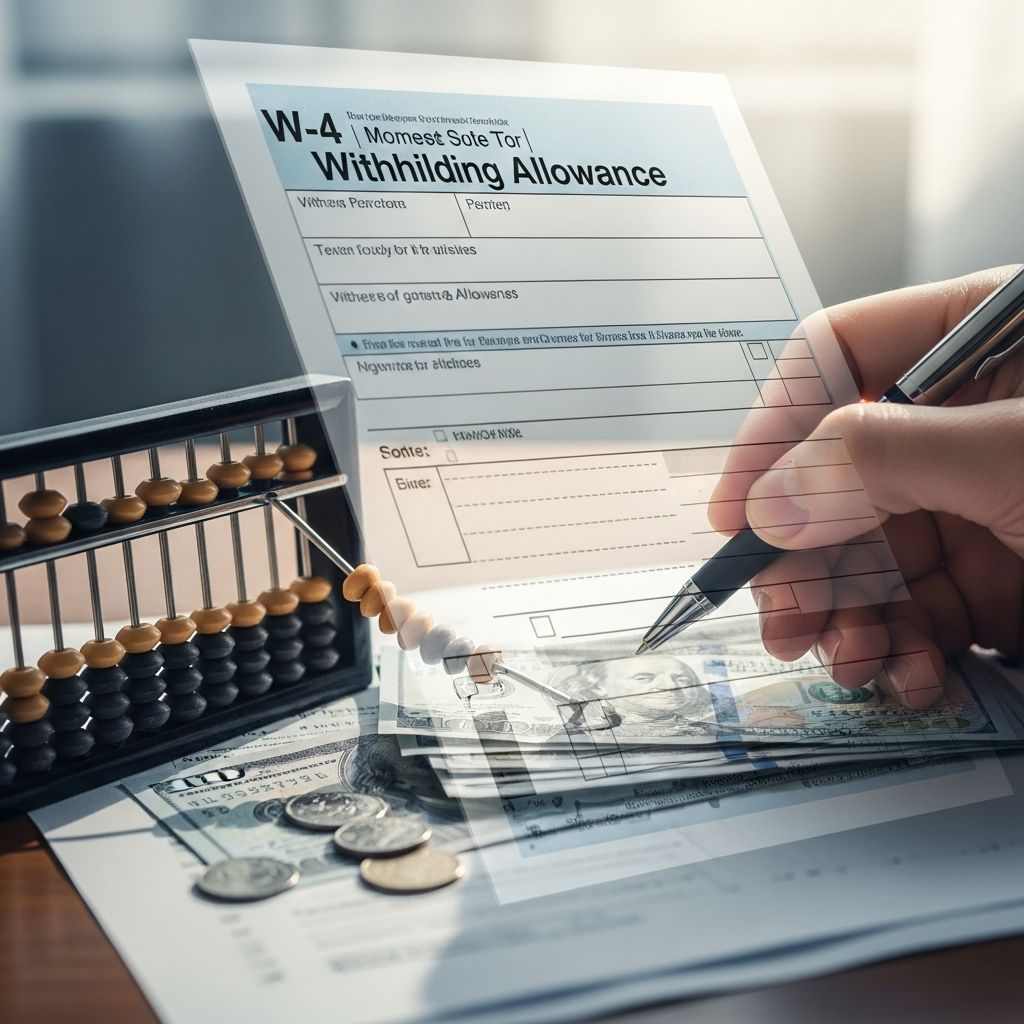
A withholding allowance is an exemption that reduces the amount of income tax your employer deducts from your paycheck. When you claim withholding allowances on your Form W-4 (Employee’s Withholding Allowance Certificate), you are essentially telling your employer to withhold less federal income tax from your wages. The more allowances you claim, the less tax gets withheld from each paycheck. Conversely, claiming fewer allowances means your employer will deduct more tax from your pay.
Understanding withholding allowances is crucial for managing your cash flow throughout the year and avoiding unexpected tax bills or excessive refunds when you file your annual tax return. The withholding system is designed to collect federal income tax on a pay-as-you-go basis, ensuring that taxes are paid gradually as you earn income rather than in one large lump sum at tax time.
How Withholding Allowances Work
Your employer uses the information you provide on Form W-4 to determine how much federal income tax to withhold from your paycheck. This form captures several key pieces of information that affect your withholding calculation, including your filing status, the number of dependents you claim, anticipated deductions, and any additional income sources.
Each withholding allowance you claim provides a specific dollar amount of income that is exempt from federal income tax withholding. The IRS updates the value of each allowance annually to reflect inflation and changes in tax law. When you claim an allowance, your employer applies a withholding table to calculate the appropriate amount of tax to deduct based on your gross income minus the value of your claimed allowances.
For example, if you are single and earn $500 per week, the amount of federal income tax withheld varies significantly based on your allowance claims:
| Withholding Allowances | Amount of Tax Withheld |
|---|---|
| 0 | $61 |
| 1 | $49 |
| 2 | $38 |
As this example illustrates, each additional allowance you claim reduces your federal income tax withholding by a meaningful amount over the course of a year.
Why Withholding Allowances Matter
Withholding allowances directly impact your take-home pay and your final tax bill. By understanding how many allowances you should claim, you can optimize your paycheck to match your actual tax liability. If you claim too few allowances, you will have excess tax withheld, resulting in a large refund when you file your return—essentially giving the government an interest-free loan of your money throughout the year. If you claim too many allowances, you may not have enough tax withheld, leaving you with a bill and potential penalties when you file.
The goal is to claim the correct number of allowances so that your withholding closely matches your actual tax liability, allowing you to keep more of your paycheck during the year while still meeting your tax obligations.
When to Review Your Withholding Allowances
You should review and potentially adjust your withholding allowances in several situations:
- Early in the year: Use the IRS Withholding Calculator to verify your withholding is accurate.
- When the tax law changes: Tax law modifications can affect how many allowances you should claim.
- Marriage or divorce: Your filing status changes, which impacts your withholding calculation.
- Birth or adoption of a child: New dependents affect the number of allowances you can claim.
- Starting or stopping a job: Changes in employment status or a second job may require withholding adjustments.
- Home purchase or major life changes: These may affect your itemized deductions or tax credits.
- Significant changes in income: If your spouse starts working or your income increases substantially.
- Retirement planning: Preparing for retirement may necessitate withholding adjustments.
Calculating Your Withholding Allowances
The number of withholding allowances you claim depends on your personal tax situation. Generally, you can claim one allowance for yourself, one for your spouse (if married and your spouse does not claim their own allowance), and one for each dependent. However, your specific situation may warrant additional adjustments.
If you have significant itemized deductions, nonwage income, or eligible tax credits, you may be able to claim additional allowances to account for these factors. Conversely, if you have substantial additional income not subject to withholding—such as interest, dividends, capital gains, or self-employment income—you may need to reduce your allowances or request additional withholding.
The IRS provides a comprehensive worksheet within the Form W-4 instructions to help you calculate the correct number of allowances based on your specific circumstances.
Types of Income Affecting Withholding Allowances
Several types of income and deductions influence how many withholding allowances you should claim:
- Nonwage income: Interest income, dividends, capital gains, self-employment income, and IRA distributions are typically not subject to employer withholding and may require adjustment to your allowances or additional estimated tax payments.
- Adjustments to income: Certain deductions like IRA contributions, student loan interest, and alimony payments reduce your taxable income and may justify additional allowances.
- Itemized deductions or tax credits: Medical expenses, state and local taxes, charitable contributions, dependent care expenses, education credits, child tax credits, and earned income credits all affect your tax liability.
State-Specific Withholding Allowances
In addition to federal withholding allowances, many states have their own withholding allowance systems. For example, New York State uses Form IT-2104 (Employee’s Withholding Allowance Certificate) for state income tax purposes, which operates similarly to the federal Form W-4. New York allows employees to claim withholding allowances to reduce state income tax withholding, and the form includes specific instructions for residents of New York City and Yonkers who are subject to local income taxes as well.
State withholding rules may differ from federal rules, so you should consult your state’s tax authority to understand your options for claiming state withholding allowances.
Changing Your Withholding Allowances
If you determine that you need to adjust your withholding allowances, the process is straightforward. You should complete a new Form W-4 (or your state’s equivalent withholding certificate) and submit it to your employer’s payroll department. Your employer must implement the change by the next payroll period or within a reasonable time thereafter.
You do not need to wait until a specific time of year to change your withholding. However, making changes early in the year allows the adjustments to affect a larger portion of your annual income, making it easier to fine-tune your withholding.
Avoiding Under-Withholding
Under-withholding occurs when too little tax is deducted from your paycheck throughout the year, leaving you with a tax bill when you file your return. Beyond owing additional tax, the IRS will charge interest on the unpaid amount and may impose penalties if the under-withholding is substantial.
To avoid under-withholding, ensure that you claim the correct number of allowances based on your tax situation and use the IRS Withholding Calculator or worksheet to verify your calculations. If you have significant nonwage income or expect substantial tax liability, you may want to request additional withholding beyond what your allowances account for.
Additional Withholding Options
If calculating negative allowances (which can occur if you have high nonwage income or few deductions), you may not be able to claim enough allowances to cover your tax liability. In these situations, most employers will not allow you to claim a negative number of allowances. Instead, you can request that your employer withhold an additional fixed dollar amount from each paycheck.
You can specify this additional withholding amount on your Form W-4, allowing you to increase your tax withholding beyond what the allowance calculation produces. This is particularly useful for self-employed individuals, investors, or those with multiple jobs who need to have additional tax withheld to cover their anticipated tax liability.
Withholding Allowances vs. Tax Credits
It is important to distinguish between withholding allowances and tax credits. Withholding allowances are used to calculate how much tax to deduct from your paycheck during the year. Tax credits, on the other hand, reduce your actual tax liability when you file your return. Common tax credits include the child tax credit, earned income credit, education credits, and dependent care credits.
While you cannot claim tax credits on Form W-4 directly, you can adjust your withholding allowances to account for anticipated tax credits you expect to claim. This ensures that you do not have excess tax withheld due to credits that will reduce your liability at tax time.
Exemption from Withholding
In some situations, you may qualify for exemption from federal income tax withholding. Generally, this applies to individuals who had no tax liability in the prior year and do not expect any tax liability in the current year. To claim exemption from withholding, you must file a specific form—not the standard Form W-4—with your employer, such as Form W-4-E or an alternative exemption certificate.
Exemption from withholding is relatively rare and has specific eligibility requirements. Most employees will claim a certain number of withholding allowances rather than seeking full exemption.
Frequently Asked Questions (FAQs)
What is the difference between a withholding allowance and a dependent exemption?
A withholding allowance is used to calculate how much tax to withhold from your paycheck during the year. A dependent exemption is a deduction you claim on your tax return for dependents. While related concepts, they serve different purposes in the tax system. When you claim a dependent on your tax return, you can typically also claim a withholding allowance for that dependent to reduce your withholding.
Can I claim zero withholding allowances?
Yes, you can claim zero withholding allowances. This will result in the maximum amount of federal income tax being withheld from your paycheck. Some individuals claim zero allowances if they have significant nonwage income or expect to owe additional tax, as it helps ensure sufficient tax is withheld throughout the year.
How often should I review my withholding allowances?
You should review your withholding allowances at least annually and whenever a significant change occurs in your life or tax situation, such as marriage, divorce, birth of a child, job change, or substantial change in income. Many tax professionals recommend reviewing withholding early in the year to allow for adjustments if needed.
What happens if I claim too many withholding allowances?
If you claim too many allowances, too little tax will be withheld from your paycheck. This may result in owing taxes when you file your return, along with potential interest and penalties. The IRS may also contact you if you significantly under-withhold.
Can my employer refuse to accept my Form W-4?
Your employer generally must accept your Form W-4, though they may contact the IRS if they believe your claim is excessive. The IRS may notify you if your withholding allowance claim is determined to be invalid or if you are not entitled to claim the number of allowances you specified.
Do I need to claim the same withholding allowances on my federal and state forms?
No. Federal and state withholding rules may differ, and you may claim a different number of allowances on your state withholding certificate than on your federal Form W-4. Review your state’s specific instructions to determine the correct number of state withholding allowances to claim.
References
- Instructions for Form IT-2104 Employee’s Withholding Allowance Certificate — New York State Department of Taxation and Finance. 2024. https://www.tax.ny.gov/forms/current-forms/it/it2104i.htm
- Understanding Paycheck Deductions — Consumer Financial Protection Bureau. 2024. https://files.consumerfinance.gov/f/documents/cfpb_building_block_activities_understanding-paycheck-deductions_handout.pdf
- Tax Withholding — Internal Revenue Service. 2024. https://www.irs.gov/individuals/employees/tax-withholding
Similar Articles








Read full bio of medha deb