Why You Shouldn’t Panic If Your Credit Score Drops
A sudden drop in your credit score can be alarming, but understanding the common causes and recovery strategies can help you regain control without unnecessary stress.

A drop in your credit score can feel like a financial emergency, triggering worries about loan approvals, higher interest rates, and damaged financial opportunities. However, most declines are temporary and reversible with informed action. Credit scores fluctuate due to routine factors like account changes or reporting updates, and panicking often leads to hasty decisions that worsen the situation. This article explores the primary reasons for score drops, why they occur, and actionable steps to recover, drawing from established credit scoring models like FICO and VantageScore.
Understanding Credit Scores: The Basics
Credit scores, such as FICO (ranging 300-850), summarize your creditworthiness based on payment history (35%), amounts owed (30%), length of credit history (15%), new credit (10%), and credit mix (10%). Scores aren’t static; they update monthly as lenders report to bureaus (Equifax, Experian, TransUnion). A drop of 20-100 points is common and often not indicative of serious issues. For context, national average FICO scores have trended upward, rising 5 points since 2013 per Experian data. Temporary dips affect millions—31% of consumers saw declines in a 2008-2009 period—yet most rebound with time.
Common Reasons Your Credit Score Drops
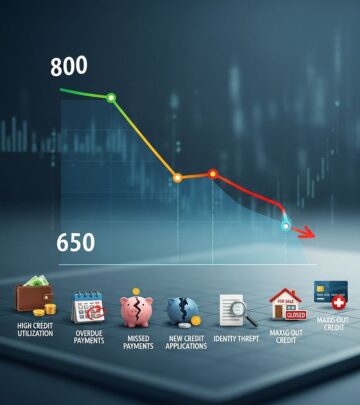
Several everyday actions or issuer decisions can cause unexplained drops. Recognizing these prevents overreaction.
You Canceled a Credit Card
Closing an account shortens your credit history and raises utilization if limits decrease. For example, canceling a $5,000-limit card with $1,000 balance boosts utilization from 20% to 33% across remaining cards, potentially dropping your score 20-50 points. Older accounts especially impact length of history, a key factor.
You’ve Been Building Up Credit Card Debt Gradually
Even small balance increases elevate utilization ratio. High balances signal risk to scorers; issuers may respond by lowering limits, further spiking utilization. If balances near 30% of limits, scores can fall 30+ points.
You’ve Applied for New Credit
Hard inquiries from applications ding scores 5-10 points each, lasting 12 months. Multiple apps (e.g., auto loan + cards) compound this, signaling desperation.
You’ve Co-Signed a Loan
Co-signing adds the debt to your report, hurting utilization and payment history if missed.
Your Credit Limit Was Reduced
Issuers cut limits amid high balances or economic caution, spiking utilization even if spending unchanged. One user noted issuers ‘manipulate’ scores by lowering limits post-usage.
Late Payments or Collections
Payment history dominates; one 30-day late can drop scores 60-110 points. Collections worsen it further.
Why These Drops Aren’t the End of the World
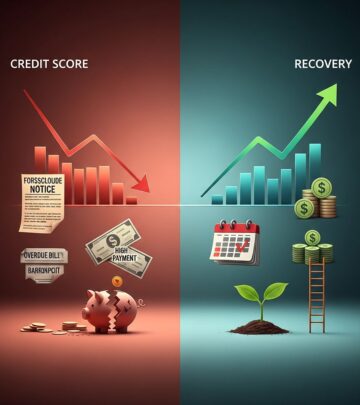
Scores recover predictably: inquiries fade after 12 months, utilization fixes in 1-2 cycles, closed accounts’ impact lessens over time. Bread Financial advises reviewing reports for errors and focusing on positives like on-time payments. During 2008-2009, 37% saw gains offsetting 31% losses. Big banks’ actions (e.g., limit cuts) affect many, not just you.
| Reason for Drop | Typical Point Loss | Recovery Time |
|---|---|---|
| Canceled Card | 20-50 | 3-6 months |
| High Utilization | 30-100 | 1-2 months |
| New Inquiries | 5-10 per | 12 months |
| Limit Reduction | 20-60 | 1-3 months |
| Late Payment | 60-110 | 6-24 months |
Steps to Recover and Improve Your Score
- Check Your Credit Reports: Pull free weekly reports from AnnualCreditReport.com. Dispute errors—25% have inaccuracies.
- Lower Utilization: Pay down balances below 30%; request limit increases cautiously.
- Keep Old Accounts Open: Use lightly to maintain history and limits.
- Pay on Time: Set autopay; payment history is 35% of FICO.
- Avoid New Credit: Space applications 6+ months.
- Become an Authorized User: On low-utilization accounts to boost averages.
- Address Collections: Negotiate pay-for-delete if possible.
Track progress via free tools like Credit Karma. Consistent habits yield 20-50 point gains in months.
Frequently Asked Questions (FAQs)
How long does a credit score drop last?
Most recover in 1-6 months with action; negatives like lates linger 7 years but impact fades.
Does checking my score hurt it?
No—soft pulls are free and score-neutral.
Can I remove accurate negatives?
Rarely; focus on positives instead.
Why did my score drop with no changes?
Issuer reports, limit cuts, or rotations.
Is 700 a good score?
Yes—prime territory for best rates.
Long-Term Strategies for Score Stability
Beyond recovery, build resilience: diversify credit mix (mortgage + cards), automate payments, monitor via alerts. Credit unions often offer better service, per satisfaction surveys. Set goals like short-term debt payoff, mid-term emergency fund. Frugality aids—Wise Bread emphasizes smart banking.
In summary, score drops are normal credit lifecycle events. Stay calm, act strategically, and your score will rebound stronger. (Word count: 1678)
References
- Recent comments | Wise Bread — Wise Bread. Pre-2026. https://www.wisebread.com/comments/moneycenter.yodlee.com?page=3518
- Are You Happy With Your Bank? – Wise Bread — Wise Bread. 2011-11. https://www.wisebread.com/are-you-happy-with-your-bank
- Credit Scores Across the Country: Which Third are You In? — Wise Bread. 2009. https://www.wisebread.com/credit-scores-across-the-country-which-third-are-you-in
- This Is Why Your Credit Limit Was Lowered – Wise Bread — Wise Bread. Pre-2026. https://www.wisebread.com/this-is-why-your-credit-limit-was-lowered
- How to approach a credit score drop – Bread Financial — Bread Financial. Pre-2026. https://www.breadfinancial.com/en/financial-education/understanding-credit/credit-score-drop.html
- 5 Reasons Why Your Credit Score Dropped Out of the Blue — Wise Bread. Pre-2026. https://www.wisebread.com/5-reasons-why-your-credit-score-dropped-out-of-the-blue
- Experian’s State of Credit study provides U.S. credit report card — PR Newswire / Experian. 2016-04-12. https://www.prnewswire.com/news-releases/experians-state-of-credit-study-provides-us-credit-report-card-300180909.html
- Your Payment History Has a Huge Impact on Your Credit Score — Wise Bread. Pre-2026. https://www.wisebread.com/your-payment-history-has-a-huge-impact-on-your-credit-score-heres-how-to-improve-it
- FLM Step 12: Wise Bread blogger Linsey Knerl on goal setting — Money Management.org. Pre-2026. https://www.moneymanagement.org/blog/flm-step-12-wise-bread-blogger-linsey-knerl-on-goal-setting
Similar Articles








Read full bio of Sneha Tete