Why You Need a Time Budget and How to Create It
Master your most precious resource with a time budget strategy that works.

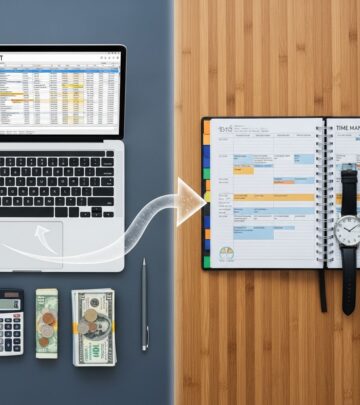
Just as a financial budget helps you manage and track a limited resource—your money—a time budget serves the same purpose for an even more precious resource: your time. Unlike money, which can be borrowed through credit cards or transferred between accounts, time cannot be recovered once it passes. This fundamental reality makes managing your time through a structured budget essential for living intentionally and achieving your goals.
When you exceed your spending in one financial category, you can borrow from another, such as transferring funds from entertainment to food. Similarly, when you overspend time in one area—such as work—you must borrow from another, like family time or sleep. The key difference is that time cannot be credited back. Creating a time budget helps you plan how you allocate your hours, ensuring you spend them as wisely as possible.
Understanding the Concept of Time Budgeting
Time budgeting applies the same principles you use to manage your finances to the management of your daily hours. Whether you’re a parent juggling childcare responsibilities, a corporate executive managing multiple projects, or both, certain activities are non-negotiable. These fixed obligations require a specific time investment, leaving you with discretionary hours to allocate toward goals, relationships, and self-care.
By creating a time budget, you gain clarity about where your hours currently go and where you want them to go. This visibility is the first step toward meaningful change. Many people feel time-crunched without understanding why—often discovering that activities like social media, casual conversations, or inefficient workflows consume far more time than they realize.
Step 1: Take an Inventory of Your Time
The first step in any budgeting process is taking inventory. For one full week, maintain a detailed time log, noting as precisely as possible how you spend each hour. This foundational step reveals patterns and identifies where your time actually goes, rather than where you think it goes.
You have several options for tracking:
- A spiral notebook or journal for manual logging
- A calendar system with detailed time blocks
- Free time-tracking apps like ATracker for smartphone users
- Paid versions of tracking applications for advanced features
The tool itself matters less than your commitment to using it consistently. Write down everything—work hours, commute time, meals, exercise, social media, household chores, and leisure activities. Don’t estimate; document in real-time whenever possible.
Step 2: Analyze Your Time Inventory
At week’s end, step back and analyze your time log. Organize your activities into categories relevant to your life, such as:
- Work and career
- Family and relationships
- School or education
- Fitness and health
- Religious practice or spirituality
- Community involvement
- Leisure and recreation
- Personal projects
Beyond categorizing by activity type, distinguish between fixed and discretionary time expenses. Fixed time represents your non-negotiable commitments—the “musts” that consume a set number of hours regardless of your preferences. Discretionary time includes the “wants”—activities you choose to do but could reduce or eliminate if necessary.
Fixed Time Expenses
Fixed time expenses are obligations that demand your time regularly. Consider the time required for your morning routine: walking the dog, showering, eating breakfast, and packing the kids’ lunches might total one hour. That hour is a fixed expense—it must happen daily, and you have limited flexibility in reducing it.
Other examples of fixed time expenses include:
- Commuting to work or school
- Work hours or class attendance
- Essential household maintenance
- Childcare or eldercare responsibilities
- Sleep and basic self-care
- Recurring medical appointments
Understanding your fixed time commitments establishes your baseline. The remaining hours represent your discretionary time—the pool from which you can draw to pursue goals, relationships, and interests.
Discretionary Time Expenses
Discretionary time expenses are harder to measure but easier to overlook. These include lunch with friends, a massage appointment, browsing social media, or a phone call with family. Who actually times these activities? Yet they accumulate rapidly, often consuming more hours than people realize.
One effective strategy for managing discretionary time is bundling. Rather than scattered social interactions throughout your day—chatting with coworkers here, scrolling social media there—consolidate these activities into designated time blocks. For example, allocate one hour in the afternoon for all social interactions: checking messages, chatting with colleagues, and using social media. This bundling makes your discretionary time more predictable and easier to track within your budget.
Creating Your Time Budget: The Envelope System
The envelope budgeting method works beautifully for time management. In traditional envelope budgeting, you divide cash into envelopes for each spending category. You can adapt this approach for time by creating seven columns on a sheet of paper (one for each day of the week) or by using digital tools.
For each category in your life, allocate a specific number of hours per week or day. Write these allocations in your “envelopes.” If your allocations exceed your available waking hours, you must adjust—reducing time in lower-priority areas to accommodate higher-priority commitments.
This visual representation helps you see at a glance whether your time commitments align with your available hours. If your cards in all envelopes total more than 16 waking hours in a day, you know immediately that something must give.
The 50/30/20 Approach to Time Budgeting
Another proven budgeting method is the 50/30/20 rule, which traditionally allocates 50% of income to fixed expenses, 30% to discretionary spending, and 20% to savings. This framework can be adapted for time management:
- 50% Fixed Time: Allocate approximately half your waking hours to non-negotiable obligations—work, sleep, essential household tasks, and caregiving.
- 30% Discretionary Time: Reserve about 30% of your waking hours for social interactions, hobbies, entertainment, and activities you enjoy.
- 20% Buffer/Unexpected: Set aside roughly 20% for unexpected delays, interruptions, and time wasters you can’t fully control—traffic jams, interruptions from overly chatty neighbors, or urgent requests from colleagues.
If you have 16 waking hours daily, this breaks down roughly as: 8 hours fixed, 5 hours discretionary, and 3 hours buffer. These percentages are guidelines, not rigid rules—adjust them based on your life circumstances and priorities.
Accounting for Unexpected Time Wasters
Time wasters are nearly unavoidable. Getting stuck in traffic, receiving urgent emails that derail your plans, or being cornered by a chatty colleague—these interruptions happen to everyone. Rather than viewing them as failures, build them into your time budget.
Include a buffer category for non-intentional time gobblers. Estimate how much unplanned time typically disrupts your day and allocate time accordingly. If you don’t need all that allotted buffer time in a given week, transfer the surplus into your discretionary column, creating bonus time for activities you enjoy.
Making Your Time Budget Work
A time budget is a guide, not a prison sentence. It only works if you actively use it, but it need not be rigid or set in stone. You’re the boss of your time budget—adjust it as needed.
Time expenses—fixed and discretionary alike—should be reviewed at intervals that make sense in your life. Some people review weekly, others monthly, and some track daily. Choose a cadence you’ll actually maintain. A budget abandoned after two weeks provides no benefit, so select a review frequency that feels sustainable.
The goal isn’t perfection; it’s awareness and intentionality. When you understand where your time goes, you can make conscious decisions about whether your current allocation aligns with your values and goals.
Combining Time Budgeting with Productivity Techniques
Time budgeting works best when paired with proactive planning. Dedicate approximately 15 minutes each morning to review your calendar and plan your day before diving into work. This “pay yourself first” approach to time management prevents you from being blindsided by meetings, deadlines, and scheduling conflicts.
Automation also supports time budgeting. Identify recurring tasks and set them up to run automatically when possible. Email templates for common responses, automatic calendar reminders for recurring tasks, and digital alerts for important deadlines all reduce the mental energy required to manage your schedule. This frees up cognitive resources for high-value activities.
Tracking Time to Identify Leaks
Just as financial tracking reveals spending leaks, time tracking exposes where your hours disappear. Many people feel perpetually time-crunched while spending hours daily on social media, entertainment, or low-value tasks. Until you track your actual time usage, you’ll struggle to find time for what matters most.
The awareness created by tracking alone often catalyzes change. Knowing you’ll have to write down watching videos on YouTube while you should be studying creates mental friction that discourages the behavior. Apps like Toggl and RescueTime provide digital tracking, but even old-school paper tracking can be remarkably effective.
Frequently Asked Questions
Q: How detailed should my time log be?
A: Log activities in intervals that make sense for your life—typically 15-minute or 30-minute blocks. The goal is accuracy sufficient to reveal patterns, not perfection. You don’t need to time every bathroom break, but you should capture major activities and how long they take.
Q: What if my schedule varies significantly from week to week?
A: Track for multiple weeks to identify patterns. Create flexible time budgets with ranges rather than fixed hours. For example, “work: 40-50 hours per week” rather than “work: exactly 45 hours.” Build larger buffers for unpredictable time.
Q: How often should I review and adjust my time budget?
A: Review weekly or monthly, whichever works for you. At minimum, review quarterly to assess whether your time allocation still reflects your priorities. Life changes—your budget should evolve with it.
Q: Can I use the same tools for time budgeting as I use for money budgeting?
A: Absolutely. Spreadsheets like Excel or Google Sheets work well for time budgeting. You can adapt financial budgeting templates to track time instead. The principles are identical; only the units change from dollars to hours.
Q: What’s the biggest mistake people make with time budgets?
A: Creating an overly optimistic budget that doesn’t account for reality. If you estimate 8 hours work but typically work 9, your budget will fail. Base your budget on actual data from your time log, not aspirational thinking.
Q: How do I handle time for activities that vary in duration, like household chores?
A: Group variable activities into a single category and allocate a weekly time total. For example, “household chores: 5 hours per week” gives you flexibility to do 45 minutes one day and 90 minutes another, without rigidly scheduling each task.
Taking Action: Your Time Budget Journey
Creating a time budget is straightforward, but maintaining one requires commitment. Start this week by keeping a detailed time log. Download an app, grab a notebook, or use your calendar—the format matters far less than consistency.
At week’s end, analyze your data without judgment. Where does your time actually go? Which categories align with your values, and which surprise you? Use these insights to design a time budget that reflects your priorities and constraints.
Remember, a time budget is a tool for better living, not a source of stress. Adjust it as needed, celebrate the control it brings, and enjoy the feeling of confidence that comes from intentionally managing your most precious resource.
References
- Why You Need a Time Budget — and How to Create It — Wise Bread. 2026. https://www.wisebread.com/why-you-need-a-time-budget-and-how-to-create-it
- How to Use Budgeting Skills to Improve Your Time Management — Wise Bread. 2026. https://www.wisebread.com/how-to-use-budgeting-skills-to-improve-your-time-management
- Time Is Money: Budget Them Both Out — Wise Bread. 2026. https://www.wisebread.com/time-is-money-budget-them-both-out
Similar Articles








Read full bio of medha deb