Why Americans Need $20K+ in Savings Now
Discover why building at least $20,000 in savings is crucial for financial security amid rising costs and economic uncertainty.

In an era of persistent inflation, job market volatility, and unexpected life events, having substantial savings is no longer optional but essential for financial resilience. Recent data reveals that most Americans fall far short of recommended savings levels, with medians hovering around minimal amounts that barely cover basic emergencies. Aiming for at least $20,000 in liquid savings provides a critical buffer against these challenges, allowing individuals to navigate economic turbulence without resorting to high-interest debt.
The Harsh Reality of American Savings Levels
Current statistics paint a sobering picture of household preparedness. The median retirement savings through defined contribution plans like 401(k)s stands at just $955 for workers aged 21 to 64, including those with zero balances. Even among those who have begun saving, the median is $40,000, while averages climb to $179,082 for savers but drop significantly when including non-savers at $93,229.
Broader savings accounts tell a similar story. According to the Federal Reserve’s 2022 Survey of Consumer Finances—the most recent comprehensive data— the average American household holds $62,410 in savings. This figure masks significant disparities by age: under 35-year-olds average $20,540, rising to $41,540 for ages 35-44, $71,130 for 45-54, $72,520 for 55-64, and peaking at $100,250 for those 65 and older before dipping to $82,800 for 75+.
| Age Group | Average Savings |
|---|---|
| Under 35 | $20,540 |
| 35-44 | $41,540 |
| 45-54 | $71,130 |
| 55-64 | $72,520 |
| 65-74 | $100,250 |
| 75+ | $82,800 |
These averages are skewed by high earners; medians are much lower, highlighting that the typical American has far less than $20,000 readily accessible.
Why $20,000 Should Be the Minimum Target
Financial experts advocate for emergency funds covering 3-6 months of expenses, but with median household incomes around $75,000 annually—or roughly $6,250 monthly—this translates to $18,750 to $37,500. Targeting $20,000 aligns with the lower end of this spectrum for many, providing coverage for common crises like medical bills, car repairs, or short-term unemployment.
Bankrate’s 2026 Emergency Savings Report underscores the urgency: only 47% of Americans could cover a $1,000 emergency without borrowing, and 24% have no savings at all. Moreover, 54% report saving less due to inflation, which has driven consumer prices 26% higher since December 2019. A $20,000 fund exceeds the $1,000-$2,499 amounts most dipped into last year (26% of those who withdrew), offering deeper protection.
- Covers prolonged job loss: With softening job markets, 3+ months of expenses prevents debt spirals.
- Buffers inflation: Locks in purchasing power against rising costs for essentials.
- Supports retirement ramp-up: Frees up income for long-term goals beyond mere survival.
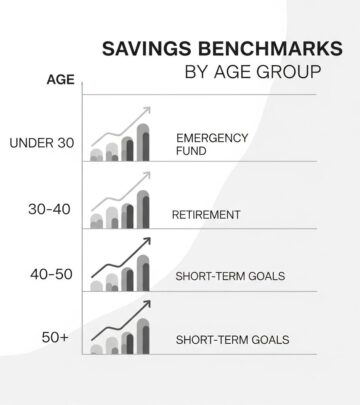
Age-Specific Savings Benchmarks for Optimal Security
Savings needs evolve with life stages. Fidelity’s guidelines recommend multiples of annual income: 1x by 30, 3x by 40, 6x by 50, 8x by 60, and 10x by 67. For a $75,000 earner, this means $75,000 by 30 and $750,000 by retirement—yet median savings at 65+ is just $87,000.
Beyond emergencies, total nest eggs must account for retirement shortfalls. No demographic group meets these targets, per NIRS analysis. Here’s a breakdown:
| Age | Fidelity Target (1x Income) | Actual Median (DC Plans) | Recommended Emergency Add-On |
|---|---|---|---|
| 30 | $75,000 | <$1,000 | $20,000 |
| 40 | $225,000 | $10,000-$20,000 | $25,000 |
| 50 | $450,000 | $50,000 | $30,000 |
| 60 | $600,000 | $100,000 | $37,500 |
Adding $20,000+ in high-yield savings to these builds a hybrid safety net.
Inflation and Economic Pressures Eroding Savings
The U.S. personal saving rate reflects broader struggles: 4.5% in January 2026, up slightly from 3.8% in December 2024 but historically low. Inflation remains a top barrier, with 54% citing it as the reason for reduced emergency contributions. Prices for housing, food, and energy continue outpacing wage growth for many.
Other factors include unemployment (26%) and recent rate cuts (17%), which diminish returns on savings accounts. Yet high-yield options still offer 4-5% APY, far better than traditional banks’ 0.01%. Building to $20,000 in such accounts could generate $800-$1,000 annually in interest, compounding security.
Practical Strategies to Reach and Maintain $20K+
Achieving this goal requires disciplined action. Start by calculating your monthly essentials—rent, utilities, groceries, insurance—and multiply by 3-6. Automate transfers to a dedicated high-yield savings account post-paycheck.
- Track and cut expenses: Use apps to monitor spending; redirect $200/month from dining out to savings.
- Boost income: Side gigs or raises can add $500+/month.
- Leverage windfalls: Tax refunds, bonuses straight to savings.
- Build incrementally: Hit $1,000 first, then $5,000, scaling to $20,000.
- Replenish wisely: Only tap for true emergencies; rebuild immediately after use.
For retirement integration, max 401(k) matches after emergency fund basics—free money amplifying growth.
Common Pitfalls and How to Avoid Them
Many fail by underestimating needs or lifestyle inflation. Avoid ‘set-it-and-forget-it’ low-interest accounts; opt for FDIC-insured online banks. Don’t confuse retirement accounts with emergencies—penalties erode 401(k)/IRA withdrawals.
Life changes like family growth or health issues demand periodic reviews. Women and lower-income groups often lag further, necessitating tailored plans.
Long-Term Benefits of a Strong Savings Foundation
Those with $20,000+ report lower stress and better financial decisions. It enables investment risks, home down payments, or career shifts without fear. Over decades, compound interest turns $20,000 at 5% into $53,000 in 10 years, $140,000 in 20.
In retirement context, it bridges gaps until Social Security or pensions kick in, especially with medians at $87,000 vs. needed $750,000.
Frequently Asked Questions (FAQs)
How much should I have in savings at age 30?
Aim for 1x your annual income in retirement savings plus $20,000 emergency fund. For $75,000 income, that’s $95,000 total.
Is $20,000 enough for 6 months of expenses?
For households with $3,333 monthly essentials, yes. Adjust based on your budget—higher for families, lower for singles.
Where should I keep my emergency savings?
High-yield savings accounts for liquidity and 4-5% returns, fully FDIC-insured up to $250,000.
What if inflation keeps rising?
Increase targets to 6-9 months; ladder CDs for locked rates amid volatility.
Can I use credit cards instead of savings?
No—average APRs over 20% turn emergencies into debt traps. Savings first.
Conclusion: Act Now for Financial Freedom
With savings rates low and shortfalls widespread, prioritizing $20,000+ empowers Americans to thrive, not just survive. Start small, stay consistent, and watch security compound.
References
- Typical American worker has just $955 saved for retirement, study shows — Fox Business. 2023. https://www.foxbusiness.com/lifestyle/typical-american-worker-has-just-955-saved-retirement-study-shows
- What Is the Average Savings by Age? — SoFi. 2022. https://www.sofi.com/learn/content/average-savings-by-age/
- Bankrate’s 2026 Annual Emergency Savings Report — Bankrate. 2026. https://www.bankrate.com/banking/savings/emergency-savings-report/
- Personal Saving Rate — U.S. Bureau of Economic Analysis (BEA). 2026. https://www.bea.gov/data/income-saving/personal-saving-rate
- Personal savings rate in U.S. 2015-2026 — Statista. 2026. https://www.statista.com/statistics/246268/personal-savings-rate-in-the-united-states-by-month/
Similar Articles








Read full bio of Sneha Tete