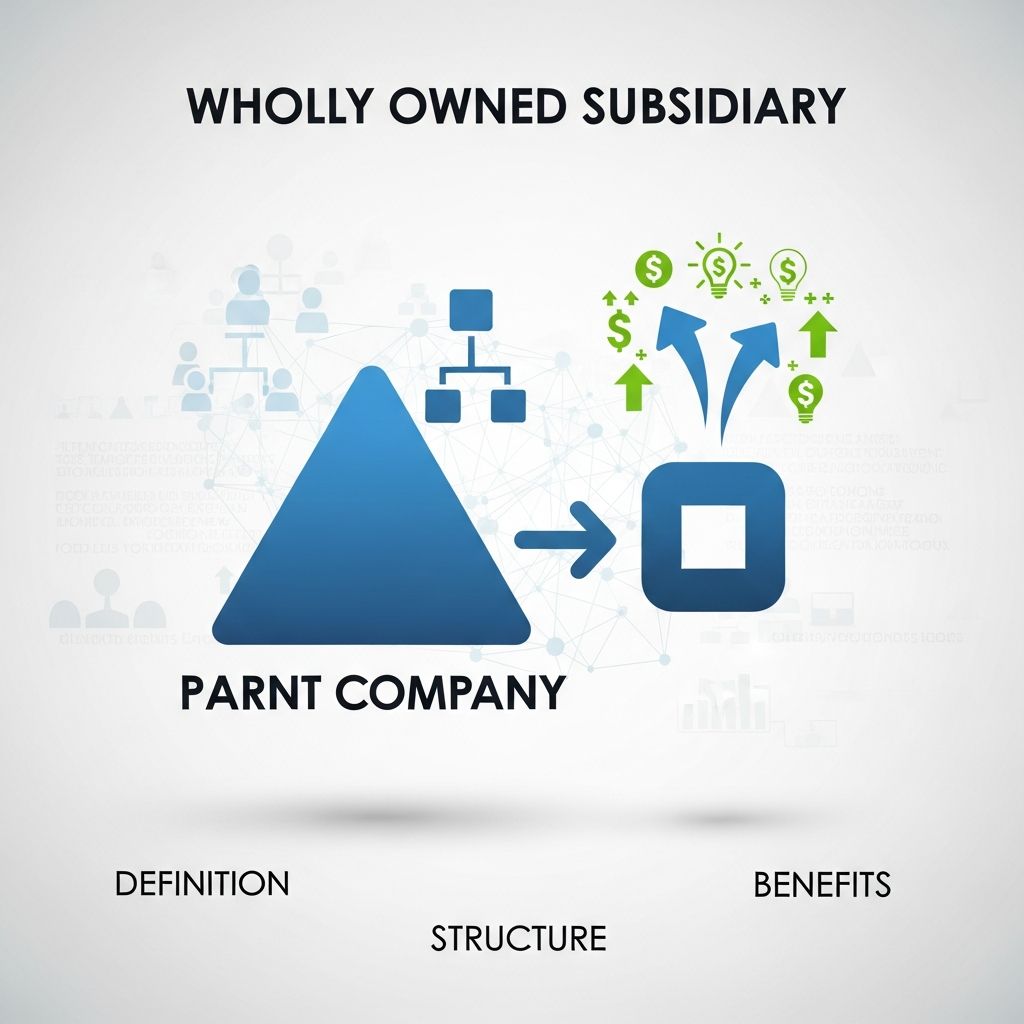
Wholly Owned Subsidiary: Definition, Structure & Benefits
Complete guide to wholly owned subsidiaries: structure, advantages, tax implications, and strategic benefits for parent companies.
What is a Wholly Owned Subsidiary?
A wholly owned subsidiary is a business entity in which a parent company, also referred to as a holding company, owns 100% of the subsidiary’s outstanding stock. This complete ownership structure gives the parent company absolute control over all strategic decisions, management appointments, and operational policies of the subsidiary. Unlike partially owned subsidiaries where the parent owns between 51% and 99% of shares, a wholly owned subsidiary has no minority shareholders, meaning the parent company is the sole shareholder with unrestricted voting rights.
The subsidiary operates as a legally and operationally independent entity with its own management structure, local tax obligations, and compliance requirements. However, despite this separation, the subsidiary remains financially consolidated with the parent company in official financial reporting. This hybrid structure allows parent companies to maintain control while enabling subsidiaries to function with operational autonomy and assume independent legal liability for their business operations.
How Wholly Owned Subsidiaries Work
The operational framework of a wholly owned subsidiary balances independence with parental control. While the subsidiary maintains its own management team and day-to-day operational independence, the parent company retains the authority to appoint the subsidiary’s board of directors and make strategic decisions that align with broader corporate objectives.
A wholly owned subsidiary can be established through two primary methods:
- Acquisition: A parent company purchases 100% of another company’s stock
- Formation: The parent company creates and establishes a new subsidiary from the ground up
Once established, the subsidiary may operate in the same industry as its parent or in an entirely different sector. It can also be located domestically within the parent company’s home country or internationally in foreign markets. This flexibility makes wholly owned subsidiaries an effective tool for companies seeking to diversify their business portfolio, enter new markets, or separate different business operations.
Key Characteristics of Wholly Owned Subsidiaries
100% Ownership by the Parent Company
The parent company owns all outstanding shares and possesses all voting rights associated with the subsidiary. This complete ownership structure ensures that the parent company’s board of directors can make unilateral strategic decisions without requiring approval from minority shareholders or independent board members. The absence of minority shareholders eliminates potential conflicts of interest and simplifies corporate governance.
Separate Legal Entity
Despite complete parental ownership, the subsidiary maintains legal recognition as a separate, independent entity. This distinction is crucial because it allows the subsidiary to enter into contracts, own property, and assume all legal liability for its business operations independently from the parent company. This separation shields the parent from direct legal exposure to the subsidiary’s contractual obligations and liabilities, provided the corporate veil is properly maintained.
Consolidated Financial Reporting
Under Generally Accepted Accounting Principles (GAAP) in the United States and International Financial Reporting Standards (IFRS) globally, the subsidiary’s financial results must be consolidated with the parent company’s financial statements. These consolidated statements combine all assets, liabilities, revenue, and expenses of both the parent and subsidiary into a single comprehensive financial report. This consolidation requirement ensures that shareholders and stakeholders have a complete picture of the entire corporate group’s financial position and performance.
Strategic Control and Decision-Making
Although the subsidiary has its own management team, the parent company maintains ultimate strategic control. The parent can appoint the subsidiary’s board of directors, establish corporate policies, approve major capital expenditures, and make decisions that ensure the subsidiary’s operations align with parent company objectives. This control extends to executive appointments, budget allocation, and major business initiatives.
Advantages of Wholly Owned Subsidiaries
Rapid Strategic Decision-Making
Since there are no minority shareholders to consult or external board members to convince, the parent company can implement strategic decisions quickly. This streamlined decision-making process is particularly valuable in dynamic markets where speed is essential for competitive advantage. The parent company can pivot strategy, approve new initiatives, or reallocate resources without delays associated with negotiating with minority stakeholders.
Market Expansion and Diversification
Wholly owned subsidiaries provide an effective mechanism for companies to expand into new geographic markets or enter entirely new industries. By establishing a separate subsidiary with its own brand, management structure, and local operations, the parent company can penetrate new markets while limiting exposure to market-specific risks. This structure allows the parent to maintain focus on its core business while the subsidiary develops expertise in its specialized market.
Risk Isolation and Financial Protection
Operating a new venture as a wholly owned subsidiary isolates financial risk from the parent company. If the subsidiary underperforms or faces financial difficulties, losses are contained within the subsidiary’s operations rather than directly impacting the parent company’s core business. This risk compartmentalization is particularly valuable when entering uncertain markets or launching innovative product lines with unproven demand.
Operational Control and Flexibility
The parent company retains complete operational control over the subsidiary without requiring approval from minority shareholders or external stakeholders. This operational flexibility enables the parent to implement standardized processes, align subsidiary operations with corporate strategy, and ensure compliance with parent company standards and policies.
Compliance with Local Regulations
When expanding internationally, wholly owned subsidiaries help parent companies navigate complex local regulatory environments. Subsidiaries can maintain separate legal structures, comply with local tax codes, and employ local management teams familiar with regional business practices. This localized approach facilitates smoother market entry and reduces regulatory compliance risks.
Accounting and Tax Considerations
Financial Reporting Requirements
Parent companies must adhere to strict financial reporting standards when establishing and operating wholly owned subsidiaries. Under GAAP and IFRS guidelines, all subsidiary assets, liabilities, costs, and revenue must be reflected in the parent company’s consolidated financial statements. This consolidation requirement ensures complete transparency regarding the entire corporate group’s financial position. Additionally, subsidiary financial results must be maintained separately for internal management purposes, allowing the parent company to track subsidiary performance and profitability independently.
Tax Implications
The tax treatment of wholly owned subsidiaries is complex and varies significantly depending on jurisdiction. Generally, the wholly owned subsidiary pays taxes in its local jurisdiction as a separate legal entity, even though it is ultimately owned by the parent company. However, parent companies may benefit from certain tax advantages:
- Loss Offsetting: In some jurisdictions, parent companies can use gains from one subsidiary to offset losses from another subsidiary when reporting consolidated tax results
- Transfer Pricing: Parent companies may optimize transfer pricing between subsidiaries to manage overall tax liability within legal parameters
- International Tax Benefits: Foreign subsidiaries may benefit from reduced tax rates or tax incentives offered by host countries
- Dividend Treatment: Dividends paid by subsidiaries to parent companies may receive preferential tax treatment depending on domestic tax laws
Tax planning around wholly owned subsidiaries requires careful attention to anti-avoidance rules and transfer pricing regulations in relevant jurisdictions.
Wholly Owned Subsidiaries vs. Partially Owned Subsidiaries
| Characteristic | Wholly Owned Subsidiary | Partially Owned Subsidiary |
|---|---|---|
| Ownership Percentage | 100% owned by parent company | 51-99% owned by parent company |
| Minority Shareholders | None present | Present with ownership rights |
| Decision-Making Speed | Faster, no minority approval needed | Slower, requires minority consultation |
| Profit Sharing | All profits accrue to parent company | Profits shared with minority shareholders |
| Board Control | Parent appoints entire board | Minority may elect some board members |
| Operational Independence | Greater parent control | More subsidiary independence |
Real-World Applications and Strategic Benefits
Market-Specific Risk Management
Companies operating in volatile or uncertain markets often utilize wholly owned subsidiaries to compartmentalize risk. If market conditions deteriorate or the venture fails, the financial impact remains isolated within the subsidiary rather than affecting the parent company’s consolidated results or shareholder value.
Brand Separation and Positioning
Wholly owned subsidiaries enable parent companies to maintain distinct brand identities and market positioning. A parent company in one industry can establish a subsidiary with a completely different brand, product line, and market strategy. This separation allows the parent to appeal to different customer segments without brand confusion or cannibalizing existing market share.
Supply Chain Vertical Integration
Many companies establish wholly owned subsidiaries to achieve vertical integration of supply chains. A manufacturer might own subsidiaries that supply raw materials or provide distribution services, ensuring supply chain reliability and capturing additional profit margins.
International Expansion
Foreign subsidiaries provide parent companies with localized operational structures that comply with host country regulations while maintaining strategic control. Subsidiaries can hire local management, adapt products to local preferences, and navigate complex regulatory environments more effectively than remote parent company operations.
Disadvantages and Challenges
Multiple Taxation Issues
While wholly owned subsidiaries provide tax planning opportunities, they can also result in multiple taxation layers. Subsidiaries pay corporate income taxes in their jurisdiction, and parent companies may face additional taxation on dividends or subsidiary profits depending on applicable tax laws.
Increased Administrative Burden
Operating wholly owned subsidiaries requires maintaining separate accounting systems, compliance procedures, and regulatory filings. This administrative complexity increases operational costs and requires dedicated resources for subsidiary management.
Potential Loss of Business Focus
Managing multiple wholly owned subsidiaries across different industries or markets can dilute management focus and strategic concentration. Parent companies must balance subsidiary development with core business operations, potentially spreading management attention too thin.
Conflicting Strategic Interests
Subsidiaries may develop strategic interests that conflict with parent company objectives. For example, a subsidiary’s focus on maximizing its own profitability might conflict with parent company strategies for long-term market development or cross-subsidiary synergies.
Frequently Asked Questions
Q: Is a wholly owned subsidiary considered its own company?
A: Yes, a wholly owned subsidiary is recognized as a separate legal entity distinct from its parent company. While the parent owns 100% of the subsidiary’s stock and controls strategic decisions, the subsidiary maintains independent legal status, can enter contracts in its own name, and assumes its own contractual and operational liabilities.
Q: Do wholly owned subsidiaries maintain separate accounting records?
A: Yes, wholly owned subsidiaries maintain their own bookkeeping systems to manage local finances, taxes, and regulatory compliance. However, for external financial reporting purposes, the parent company must consolidate the subsidiary’s financial results with its own consolidated financial statements as required by GAAP or IFRS.
Q: What is the difference between a subsidiary and a wholly owned subsidiary?
A: A subsidiary is owned at least 50% by a parent company, while a wholly owned subsidiary is owned 100% by the parent. In partially owned subsidiaries, minority shareholders exist and retain certain rights. In wholly owned subsidiaries, the parent company is the sole shareholder with complete voting control.
Q: How are wholly owned subsidiaries created?
A: Wholly owned subsidiaries are created either through acquisition (the parent purchases 100% of an existing company’s stock) or formation (the parent establishes a new subsidiary from inception). Both methods result in the parent holding complete ownership of the subsidiary.
Q: Can a wholly owned subsidiary operate in a different country than the parent company?
A: Yes, wholly owned subsidiaries frequently operate in foreign countries. International subsidiaries help parent companies expand into new markets while complying with local regulations, tax requirements, and business practices. Foreign subsidiaries maintain their own legal status in the host country while remaining strategically controlled by the parent company.
Q: What are the main tax advantages of wholly owned subsidiaries?
A: Tax advantages may include loss offsetting between subsidiaries, favorable transfer pricing arrangements, access to foreign tax credits or incentives, and potential treaty benefits for international subsidiaries. However, specific advantages depend on applicable tax laws in relevant jurisdictions, and careful tax planning is essential to ensure compliance.
References
- What is a wholly owned subsidiary? How it works and examples — Oyster HR. 2024. https://www.oysterhr.com/glossary/wholly-owned-subsidiary
- Wholly Owned Subsidiary | Definition & Examples — Study.com. 2024. https://study.com/academy/lesson/wholly-owned-subsidiary-definition-advantages-disadvantages.html
- What is a subsidiary company? Definition, examples and FAQs — Diligent. 2024. https://www.diligent.com/resources/blog/what-is-a-subsidiary-company
Similar Articles








Read full bio of medha deb