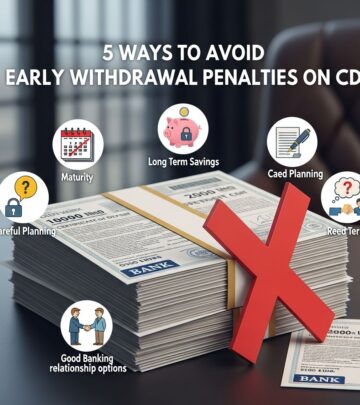
When to Break a CD Early: Smart Strategies
Discover if cashing out your CD before maturity makes financial sense, weighing penalties against urgent needs and better opportunities.

Certificates of deposit (CDs) offer a secure way to grow savings with fixed interest rates over a set period, but life events can force savers to reconsider locking in funds. Early withdrawal from a CD triggers penalties designed to discourage breaking the agreement, yet certain situations may justify the cost. This guide examines penalty structures, calculates potential losses, identifies viable scenarios for early access, and explores penalty-free alternatives to help you decide confidently.
Understanding CD Early Withdrawal Penalties
Federal regulations establish a baseline for penalties on CDs to protect banks that rely on deposits for lending. For withdrawals within the first six days of deposit, banks must impose at least seven days of simple interest as a penalty. Beyond this minimum, institutions set their own rules, often scaling penalties with term length.
Penalties typically deduct a portion of earned interest or, in severe cases, principal. Common formulas include 90 days of simple interest for terms up to one year or 180 days for longer terms. For instance, Citi applies a 90-day penalty on CDs of one year or less and 180 days for extended durations, calculated on the withdrawn principal.
How Banks Calculate and Apply Fees
Different institutions use varied methods, leading to diverse impacts on your balance. Some charge fixed days of interest, while others take a percentage of expected earnings or recent dividends.
- Interest forfeiture: Most common, where you lose days or months of accrued or projected interest.
- Principal reduction: If interest earned is insufficient, banks like PenFed may dip into your deposit, potentially resulting in a net loss.
- Flat fees: Rare, but some add a fixed dollar amount alongside interest penalties.
Review your account agreement, as terms differ widely. For example, Ally’s penalties escalate with term length: 60 days for 12 months, 90 for 36 months, and 150 for 60 months.
Comparing Penalties Across Major Institutions
To illustrate variations, here’s a table summarizing early withdrawal penalties from select banks and credit unions for common CD terms. These are based on publicly available policies and assume standard calculations.
| Institution | 3-12 Month CD | 1-3 Year CD | 3-5 Year CD |
|---|---|---|---|
| Ally Bank | 60 days interest | 90 days interest | 150-365 days interest |
| Citi | 90 days simple interest | 180 days simple interest | 180 days simple interest |
| Wells Fargo | 3 months interest | 6 months interest | 12 months interest |
| PenFed CU | 90 days dividends | 1 year expected dividends | 30% total expected dividends |
| Alliant CU | 90 days dividends earned | 180 days dividends earned | 365 days dividends earned |
This comparison highlights how credit unions like PenFed may impose harsher hits by using projected rather than earned interest, increasing principal risk.
Real-World Penalty Examples
Consider a $10,000 deposit in a 5-year CD at 2% annual interest, withdrawn after two years (earning about $400 total interest). A 365-day penalty (one year’s interest, $200) leaves net earnings of $200. If withdrawn earlier with less interest accrued, you could lose principal.
For a 36-month CD at Ally with a $10,000 principal at similar rates, a 90-day penalty might cost $53, scaling to $212 for a full-year equivalent on longer terms. Always use bank calculators or consult advisors for precise figures based on your rate and timing.
Scenarios Where Early Withdrawal Pays Off
Despite costs, breaking a CD can be rational if alternatives yield higher returns or avert greater losses. Key situations include:
- High-interest debt payoff: Paying off 18% credit card debt with CD funds (even after a 90-day penalty) saves far more in avoided interest. For example, a $5,000 withdrawal costing $100 in penalties eliminates $900 annual card interest.
- Locking in better rates: If rates rise sharply (e.g., from 2% to 5%), penalties of 180 days might be offset by reinvesting principal at the new rate over remaining years.
- Emergency needs: Job loss or medical bills where liquid cash outweighs future interest. Compare penalty to high-fee alternatives like payday loans.
- Home or investment opportunities: Down payments or stock market entry if expected returns exceed penalty plus forgone CD yield.
Run the math: Penalty cost vs. benefit. If net gain exceeds 1-2% annually post-penalty, it often justifies action.
Tax Consequences of Early CD Withdrawals
Interest earned is taxable as ordinary income, reported via Form 1099-INT regardless of early access. Penalties provide relief: they are deductible as an adjustment to income on Schedule A (if itemizing), offsetting some tax hit. Limitations apply, so check IRS Publication 550 or a tax pro. This deduction can reclaim 20-30% of the penalty cost depending on your bracket.
Avoiding Penalties Altogether: Better Options
Proactive strategies preserve earnings without fees:
- No-penalty CDs: Offered by Discover and others, allowing withdrawal after a 7-day lockout with lower rates but full flexibility.
- Laddering: Split savings across staggered maturities (e.g., 6/12/24 months) for regular access without full-term commitment.
- Interest-only withdrawals: Some CDs permit monthly interest pulls without touching principal.
- High-yield savings accounts (HYSAs): Variable rates, no lock-in, often competitive with short-term CDs.
- Bump-up or step-up CDs: Adjust rates mid-term without penalty.
Shop via platforms comparing FDIC-insured options for best fits.
Frequently Asked Questions (FAQs)
Is there a minimum penalty for CD early withdrawal?
Yes, federal law requires at least seven days’ simple interest for withdrawals in the first six days; banks set higher amounts thereafter.
Can I lose my principal on early CD withdrawal?
Possible if penalty exceeds earned interest, especially with institutions using expected dividends like PenFed.
Are CD penalties tax-deductible?
Yes, as an itemized deduction on federal taxes, reducing taxable income.
What are no-penalty CDs?
Flexible CDs with withdrawal options post-initial period, trading slightly lower rates for liquidity.
How do I calculate my specific penalty?
Check your deposit agreement or use bank-provided calculators inputting amount, rate, term, and withdrawal date.
Final Thoughts on CD Management
CDs suit stable savings goals, but rigidity demands planning. Assess penalties against needs, prioritize emergencies or superior opportunities, and favor flexible products for uncertain futures. Consult financial advisors for personalized math, ensuring decisions align with your risk tolerance and timeline.
References
- What are the penalties for withdrawing money early from a CD? — HelpWithMyBank.gov. Accessed 2026. https://www.helpwithmybank.gov/help-topics/bank-accounts/certificates-of-deposit/cd-penalties.html
- What to Know about CD Early Withdrawal Penalties — Citi. Accessed 2026. https://www.citi.com/banking/personal-banking-guide/basic-finance/cd-early-withdrawal-penalty
- CD Early Withdrawal Penalty Calculator — NerdWallet. Accessed 2026. https://www.nerdwallet.com/banking/learn/cd-early-withdrawal-penalty-by-bank
- CD Early Withdrawal Penalty: What You Should Know — Ally. Accessed 2026. https://www.ally.com/stories/save/cd-early-withdrawal-penalties/
- CD Early Withdrawal Penalty Explained — Chase. Accessed 2026. https://www.chase.com/personal/banking/education/basics/cdearly-withdrawal-penalty
- How To Avoid CD Withdrawal Penalties — Centier Bank. Accessed 2026. https://www.centier.com/resources/articles/article-details/how-to-avoid-cd-withdrawal-penalties
- What is a CD early withdrawal penalty? — Discover. Accessed 2026. https://www.discover.com/online-banking/banking-topics/cd-early-withdrawal-penalty/
Similar Articles








Read full bio of medha deb