When Does Your First Credit Score Appear?
Discover the timeline for your initial credit score after opening your first account and proven strategies to accelerate credit building.

Establishing your first credit score typically requires opening at least one credit account and allowing time for activity to report to the major credit bureaus. For FICO scores, this process generally takes about six months of account activity, while VantageScore can generate a score as early as one to two months in some cases.
Understanding Credit Scores and Bureaus
Credit scores serve as numerical summaries of your creditworthiness, ranging from 300 to 850, with higher numbers indicating lower risk to lenders. The three primary bureaus—Experian, Equifax, and TransUnion—collect data from creditors to compile your credit reports, which scoring models like FICO and VantageScore analyze.
Without any accounts, no score exists because there’s no data to evaluate. Your first score emerges once sufficient positive information, such as on-time payments, accumulates.
Timeline for Generating Your Initial Credit Score
The exact wait depends on the scoring model and reporting patterns:
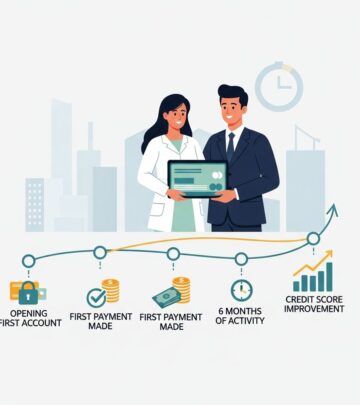
- Months 1-2: Open your first account, like a secured credit card or credit-builder loan. Initial data may report, but scores aren’t generated yet due to insufficient history.
- Month 3: VantageScore often produces an initial score here, typically in the 300-500 range for new users with on-time payments.
- Months 4-6: FICO scores become available after one account open for six months with recent reporting activity. Expect scores around 550-650 with consistent payments.
- Year 1+: Scores climb into fair (580-669) or good (670-739) territory with ongoing responsible use.
| Timeframe | FICO Requirement | VantageScore | Typical Starting Score |
|---|---|---|---|
| 1-3 Months | No score | Possible score | 300-500 |
| 6 Months | First score | Established | 550-650 |
| 12 Months | Fair credit | Improving | 600-700 |
This table illustrates standard progress based on bureau data and scoring criteria.
Factors That Determine When Your Score Appears
Several elements influence timing:
- Account Type: Secured cards and credit-builder loans report monthly to all bureaus, hastening score creation.
- Payment History: On-time payments are crucial; even one late payment delays progress.
- Reporting Frequency: Creditors update bureaus monthly, so activity from the prior cycle affects scores.
- Scoring Model: VantageScore requires less history than FICO, enabling quicker starts.
Length of history (15% of FICO score) grows over time, rewarding older accounts. Credit mix (10%) diversifies your profile faster.
Typical Starting Scores and What They Mean
New scores often land in the low range: 300-500 initially, rising to 550+ by month six with perfect payments. These reflect thin files with limited data, not poor habits.
- Poor (300-579): Limited options; high rates.
- Fair (580-669): Access to basic products.
- Good (670-739): Better terms available after 12-18 months.
Scores stabilize and improve as history lengthens.
Best Ways to Start Building Credit from Nothing
Begin with accessible tools:
- Secured Credit Cards: Deposit sets your limit; use lightly and pay fully monthly. Reports to all bureaus.
- Credit-Builder Loans: Funds held as savings while you repay; builds payment history and savings.
- Authorized User: Piggyback on a trusted person’s good-standing card.
- Retail or Gas Cards: Easier approval for beginners.
Combine methods—like a secured card plus builder loan—for rapid reporting and mix benefits.
Proven Strategies to Accelerate Credit Growth
Once scored, optimize these factors (FICO weights):
- Payment History (35%): Automate payments; aim for 100% on-time.
- Utilization (30%): Keep balances under 30% of limits, ideally 10%.
- Length of History (15%): Retain old accounts open.
- New Credit (10%): Limit applications to avoid inquiries.
- Mix (10%): Balance revolving (cards) and installment (loans).
Expect 10-30 point monthly gains early, slowing later. Good credit (670+) achievable in 12-18 months.
Common Roadblocks and How to Avoid Them
New builders face pitfalls:
- Missed Payments: Drops score 100+ points; sets back months.
- High Utilization: Maxing cards hurts even if paid off.
- Closing Accounts: Shortens history.
- Too Many Inquiries: Signals risk.
Monitor free weekly reports at AnnualCreditReport.com and scores via apps.
Long-Term Credit Building Milestones
- Year 1: Fair score; qualify for unsecured cards.
- Year 2: Good score; lower rates on loans.
- Year 3+: Excellent (750+); premium offers.
Positive history builds indefinitely; negatives fade after 7 years.
Frequently Asked Questions
How soon can I get a credit score after my first account?
VantageScore: 1-3 months. FICO: Up to 6 months.
What’s a realistic first score?
300-600, improving quickly with good habits.
Can I build credit without a card?
Yes, via builder loans or authorized user status.
Does closing my first account hurt?
Yes, it shortens history; keep it open.
How to check if I have a score?
Use free tools from bureaus or banks.
References
- How Long Does It Take to Build Credit? (Realistic Timeline) — Firstcard. 2024. https://www.firstcard.app/learn/blog/how-long-to-build-credit
- How Long Does It Take to Build Credit? — Capital One. 2024. https://www.capitalone.com/learn-grow/money-management/how-long-to-build-credit/
- Money Basics Guide to Building and Maintaining Credit — MyCreditUnion.gov (NCUA). 2023. https://mycreditunion.gov/brochure-publications/brochure/money-basics-guide-building-and-maintaining-credit
- How to Build Credit From Scratch at Any Age — NerdWallet. 2024. https://www.nerdwallet.com/finance/learn/how-to-build-credit
- How to Build a Credit History Explained: A Beginner’s Guide — Academy Bank. 2024. https://www.academybank.com/article/how-to-build-a-credit-history-explained-a-beginners-guide
- What Credit Score Do You Start With? — Discover. 2024. https://www.discover.com/credit-cards/card-smarts/starting-credit-score/
- What are some ways to start or rebuild a good credit history? — Consumer Financial Protection Bureau (CFPB). 2024. https://www.consumerfinance.gov/ask-cfpb/what-are-some-ways-to-start-or-rebuild-a-good-credit-history-en-2155/
Similar Articles








Read full bio of Sneha Tete