What Your Resume Should Include In 2026: Essential Checklist
Master the essential elements for a standout resume in today's competitive job market with proven strategies and modern best practices.
What Your Resume Should Include in 2026
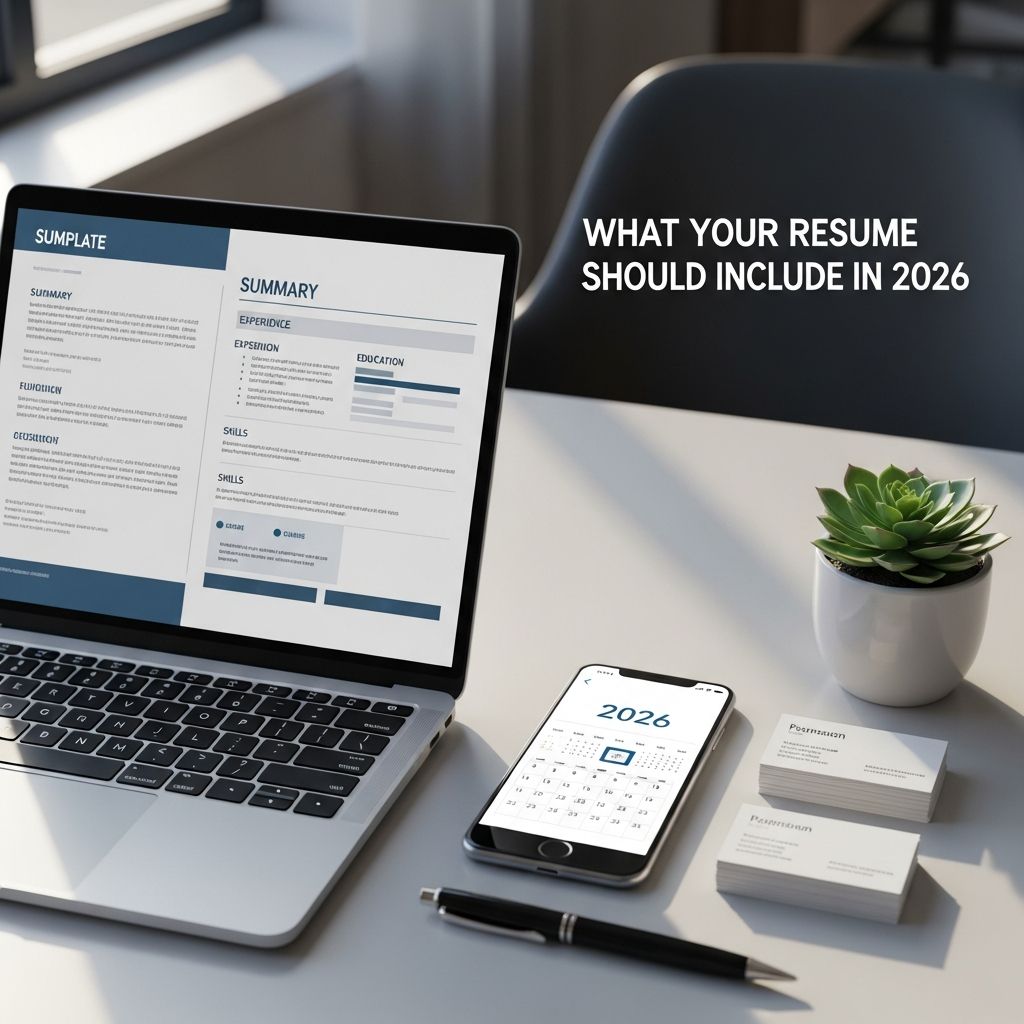
In the fast-evolving job market of 2026, your resume remains your first impression and primary tool for landing interviews. With applicant tracking systems (ATS) screening 75% of resumes before human eyes see them, and hiring managers spending an average of 7.4 seconds scanning each one, crafting a targeted, scannable document is crucial. This guide covers every essential element your resume must include, drawing from timeless principles updated for AI-driven recruitment, remote work trends, and skill-based hiring. Whether you’re a recent graduate, career changer, or seasoned professional, these components will position you for success.
Contact Information
Start strong with prominent, professional contact details at the top of your resume. Include your full name in bold, larger font (24-30pt), phone number with area code, professional email (e.g., firstname.lastname@gmail.com, not partyanimal2000@yahoo.com), LinkedIn profile URL, and optionally your GitHub or portfolio site if relevant to the field. In 2026, add a professional headshot only if applying internationally or in creative industries—U.S. employers generally prefer not to see photos to avoid bias. Location should list city and state, not full address, to protect privacy. Hyperlink URLs for easy clicking in digital formats. This section ensures recruiters can reach you instantly without hunting.
- Full name: Jane Doe
- Phone: (123) 456-7890
- Email: jane.doe@email.com
- LinkedIn: linkedin.com/in/janedoe
- Location: Seattle, WA
Pro tip: Use a consistent color scheme (navy blue hyperlinks on white background) for a polished look that passes ATS parsing.
Professional Summary or Objective
The 3-5 sentence summary replaces the outdated objective statement. Tailor it to the job, highlighting your years of experience, top skills, and unique value proposition. For example: “Results-driven marketing manager with 8+ years in digital strategy, boosting ROI by 40% across e-commerce platforms. Expert in SEO, content optimization, and AI-driven analytics. Seeking to drive growth at innovative tech firms.” Mid-career pros emphasize achievements; entry-level candidates focus on transferable skills and enthusiasm. This section hooks the reader, incorporating job description keywords for ATS compatibility.
Avoid generic phrases like “hard worker”—quantify impact instead. In 2026, weave in trending skills like AI literacy or hybrid team leadership to stand out.
Skills Section
Dedicate a prominent section to 8-12 bullet-pointed skills, categorized if space allows (e.g., Technical, Soft, Tools). Prioritize those matching the job posting: hard skills like Python, Salesforce, or Adobe Suite first, followed by soft skills like agile project management or cross-functional collaboration. Use ATS-friendly formatting—no graphics, tables, or acronyms without expansion.
| Technical Skills | Soft Skills | Tools & Platforms |
|---|---|---|
| Python, SQL, Machine Learning | Leadership, Communication | AWS, Tableau, Slack |
| SEO/SEM, Google Analytics | Problem-Solving, Adaptability | HubSpot, Figma |
This skimmable format helps recruiters match you to roles in seconds. Update quarterly to reflect emerging tech like generative AI tools.
Professional Experience
The core of your resume: List jobs in reverse chronological order, with company name, title, location, and dates (month/year format, e.g., Jan 2022 – Present). Limit to 10-15 years unless earlier roles add unique value. Each position gets 4-6 bullets starting with strong action verbs (e.g., “Led,” “Optimized,” “Generated”).
Focus on achievements, not duties: Swap “Managed social media” for “Grew Instagram following 150% in 6 months, generating $200K in leads.” Use STAR method (Situation, Task, Action, Result) implicitly. Quantify wherever possible: percentages, dollars, numbers. For gaps, use neutral phrasing like “Career Break for Family” or highlight freelance/upskilling.
- Senior Developer, TechCorp, Remote – Jun 2023 – Present
- Developed scalable microservices architecture, reducing downtime by 99% and saving $150K annually.
- Mentored 5 junior devs, accelerating team velocity by 30%.
- Software Engineer, Innovate Inc., San Francisco, CA – Jan 2020 – May 2023
- Integrated AI chatbots, improving customer response time by 60%.
In 2026, highlight remote/hybrid experience and tools like Zoom or Notion to appeal to distributed teams.
Education
Place after experience unless you’re a recent grad. Include degree, major, institution, graduation year (omit if 10+ years ago to avoid age bias), and GPA (3.5+ only). Add relevant coursework, honors, or certifications (e.g., Google Data Analytics, PMP).
- B.S. Computer Science, University of Washington, 2019
- Dean’s List, 3.8 GPA
- Certifications: AWS Certified Developer (2025), Certified ScrumMaster (2024)
For non-traditional paths, list bootcamps or online credentials prominently.
Certifications and Awards
A dedicated section for credibility boosters. List with issuing body, date earned, and a brief benefit (e.g., “PMP Certification, PMI – 2024: Enabled leading $5M projects on time/budget.”). In 2026, prioritize in-demand certs like cybersecurity (CompTIA Security+), cloud (Azure Fundamentals), or sustainability (LEED).
- AWS Solutions Architect – Associate, Amazon Web Services, 2025
- Digital Marketing Professional, Google, 2024
- Employee of the Year, TechCorp, 2023
Projects and Portfolio
Essential for tech, design, and creative fields. Describe 3-5 personal or open-source projects with links, tech stack, and outcomes. Example: “E-Commerce Dashboard (GitHub: github.com/jdoe/dashboard): Built React/Node app analyzing 10K+ sales records, deployed on Vercel.” This demonstrates initiative and real-world skills beyond job descriptions.
Volunteer Work and Extrurriculars
Include if relevant or space allows, especially for entry-level applicants. Frame like professional experience: “Volunteer Coordinator, Local Food Bank – Organized events serving 500+ families, honing logistics skills.” Ties into soft skills like teamwork and leadership.
Technical Considerations for ATS and Formatting
ATS systems from Taleo, Workday, and iCIMS parse 90% of resumes. Use standard fonts (Arial, Calibri 10-12pt), 1-inch margins, PDF export (unless Word requested), and keyword density matching the job (e.g., “project management” if listed). Test with free tools like Jobscan. Avoid headers/footers, images, or fancy graphics—they garble parsing. Length: 1 page for <10 years experience, 2 pages max otherwise.
- Save as PDF for formatting fidelity
- Plain text version for email/copy-paste applications
- Standard section headings: “Experience,” not “Work History”
Frequently Asked Questions (FAQs)
What if I have employment gaps?
Address briefly in experience or cover letter: “Career Break 2022-2023: Pursued professional development in AI/ML via Coursera.” Focus on positives.
Should I include references?
No—”References available upon request” is optional and outdated. Provide separately if asked.
One-page or two?
One page ideal for most; executives/seniors can extend to two with dense achievements.
How often should I update?
Quarterly, or after every new accomplishment/certification. Tailor per application.
Is a cover letter still needed?
Yes, 40% of jobs require it. Customize to explain fit and passion.
Final Tips for Resume Success in 2026
Proofread ruthlessly—use Grammarly and a friend. Get feedback from LinkedIn peers. Track applications in a spreadsheet. Network alongside applying; 70% of jobs fill via referrals. Your resume opens doors—pair it with a strong LinkedIn profile and interview prep for the win.
References
- National Association of Colleges and Employers (NACE) Recruiting Benchmarks Survey — NACE. 2025. https://www.naceweb.org/talent-acquisition/trends-and-predictions/recruiting-benchmarks-2025/
- Jobscan ATS Research Report — Jobscan. 2025-06-15. https://www.jobscan.co/ats-research-report/
- U.S. Bureau of Labor Statistics: Occupational Outlook Handbook — U.S. Department of Labor. 2025-09-01. https://www.bls.gov/ooh/
- TheLadders Eye-Tracking Study on Resume Reading — TheLadders. 2024 (reaffirmed 2025). https://www.theladders.com/career-advice/eye-tracking-study-resume
- LinkedIn Economic Graph Research: Skills-Based Hiring — LinkedIn. 2025-11-12. https://economicgraph.linkedin.com/research/skills-based-hiring
Similar Articles







Read full bio of Sneha Tete