Types Of Annuities: 5 Key Options For Retirement Income
Explore fixed, variable, indexed, immediate, and deferred annuities to find the best fit for your retirement income strategy and financial goals.
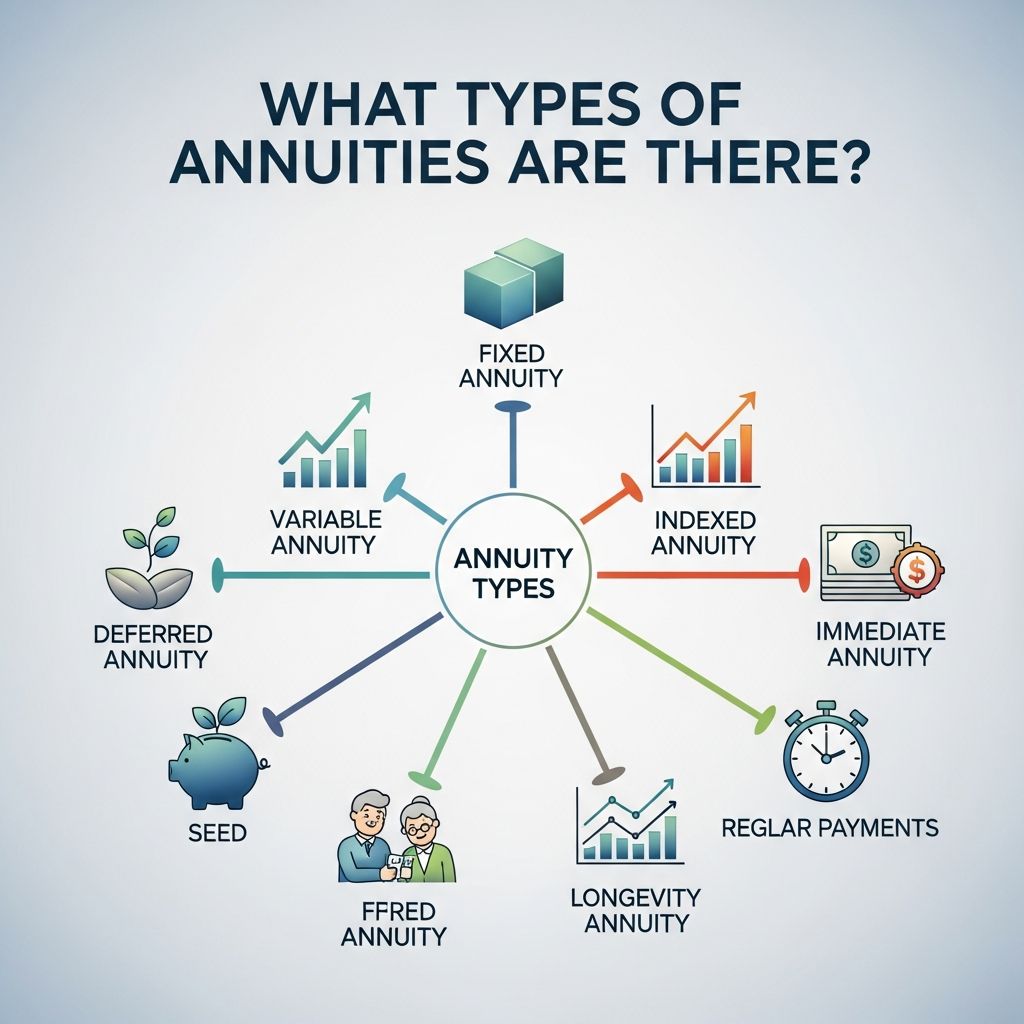
Annuities are financial products designed to provide steady income, often for retirement, by converting premiums into guaranteed payments. They come in various types categorized by risk level, payout timing, and growth potential, helping individuals tailor solutions to their financial needs.
What Is an Annuity?
An annuity is a contract between you and an insurance company where you pay premiums in exchange for future payments. These can offer tax-deferred growth, principal protection in some cases, and lifelong income streams. Annuities suit retirees seeking to manage longevity risk—the chance of outliving savings—while balancing safety and growth.
Key benefits include predictable income, tax advantages, and customization through riders like death benefits or long-term care coverage. However, they often have surrender charges for early withdrawals and fees that reduce returns.
Main Types of Annuities by Investment Risk
Annuities primarily divide into
fixed
,fixed indexed (or indexed)
, andvariable
based on how returns are generated and risk exposure. Fixed options prioritize safety, indexed blend protection with upside, and variable tie performance to markets.1. Fixed Annuities
**Fixed annuities** guarantee a minimum interest rate set by the insurer, unaffected by market volatility. Your principal is protected, and payouts remain steady, making them ideal for conservative investors wanting reliable income without stock market worries.
They grow at a declared rate, often higher than CDs for multi-year terms. Payments can be for a set period or lifetime. Common subtypes include:
- Multi-Year Guaranteed Annuity (MYGA): Locks in a rate for 2-10 years, e.g., 4.8% annually, offering predictable growth.
- Single Premium Immediate Annuity (SPIA): Converts a lump sum into income starting within a year, perfect for immediate paycheck replacement.
Example: A 67-year-old retiree invests $100,000 in a 5-year MYGA at 4.8%, earning steady, guaranteed returns regardless of economic conditions.
2. Variable Annuities
**Variable annuities** invest premiums in subaccounts like mutual funds (stocks, bonds). Returns fluctuate with market performance, offering high growth potential but no principal guarantee—payouts can decrease if investments underperform.
Suitable for risk-tolerant investors comfortable with volatility for tax-deferred growth and optional riders like lifetime withdrawal guarantees. They may include death benefits passing untouched value to heirs.
Risks include market losses and higher fees for management and riders. Best for those with long horizons seeking upside.
3. Indexed Annuities
**Indexed annuities** (fixed index or registered index-linked) link returns to a market index like the S&P 500, with principal protection via floors (minimum rate, often 0-1%) and caps on gains.
They provide moderate growth without full market downside, balancing fixed safety and variable potential. Features include participation rates (percentage of index gain credited) and buffers against losses in registered index-linked annuities (RILAs).
Ideal for balanced portfolios wanting some equity exposure with safeguards.
Comparison Table: Annuities by Risk
| Feature | Fixed Annuity | Indexed Annuity | Variable Annuity |
|---|---|---|---|
| Risk Level | Lowest – Guaranteed | Moderate – Index-tied with protection | Highest – Market-dependent |
| Growth Potential | Low, predictable | Moderate, capped | High, uncapped |
| Principal Protection | Yes | Yes (floors/buffers) | No |
| Best For | Conservative retirees | Balanced investors | Risk-tolerant growth seekers |
Types of Annuities by Payout Timing
Annuities also classify as
immediate
ordeferred
based on when payments begin.4. Immediate Annuities
**Immediate annuities**, often SPIAs, start payouts within 12 months of a single premium payment. Funded by lump sums from savings or rollovers, they provide instant income for retirees needing to replace paychecks.
Options include lifetime payments, period-certain (e.g., 10 years), or joint-life for couples. They offer longevity protection but limited liquidity.
5. Deferred Annuities
**Deferred annuities** accumulate value tax-deferred before payouts start later, often at retirement. Flexible funding via lump sum or installments suits long-term planning.
Subtypes mirror risk categories: deferred fixed (steady growth), indexed (market-linked protection), or variable (investment-driven). Annuitization converts accumulation to income streams.
Comparison Table: Immediate vs. Deferred
| Feature | Immediate Annuity | Deferred Annuity |
|---|---|---|
| Payments Start | Within 12 months | Years later |
| Funding | Typically lump sum | Lump sum or flexible |
| Growth | Minimal, immediate focus | Tax-deferred accumulation |
| Best For | Current retirees | Pre-retirees planning ahead |
Specialized Annuity Products
Beyond basics, specialized annuities address niche needs:
- Qualified Longevity Annuity Contract (QLAC): Delays required minimum distributions (RMDs) from IRAs until age 85, managing tax and longevity risks.
- Registered Index-Linked Annuity (RILA): Offers index growth with buffers limiting losses (e.g., -10% max loss).
- Long-Term Care Annuity: Combines annuity income with coverage for nursing home costs via riders.
These enhance flexibility for complex retirement scenarios.
How to Choose the Right Annuity
Selecting an annuity depends on risk tolerance, timeline, income needs, and goals. Conservative savers favor fixed or immediate for stability; growth-oriented choose variable or indexed.
- Assess fees, surrender periods (often 7-10 years), and insurer ratings (A.M. Best, etc.).
- Consider tax status: qualified (pre-tax) vs. non-qualified (after-tax).
- Consult advisors; shop via independent agents for best rates.
Example scenarios:
- Immediate need: SPIA for steady checks.
- Growth with safety: Fixed indexed.
- High upside: Variable with riders.
Frequently Asked Questions (FAQs)
What is the safest type of annuity?
Fixed annuities offer the lowest risk with guaranteed rates and principal protection.
Can annuities lose money?
Fixed and indexed typically protect principal; variable can lose value due to market declines.
Are annuities worth it for retirement?
Yes for those needing guaranteed income to hedge longevity risk, but weigh fees against benefits.
How much does an immediate annuity pay?
Varies by age, amount, and rates; e.g., $100,000 at 65 might yield $500-600/month for life.
What’s the difference between indexed and variable annuities?
Indexed caps gains but protects principal; variable has uncapped potential but full downside risk.
Pros and Cons of Annuities
Pros:
- Guaranteed lifetime income options.
- Tax-deferred growth.
- Principal protection in fixed/indexed.
- Customizable riders for care, death benefits.
Cons:
- High fees and commissions.
- Limited liquidity (surrender penalties).
- Inflation risk eroding fixed payments.
- Complexity requiring professional advice.
Annuities complement Social Security and pensions, forming a diversified retirement pillar when chosen wisely.
References
- Types of Annuities Made Easy – Which is Right for You? — Annuity.org. 2023. https://www.annuity.org/annuities/types/
- What are the Different Types of Annuities? — Equifax. 2024. https://www.equifax.com/personal/education/personal-finance/articles/-/learn/what-types-of-annuities-are-there/
- Annuities Explained: Types, Benefits, & How They Work — Guardian Life. 2024. https://www.guardianlife.com/annuities
- What Are the Various Types of Insured Annuities? — American Academy of Actuaries. 2022-08-01. https://www.actuary.org/sites/default/files/2022-08/IB.Annuities.8.22.pdf
- Annuities | FINRA.org — FINRA. 2024. https://www.finra.org/investors/investing/investment-products/annuities
- Types of Annuities — NC Department of Insurance. 2024. https://www.ncdoi.gov/consumers/annuities/types-annuities
Similar Articles








Read full bio of medha deb