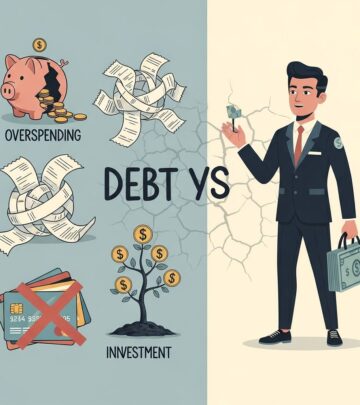
What to Do If You’re Terrible With Money
Practical steps to regain control over your finances, even if you've always struggled with money management and debt.

Admitting you’re terrible with money is the first step toward improvement. Many people, including personal finance experts, have been there—struggling to make, save, or even track spending. The good news is you don’t need advanced skills or hours of effort to turn things around. Simple actions like listing debts, making minimum payments anywhere, and using a basic budgeting rule can build momentum quickly.
This guide outlines low-effort strategies to tackle spending, earning, and debt. These steps helped transform chaotic finances into manageable ones, even during broke periods. Start small to avoid overwhelm.
1. Figure out Where You Owe Money
Ignoring bills leads to a snowball of debt from student loans, credit cards, medical expenses, or other sources. Avoiding calls or mail only makes it worse, as interest accrues unnoticed.
To begin:
- Pull credit reports from AnnualCreditReport.com (free weekly) to list all debts, balances, and creditors.
- Gather statements for loans, cards, and utilities.
- Create a simple list: creditor name, total owed, minimum payment, interest rate.
This visibility ends the ‘head in the sand’ cycle. One person shared how ignoring debt grew it uncontrollably until facing it head-on. According to the Federal Reserve, U.S. household debt hit $17.5 trillion in 2023, with credit card balances surging—highlighting how common this issue is.
2. Start Paying Someone — Anyone — Back
Once debts are listed, action beats perfection. Pay anything toward any debt to build habit and momentum. Even $5 shows creditors you’re serious and can halt collection escalation.
Why it works:
- Stops penalties and fees.
- Boosts credit score via on-time payments.
- Creates psychological wins.
Prioritize high-interest debts later, but starting anywhere prevents total paralysis. The Consumer Financial Protection Bureau (CFPB) recommends this ‘debt snowball’ or ‘avalanche’ approach, starting with smallest or highest-interest first after initial payments.
3. Cut Up Your Credit Cards (or at Least Stop Using Them)
Credit cards enable overspending with high interest (up to 24% APR), trapping you in cycles where payments barely dent principal. Americans carry over $1 trillion in credit card debt, normalized but costly.
Steps to break free:
- Pay off balances before cutting, or transfer if possible.
- Physically destroy cards or freeze them in ice for emergencies only.
- Switch to debit or cash for purchases to match spending to income.
This forces living within means. Track progress monthly to stay motivated.
4. Create a Super-Simple Budget (No Spreadsheet Required)
Traditional budgets fail because life changes—groceries or gas vary monthly. Instead, use the proven 50/30/20 rule for effortless control.
How it divides after-tax income:
| Category | Percentage | Examples |
|---|---|---|
| Essentials | 50% max | Housing, food, utilities, minimum debt payments |
| Personal Spending | 30% | Dining out, entertainment, clothes, vacations |
| Financial Goals | 20% | Extra debt paydown, retirement savings, emergency fund |
Example: $3,000 monthly income → $1,500 essentials, $900 fun, $600 goals. Adjust as needed; no tracking apps required initially. Senator Elizabeth Warren popularized this in ‘All Your Worth,’ backed by financial stability research.
5. Find a Bank Account That Doesn’t Hate Poor People
Fees erode low balances: monthly charges, overdrafts, ATMs. Choose accounts minimizing these.
Key factors:
- Minimum balance/deposit: Zero or low.
- Monthly fees: Waivable or none.
- ATM fees: Free network access.
- Overdraft policy: Opt-out or no-fee declines.
Options like Chime, Ally, or credit union accounts fit. FDIC data shows overdraft fees cost Americans $8.5 billion yearly—avoidable with smart choices[10].
6. Turn All Your Confusing Debts Into One Simpler Debt
Multiple payments with varying rates overwhelm. Consolidate via personal loan or balance transfer for one lower-rate payment.
Benefits:
- Simplifies tracking.
- Lowers interest (e.g., 10% vs. 24%).
- Fixed term ends debt faster.
Check credit first; good for 670+ scores. CFPB warns of scams—use reputable lenders.
7. Make More Money (Without Getting a Second Job)
Boost income easily: sell unused items, negotiate bills, cancel subscriptions, or monetize skills online.
Quick wins:
- Sell stuff: eBay, Facebook Marketplace for clothes, gadgets.
- Negotiate: Cable, insurance rates drop 10-20% often.
- Side cash: Surveys (Swagbucks), plasma donation.
Bureau of Labor Statistics notes gig economy growth aids supplemental income without full jobs[11].
8. Stop normalized Bad Habits Like Overspending
We’ve normalized credit debt, living beyond means, vague budgeting. Counter with awareness:
- Spend less than earned.
- Track big categories weekly.
- Audit subscriptions quarterly.
These shifts save thousands yearly.
9. Sell All the Stuff You Never Needed in the First Place
Impulse buys clutter homes and drain cash. Declutter for profit: list 10 items weekly.
Average American household has $4,000+ unused goods worth selling, per surveys. Platforms like Poshmark specialize in clothes, others for electronics.
Frequently Asked Questions (FAQs)
Q: What if I can’t afford minimum payments?
A: Contact creditors for hardship plans; nonprofits like NFCC offer free counseling.
Q: Is the 50/30/20 rule for everyone?
A: Adapt for high-cost areas, but it provides a flexible starting point.
Q: How long to become good with money?
A: Habits form in 3-6 months with consistency; track small wins.
Q: What’s the fastest debt payoff method?
A: Debt avalanche (highest interest first) saves most money.
Q: Should I close old accounts after payoff?
A: Keep open for credit history length; use responsibly.
References
- Financial Advice for Anyone Who’s Ever Been Terrible With Money — The Penny Hoarder. 2023. https://www.thepennyhoarder.com/save-money/what-to-do-if-youre-terrible-with-money/
- 6 Money Habits We’ve Normalized (And Why It’s Time to Stop) — The Penny Hoarder. 2023. https://www.thepennyhoarder.com/save-money/normalized-habits/
- Consumer Credit – G.19 — Federal Reserve Board. 2024-01-10. https://www.federalreserve.gov/releases/g19/current/
- Debt Collection — Consumer Financial Protection Bureau. 2024-05-15. https://www.consumerfinance.gov/consumer-tools/debt-collection/
- All Your Worth: The Ultimate Lifetime Money Plan — Elizabeth Warren & Amelia Warren Tyagi. 2006 (relevant standard). https://www.consumerfinance.gov/about-us/blog/50-30-20-budget-rule/
- FDIC National Survey of Unbanked and Underbanked Households — FDIC. 2023-12-15. https://www.fdic.gov/analysis/household-survey/2023/2023report.pdf
- Consumer Expenditure Survey — Bureau of Labor Statistics. 2024-09-10. https://www.bls.gov/cex/
Similar Articles








Read full bio of medha deb