What Is Unsystematic Risk? Definition & Examples
Learn how unsystematic risk affects individual investments and portfolios, and how diversification can help mitigate company-specific risks.
What Is Unsystematic Risk?
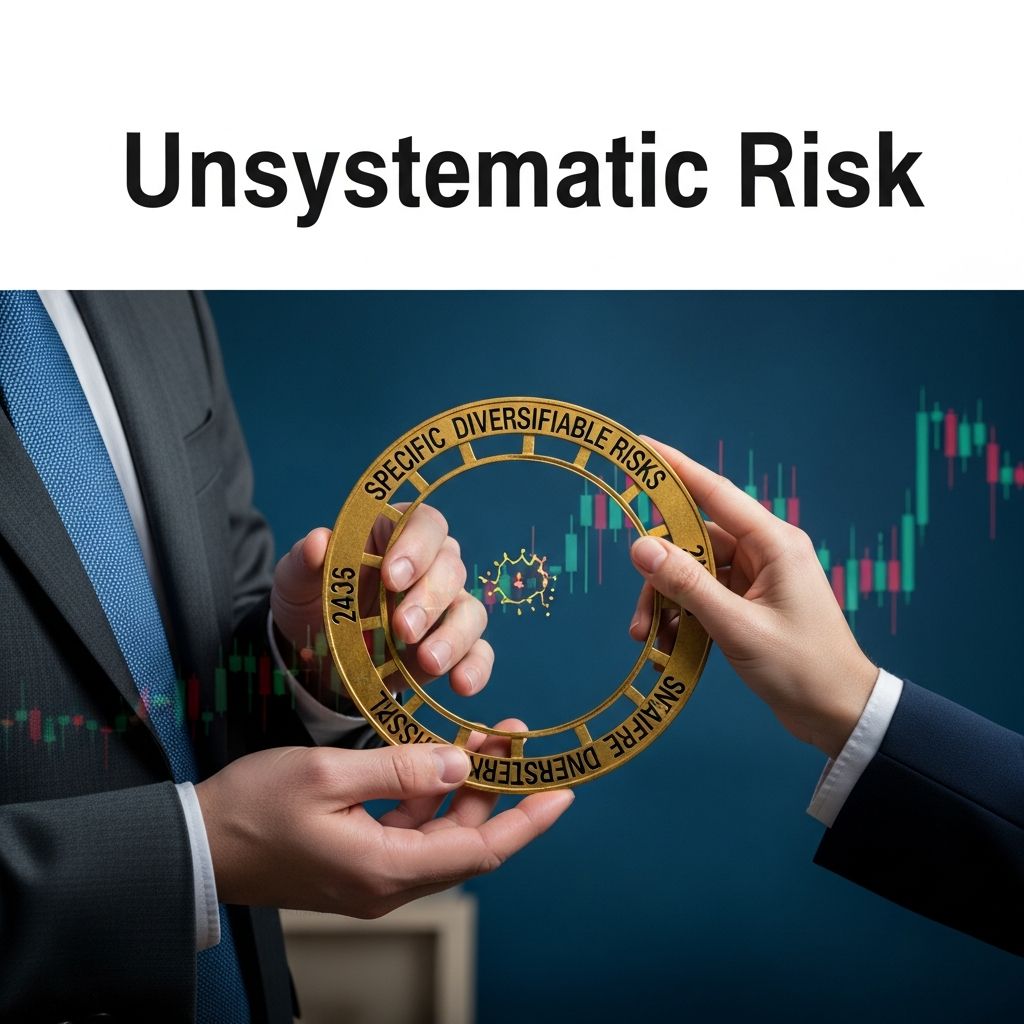
Unsystematic risk, also known as diversifiable risk, company-specific risk, idiosyncratic risk, or residual risk, refers to the uncertainty associated with an investment in a specific firm or industry. Unlike systematic risk, which affects the entire market or economy, unsystematic risk is unique to individual securities or particular sectors. This type of risk arises from factors that influence only a specific company or industry rather than the broader financial markets.
Understanding unsystematic risk is crucial for investors who want to build effective investment portfolios. The fundamental characteristic of unsystematic risk is that it can be significantly reduced or eliminated through strategic portfolio diversification. By spreading investments across different companies, industries, and asset classes, investors can effectively hedge against company-specific risks.
The concept of unsystematic risk is grounded in modern portfolio theory, which emphasizes that investors should not accept risk without proper compensation. When investors concentrate their holdings in a single stock or industry without diversifying, they expose themselves to unnecessary unsystematic risk for which they receive no additional reward.
Understanding the Difference: Unsystematic Risk vs. Systematic Risk
To fully grasp unsystematic risk, it’s essential to understand how it differs from systematic risk. These two types of risk form the total risk inherent in any investment portfolio.
Unsystematic Risk Characteristics
Unsystematic risk is company-specific or industry-specific in nature. It stems from internal factors within an organization or conditions affecting a particular industry sector. This type of risk can be mitigated through portfolio diversification, making it technically avoidable through prudent investment strategies. Examples include unexpected supply chain disruptions, management changes, product recalls, labor disputes, and regulatory changes affecting a specific company or sector.
Systematic Risk Characteristics
Systematic risk, also referred to as market risk, is inherent to the entire economy and global financial markets. It cannot be reduced through diversification because it affects all investments regardless of their diversity. Systematic risk arises from macroeconomic factors including interest rate changes, inflation, economic recessions, geopolitical conflicts, currency fluctuations, and market crashes. For example, during the COVID-19 pandemic, systematic risk impacted essentially all industries simultaneously, making diversification ineffective in mitigating losses.
Key Differences Between the Two Risk Types
| Aspect | Unsystematic Risk | Systematic Risk |
|---|---|---|
| Scope | Company or industry-specific | Affects entire market/economy |
| Diversifiability | Can be reduced through diversification | Cannot be reduced through diversification |
| Examples | Management decisions, product recalls, labor disputes | Interest rate changes, inflation, recessions |
| Compensation | No compensation for accepting it without diversifying | Investors compensated through risk premium |
Sources and Types of Unsystematic Risk
Unsystematic risk can originate from multiple sources within a company or industry. Understanding these sources helps investors identify and manage potential risks in their portfolios.
Operational Risk
Operational risk encompasses uncertainties arising from how a company conducts its business. This includes discretionary management decisions that may impact company performance, such as capital allocation strategies, acquisition decisions, or strategic pivots. Company-specific corporate actions like dividend announcements, share splits, or restructuring initiatives can also create operational risk.
Business Risk
Business risk relates to the fundamental performance drivers of a company’s core operations. Factors such as product quality, brand reputation, customer loyalty, and market share fluctuations all contribute to business risk. A company that fails to innovate or maintain product quality faces elevated business risk. Changes in consumer preferences can significantly impact companies dependent on specific product categories.
Regulatory Risk
Regulatory risk arises from changes in laws, regulations, or compliance requirements affecting specific industries or companies. Examples include antitrust actions, environmental regulations, healthcare compliance rules, and industry-specific licensing requirements. A regulatory change can dramatically alter a company’s profitability or operational capabilities.
Industry Risk
Industry risk stems from competitive dynamics within a specific sector. Factors include the competitive landscape, market positioning of competitors, entry of new market participants, technological disruption, and industry consolidation. For instance, the energy sector experienced significant unsystematic risk in 2016 when oil prices plummeted, causing energy stocks to decline sharply despite broader market stability.
Financial and Credit Risk
Financial risk relates to a company’s capital structure and financing decisions. Companies with high leverage face greater financial risk because debt obligations must be met regardless of business performance. Credit risk reflects the possibility that a company may default on its obligations, especially during economic downturns when revenues decline.
Additional Sources of Unsystematic Risk
Other specific sources of unsystematic risk include labor strikes, supply chain disruptions, natural disasters affecting specific facilities, key personnel departures, litigation outcomes, intellectual property disputes, and technology obsolescence. Each of these factors affects individual companies or industries rather than the broader market.
How Portfolio Diversification Mitigates Unsystematic Risk
The most effective method for managing unsystematic risk is portfolio diversification. By strategically including uncorrelated assets across different companies, industries, and asset classes, investors can substantially reduce the impact of company-specific risks.
The Diversification Strategy
Effective diversification involves investing in assets that don’t move in tandem with each other. When one investment experiences losses due to unsystematic risk, other non-correlated investments may maintain or increase in value, offsetting the decline. The theory underlying diversification is that spreading risk across multiple investments prevents any single company-specific setback from significantly damaging overall portfolio returns.
Optimal Portfolio Size
Research demonstrates that most unsystematic risk is eliminated when a portfolio contains approximately 20 or more stocks from several different sectors. As investors add more diversified holdings, the impact of any single company’s poor performance becomes increasingly negligible. However, diminishing returns occur as portfolio size increases beyond this optimal level.
Cross-Asset Diversification
Diversification becomes increasingly effective when it spans different asset classes, industries, and geographic regions. A portfolio combining stocks, bonds, commodities, and real estate across various sectors and countries provides superior unsystematic risk reduction compared to diversification within a single asset class. Geographic diversification helps protect against region-specific economic downturns or regulatory changes.
Limitations of Diversification
While diversification effectively reduces unsystematic risk, it cannot eliminate systematic risk. During market-wide downturns affecting all sectors simultaneously, diversification provides minimal protection. Additionally, diversification is not an absolute guarantee against losses. Extreme market conditions or unusually large systematic shocks can impact even well-diversified portfolios. Diversification’s effectiveness also depends on the actual correlation between investments; highly correlated assets provide limited diversification benefits.
Why Accepting Unsystematic Risk Without Diversification Is Uncompensated
A fundamental principle of modern portfolio theory states that investors should only accept additional risk when adequately compensated. When investors concentrate their portfolios in individual stocks or sectors without diversifying, they expose themselves to uncompensated risk—risk for which they receive no additional reward.
The stock market does not provide extra returns for accepting idiosyncratic, company-specific risk. On average, the market compensates investors only for systematic risk through the market risk premium. Investors accepting unsystematic risk effectively bet they can predict which companies will outperform, a task with no reliable method or consistent success rate. Without a valid reason to expect outperformance, taking concentrated positions exposes investors to unnecessary volatility with no expected compensation.
Practical Examples of Unsystematic Risk
Understanding unsystematic risk becomes clearer through real-world examples demonstrating how company and industry-specific events impact individual investments.
Product Recall: An automobile manufacturer experiences a massive recall affecting millions of vehicles. While the broader market continues functioning normally, the company’s stock may decline significantly due to liability exposure, reputation damage, and operational disruption. Other automotive manufacturers may not be similarly affected, demonstrating the company-specific nature of this risk.
Management Change: A technology company announces its CEO is leaving unexpectedly. Market uncertainty about succession planning and strategic direction may cause the stock to decline, even if the broader tech sector remains stable. Investors with diversified portfolios containing multiple technology stocks experience minimal portfolio impact.
Regulatory Change: A pharmaceutical company’s primary drug fails FDA approval while competitors’ drugs receive approval. This regulatory setback creates unsystematic risk specific to that company, affecting its stock price independently of broader pharmaceutical or market trends.
Supply Chain Disruption: A manufacturing company experiences unexpected supply chain shutdowns due to natural disasters or geopolitical events affecting specific suppliers. Competitors with diversified supply chains may continue operations normally, creating company-specific performance divergence.
Measuring Unsystematic Risk
Investors and analysts measure unsystematic risk using statistical methods. Standard deviation quantifies the total volatility of a portfolio’s returns, reflecting both unsystematic and systematic components. As investors add diversified holdings, standard deviation typically decreases, demonstrating unsystematic risk reduction.
Financial analysts also use beta, which measures systematic risk relative to the market. The residual risk after accounting for beta represents unsystematic risk. Low-beta stocks naturally carry less systematic risk but may carry significant unsystematic risk if company-specific factors are volatile.
Frequently Asked Questions
Q: Can unsystematic risk be completely eliminated?
A: While unsystematic risk cannot be completely eliminated, it can be substantially reduced through proper diversification. Most unsystematic risk is removed with a portfolio of 20+ stocks across different sectors, though some residual unsystematic risk remains.
Q: Why is unsystematic risk called diversifiable risk?
A: Unsystematic risk is called diversifiable risk because its impact can be reduced by holding a diversified portfolio. Unlike systematic risk, which affects all investments equally, unsystematic risk affects individual companies or industries that can be balanced against other holdings.
Q: Is all stock-specific risk unsystematic risk?
A: No. While most stock-specific risk is unsystematic, stocks also carry systematic risk related to broader market conditions. Total stock risk comprises both unsystematic risk (company-specific) and systematic risk (market-wide).
Q: Should investors ever accept unsystematic risk?
A: Investors naturally accept some unsystematic risk when holding individual stocks, but they should minimize unnecessary unsystematic risk through diversification. Accepting concentrated unsystematic risk without expected compensation is generally not prudent.
Q: How does unsystematic risk affect bond portfolios?
A: Bond portfolios face unsystematic risk including credit risk (issuer default probability), liquidity risk, and issuer-specific events like downgradings. Diversifying across multiple bond issuers and types reduces unsystematic bond risk.
Q: Can international diversification reduce unsystematic risk?
A: Yes. Geographic diversification across multiple countries and regions adds an additional layer of unsystematic risk reduction, particularly for company-specific or region-specific economic conditions.
Conclusion
Unsystematic risk represents the company or industry-specific uncertainty inherent in individual investments. Unlike systematic risk, which affects entire markets and cannot be mitigated, unsystematic risk can be substantially reduced through strategic portfolio diversification. By understanding the sources of unsystematic risk—including operational, business, regulatory, industry, and financial risks—investors can make informed decisions about portfolio construction.
Accepting unsystematic risk without adequate diversification exposes investors to uncompensated risk with no expected additional returns. The market does not reward investors for taking company-specific risks that could have been eliminated through diversification. Prudent investors recognize that building diversified portfolios containing 20 or more stocks across multiple sectors, asset classes, and geographies effectively manages unsystematic risk while maintaining appropriate systematic risk exposure for their investment objectives.
References
- Unsystematic Risk | Definition + Examples — Wall Street Prep. 2024. https://www.wallstreetprep.com/knowledge/unsystematic-risk/
- Systematic and Unsystematic Risk — ICFS, Inc. 2024. https://icfs.com/financial-knowledge-center/systematic-and-unsystematic-risk
- Unsystematic Risk – Meaning, Types, Examples & Benefits — Bajaj Finserv. 2024. https://www.bajajfinserv.in/what-is-unsystematic-risk
- A Guide to Types of Investment Risk — National Council on Aging. 2024. https://www.ncoa.org/article/a-guide-to-types-of-investment-risk/
- Idiosyncratic Risk – Definition, Types, Examples — Corporate Finance Institute. 2024. https://corporatefinanceinstitute.com/resources/career-map/sell-side/risk-management/idiosyncratic-risk/
- Unsystematic Risk Definition — Nasdaq. 2024. https://www.nasdaq.com/glossary/u/unsystematic-risk
Similar Articles








Read full bio of medha deb