Trans-Pacific Partnership Explained: Origins, Impact, CPTPP
Understanding the TPP: A comprehensive trade agreement reshaping Asia-Pacific economics and global commerce.
What Is the Trans-Pacific Partnership?
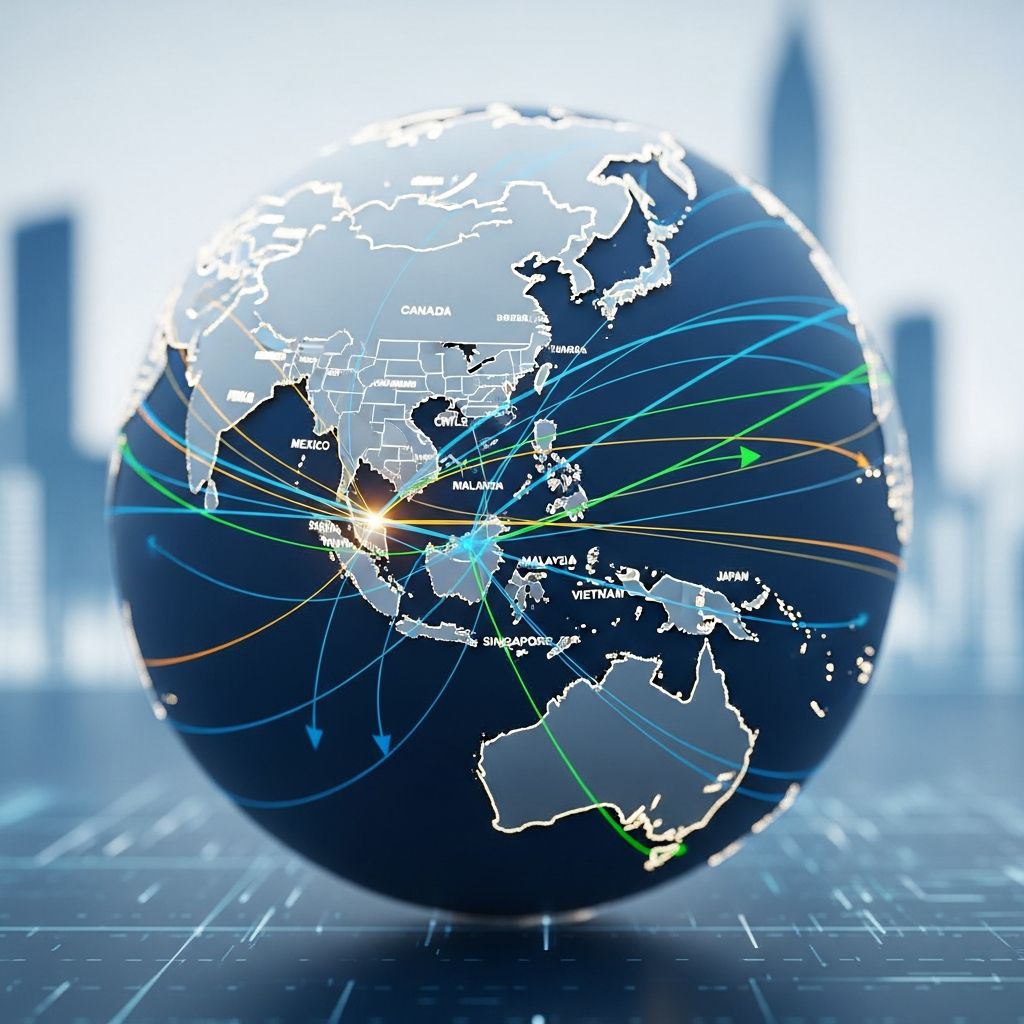
The Trans-Pacific Partnership (TPP) was a massive multilateral trade agreement negotiated among twelve Pacific Rim countries, representing approximately 40 percent of global GDP and one-third of world trade. The agreement aimed to create a comprehensive economic framework that would eliminate trade barriers, establish consistent rules for global investment, and promote economic integration across the Asia-Pacific region. The TPP was signed in early 2016 after nineteen official rounds of negotiations, representing one of the most ambitious trade agreements in modern history. Though the United States ultimately did not ratify the agreement, the remaining eleven signatories continued with the pact, creating the Comprehensive and Progressive Agreement for Trans-Pacific Partnership (CPTPP).
The Origins and Development of the TPP
The journey toward the TPP began well before its formal negotiations with the United States. The impetus originated from a 2005 trade agreement between four Pacific Rim countries—Brunei, Chile, New Zealand, and Singapore—known as the Trans-Pacific Strategic Economic Partnership Agreement (TPSEP or P4). This initial agreement laid the groundwork for what would eventually become a much larger undertaking.
In 2008, President George W. Bush announced that the United States would begin trade talks with this original group of four countries. This decision marked a significant shift in American trade policy and opened the door for expansion. Following this announcement, several additional nations expressed interest in joining the negotiations. Australia, Vietnam, and Peru joined the talks, followed by Canada, Japan, Malaysia, and Mexico, bringing the total number of participating countries to twelve.
When President Barack Obama took office in 2009, he demonstrated strong commitment to the TPP, continuing and accelerating the trade talks initiated by his predecessor. In 2011, Secretary of State Hillary Clinton framed the TPP as the centerpiece of the United States’ strategic pivot to the Asia-Pacific region, signaling its importance to American foreign policy and economic strategy. After extensive negotiations spanning multiple official rounds and countless separate bilateral meetings, the participating countries reached an agreement in October 2015 and formally signed the pact in early 2016.
The Twelve Signatory Countries
The TPP brought together twelve nations with diverse economies and geographic locations:
– Australia- Brunei- Canada- Chile- Japan- Malaysia- Mexico- New Zealand- Peru- Singapore- Vietnam- United States
This diverse coalition represented a significant portion of global economic activity and reflected a deliberate strategy to create a counterbalance to China’s growing economic influence in the region.
Comprehensive Scope and Content of the Agreement
The TPP was exceptionally comprehensive, consisting of thirty chapters that addressed nearly every aspect of international trade and commerce. The agreement went far beyond the standards established by the World Trade Organization, incorporating innovative provisions addressing twenty-first-century trade issues.
The key areas covered by the TPP included:
– Tariffs on goods and services- Intellectual property (IP) rights protection- E-commerce rules and regulations- Labor standards and protections- Environmental standards and commitments- Dispute resolution mechanisms- Investment regulations and protections- Government procurement rules- Competition policy- Rules regarding state-owned enterprises- Technical barriers to trade- Sanitary and phytosanitary measures
The agreement employed a negative-list approach for trade liberalization, meaning all sectors were covered for trade liberalization except those explicitly excluded by member states. This comprehensive approach distinguished the TPP from traditional trade agreements and reflected the complexities of modern global commerce.
Tariff Elimination and Market Access
One of the most significant aspects of the TPP was its commitment to dramatic tariff reduction. The agreement called for the elimination of over 18,000 tariffs between member countries. Tariffs on all U.S. manufactured goods and almost all U.S. farm products would have been eliminated, with most eliminations occurring immediately upon implementation.
According to the Congressional Research Service, the TPP would have been the largest U.S. free trade agreement by trade flows, encompassing $905 billion in U.S. goods and services exports and $980 billion in imports in 2014. This substantial economic commitment demonstrated the agreement’s potential to reshape trade relationships across the Asia-Pacific region.
Key Objectives and Strategic Goals
The United States had several overarching objectives for the TPP negotiations. The primary goal was to create a fully integrated economic area with consistent rules for global investment, ensuring that the United States—rather than countries like China—would be writing the rules for the world’s economy in the twenty-first century.
Specific U.S. objectives included:
– Elimination of tariffs and commercially-meaningful market access for American products- Provisions addressing non-tariff barriers, including import licensing requirements- Liberalized access for U.S. investment in TPP markets- Protection against unlawful expropriation and performance requirements- Strong intellectual property protections- Fair and transparent government procurement rules- High labor standards and environmental commitments- Development and trade capacity-building initiatives
The agreement sought to establish fair, transparent, and non-discriminatory rules to govern trade and investment throughout the region, while simultaneously promoting innovation and technological advancement.
Intellectual Property and Innovation
The TPP included groundbreaking provisions for intellectual property protection that went significantly beyond previous trade agreements. These provisions aimed to promote an open, innovative, and technologically-advanced Asia-Pacific region, accelerating invention and creation of new products and industries across TPP countries. The agreement ensured that all TPP countries could draw on the full benefits of scientific, technological, and medical innovation while allowing participation in the development and enjoyment of new media and the arts.
Labor and Environmental Standards
The TPP introduced strong and enforceable labor standards and environmental commitments that were among the most comprehensive in any trade agreement. These provisions reflected an understanding that economic growth must be balanced with worker protections and environmental sustainability. The agreement addressed labor codes and practices across member nations, setting expectations for fair working conditions and worker rights.
Investment Protection and State-Owned Enterprise Regulations
The agreement included an investor-state dispute settlement (ISDS) mechanism that allowed private corporations to seek compensation from governments for policies they believed violated the agreement. Additionally, the TPP included groundbreaking new rules designed to ensure fair competition between state-owned enterprises and private companies, addressing concerns about unfair advantages granted to government-controlled businesses.
Economic Impact Assessment
Multiple authoritative organizations assessed the potential economic impact of the TPP. The U.S. International Trade Commission, the Peterson Institute for International Economics, the World Bank, and the Office of the Chief Economist at Global Affairs Canada all stated that the final agreement, if ratified, would have led to net positive economic outcomes for all signatories.
The TPP represented the largest mega free trade area in history at the time of negotiation, encompassing forty percent of world trade. The agreement was designed to boost U.S. economic growth and support the creation and retention of high-quality American jobs by increasing exports in a region that includes some of the world’s most robust economies.
Political Opposition and Non-Ratification
Despite being signed in February 2016, the TPP was not ratified by the United States. The agreement faced significant domestic political opposition from both major political parties. Both Hillary Clinton and Donald Trump opposed the agreement during their 2016 presidential campaigns, reflecting broader concerns among American workers and certain interest groups about the potential impacts of the trade deal.
When Donald Trump became president, he made withdrawal from the TPP a priority, formally removing the United States from the agreement and ending American participation in the pact.
Evolution into the CPTPP
Following the U.S. withdrawal from the TPP, the remaining eleven signatory countries did not allow the agreement to collapse. Instead, they continued negotiations with the aim of salvaging a pact without American participation. Their efforts proved successful, leading to the development of the Comprehensive and Progressive Agreement for Trans-Pacific Partnership (CPTPP).
The CPTPP was signed in March 2018 and has already been ratified by a majority of member states. The agreement entered into force for participating countries on December 30, 2018, marking a significant milestone in regional trade integration. The CPTPP maintains the core principles and provisions of the original TPP while allowing for modifications to accommodate the absence of the United States.
Recent Developments and UK Accession
The CPTPP has continued to evolve and attract new members. On July 16, 2023, Kemi Badenoch, the UK business secretary, signed the accession protocol for the CPTPP, marking Britain’s formal entry into the trade bloc. The UK government claims that this agreement will provide British businesses with access to a market of 500 million people, resulting in significant benefits for the British economy.
However, critics argue that the economic impact of the deal over a 10-year period may be more limited than proponents suggest, requiring careful monitoring of actual outcomes.
Geopolitical Significance
Beyond its purely economic dimensions, the TPP carried substantial geopolitical significance. Many observers recognized that the trade deal served important geopolitical purposes, particularly in reducing the signatories’ dependence on Chinese trade and bringing them closer to the United States. The agreement reflected broader strategic considerations about regional influence and economic alignment in the Asia-Pacific region.
Frequently Asked Questions
Q: What does TPP stand for?
A: TPP stands for Trans-Pacific Partnership. The agreement is also sometimes referred to as the Trans-Pacific Partnership Agreement (TPPA).
Q: How many countries were involved in the TPP?
A: Twelve countries signed the original TPP agreement: Australia, Brunei, Canada, Chile, Japan, Malaysia, Mexico, New Zealand, Peru, Singapore, Vietnam, and the United States.
Q: Why did the United States withdraw from the TPP?
A: The United States did not ratify the TPP due to significant domestic political opposition. President Donald Trump made withdrawal from the agreement a priority upon taking office in 2017.
Q: What is the CPTPP?
A: The CPTPP (Comprehensive and Progressive Agreement for Trans-Pacific Partnership) is the agreement that the remaining eleven countries continued after U.S. withdrawal. It maintains the core provisions of the original TPP and entered into force on December 30, 2018.
Q: Did the TPP include labor and environmental standards?
A: Yes, the TPP included strong and enforceable labor standards and environmental commitments among the most comprehensive in any trade agreement.
Q: How many tariffs were eliminated by the TPP?
A: The agreement called for the elimination of over 18,000 tariffs between member countries, with most eliminations occurring immediately upon implementation.
Q: Is the CPTPP still active?
A: Yes, the CPTPP remains active and continues to attract new members. The United Kingdom joined the agreement in 2023.
References
- What’s Next for the Trans-Pacific Partnership (TPP)? — Council on Foreign Relations. 2016. https://www.cfr.org/backgrounder/what-trans-pacific-partnership-tpp
- Trans-Pacific Partnership — Wikipedia. 2024. https://en.wikipedia.org/wiki/Trans-Pacific_Partnership
- Overview of the TPP — United States Trade Representative Office. 2016. https://ustr.gov/tpp/overview-of-the-TPP
- Trans-Pacific Partnership: Summary of U.S. Objectives — United States Trade Representative Office. 2016. https://ustr.gov/tpp/Summary-of-US-objectives
- The Trans-Pacific Partnership — Obama White House Archives. 2016. https://obamawhitehouse.archives.gov/node/347756
- How the United States Uses the Trans-Pacific Partnership to Contain China in International Trade — University of Chicago Journal of International Law. https://cjil.uchicago.edu/print-archive/how-united-states-uses-trans-pacific-partnership-contain-china-international-trade
- Overview: Understanding the Trans-Pacific Partnership — Peterson Institute for International Economics. https://www.piie.com/publications/chapters_preview/7137/overviewiie7137.pdf
Similar Articles








Read full bio of Sneha Tete