What Is the Japanese Yen: Currency Guide
Explore the Japanese Yen's history, role in global markets, and economic significance today.
What Is the Japanese Yen?
The Japanese Yen (JPY) is the official currency of Japan and stands as one of the world’s most important and widely traded currencies. As the third-most traded currency globally, the yen plays a crucial role in international commerce, finance, and foreign exchange markets. The currency’s symbol is ¥, and it is subdivided into 100 sen. Beyond its function as Japan’s domestic medium of exchange, the yen serves as a major reserve currency held by central banks and financial institutions worldwide, reflecting Japan’s significant position in the global economy.
The yen’s importance extends far beyond Japan’s borders. It influences international trade flows, particularly in Asia, and serves as a benchmark for understanding economic conditions in the world’s third-largest economy. Investors, traders, and policymakers worldwide closely monitor the yen’s value because fluctuations in its exchange rate affect everything from the competitiveness of Japanese exports to global financial market stability. Understanding the yen is essential for anyone involved in international business, currency trading, or global economic analysis.
Historical Origins of the Japanese Yen
The story of the Japanese Yen is intrinsically linked to Japan’s dramatic modernization during the Meiji era in the late 19th century. Before the yen’s introduction, Japan’s monetary system was fragmented and chaotic, consisting of hundreds of different coins and notes issued by local feudal domains known as han. According to historical records, a Ministry of Finance survey conducted in 1868 documented that 244 clans, 14 magistrates’ offices, and 9 shogunate retainers had collectively issued approximately 1,694 different denominations of clan money during the Tokugawa period (1603-1867).
This monetary chaos created significant inefficiencies in domestic commerce and severely hampered Japan’s ability to participate in international trade. The shogunate’s collapse during the Meiji Restoration created an opportunity for comprehensive economic reform. Emperor Meiji’s government, recognizing the need for modernization, appointed Ōkuma Shigenobu to lead a monetary reform program. Working alongside other influential figures including Inoue Kaoru, Itō Hirobumi, and Shibusawa Eiichi at the Ministry of Finance, Ōkuma developed plans to introduce a modern, unified monetary system modeled on Western financial practices.
The New Currency Act of 1871
The pivotal moment came with the New Currency Act of 1871, which formally established the yen as Japan’s official currency. First minted in 1869 and officially adopted on June 27, 1871, the yen replaced the confusing array of feudal currencies with a single, modern national currency. The literal meaning of “yen” in Japanese is “circle,” referencing the shape of the first coins used in the new monetary system.
The 1871 reform established the yen using a decimal system, with the currency subdivided into 100 sen and 1,000 rin. Initially, the yen was defined as containing 1.5 grams of gold or 24.26 grams of silver, giving it an intrinsic commodity value that provided confidence in the new currency. This dual metallic standard reflected practical considerations: in the late 19th century, Japan’s main trading partners were Asian countries using silver-based monetary systems, so silver peg made commercial sense.
The immediate effect of the New Currency Act was transformative. By standardizing the monetary system, the government eliminated the confusion that had plagued economic activity and laid the groundwork for industrialization and economic growth. The act also addressed the challenge of circulating clan notes: the government suspended the exchange of these feudal-era paper currencies, removing them from circulation as the new yen-based system took hold.
Evolution from Silver to Gold Standard
Japan’s initial commitment to a silver standard served the nation well during its early modernization phase. However, as Japan’s international trade gradually shifted toward Western nations using the gold standard, the silver peg became a disadvantage. Price fluctuations in global silver markets created instability, and the government recognized that alignment with major trading partners like Britain was essential for gaining credibility in international finance.
In 1897, Japan made a pivotal decision by officially adopting the gold standard, defining the yen as containing 0.75 grams of fine gold equivalent to approximately $0.4985 USD. This transition strengthened the yen’s position in international markets and facilitated Japan’s fuller integration into the global financial system. The gold standard remained in effect for decades and helped establish the yen as a respectable reserve currency.
Institutional Development: The Bank of Japan
A crucial milestone in the yen’s evolution came with the establishment of the Bank of Japan (BOJ) in 1882. Initially, private chartered banks retained the right to print currency after the 1871 reform, but the creation of the BOJ centralized monetary authority under a single institution. The BOJ commenced operations on October 10, 1882, with exclusive authority to print banknotes that could be exchanged for older Government and National Bank Notes.
This institutional consolidation was essential for establishing monetary stability and credibility. By May 1883, another legislative act provided for the systematic redemption and retirement of national bank notes, further centralizing control. The National Bank Act was amended again in March 1896 to provide for the dissolution of national banks upon charter expiration, with a final prohibition on national bank note circulation after December 31, 1899. These measures ensured that the Bank of Japan possessed undisputed control over the money supply and currency issuance.
The Yen in the 20th Century: From War to Bretton Woods
The Japanese yen experienced dramatic transformations throughout the 20th century, reflecting Japan’s tumultuous history including war, defeat, reconstruction, and economic renewal. The gold standard era came to an abrupt end in December 1931 when Japan abandoned the gold standard. Following this departure, the yen’s value declined significantly: from $0.30 in 1931, it fell to $0.20 by 1933, reflecting economic pressures and geopolitical tensions.
During World War II, wartime inflation severely eroded the yen’s value. No true exchange rate existed for the yen between December 7, 1941, and April 25, 1949, as the currency’s purchasing power collapsed under wartime pressures. After Japan’s defeat and subsequent U.S. occupation, the yen underwent a fundamental restructuring. On April 25, 1949, the U.S. occupation government fixed the yen at ¥360 per USD through the Bretton Woods system, which aimed to stabilize prices in the Japanese economy and establish a framework for international monetary cooperation.
The Bretton Woods Period and Fixed Exchange Rates
The fixed exchange rate of 360 yen per dollar remained in place for over two decades, providing stability for international commerce and economic reconstruction. This rate was instrumental in Japan’s postwar economic miracle, allowing the nation to maintain competitive export prices while rebuilding its industrial base. Japanese manufacturers leveraged this favorable exchange rate to capture growing shares of international markets.
However, this stability was eventually undermined by changing global economic conditions. As the United States experienced inflation and trade deficits, the dollar’s value came under pressure. In the summer of 1971, the U.S. implemented measures to devalue the dollar, prompting the Japanese government to negotiate a new fixed exchange rate under the Smithsonian Agreement. The new rate was set at ¥308 per USD, representing a significant revaluation of the yen. However, maintaining these fixed rates proved impossible in the face of foreign exchange market pressures.
The Floating Rate Era and Modern Exchange Dynamics
In early 1973, the major nations of the world abandoned fixed exchange rates and allowed their currencies to float freely in response to market supply and demand. This transition marked a fundamental shift in how currencies, including the yen, were valued. The floating rate system introduced volatility but also allowed exchange rates to reflect underlying economic conditions more accurately.
Following the collapse of Bretton Woods, the yen experienced significant appreciation. The Plaza Accord of 1985 proved particularly significant, increasing the yen’s exchange rate from an average of 239 yen per USD to 128 yen within three years (1985-1988). This rapid appreciation reflected international efforts to address trade imbalances and rebalance the global economy. By 1995, the yen reached a historic high of 80 yen per USD, which dramatically increased the size of Japan’s GDP when measured in dollars, nearly equaling the U.S. economy’s size.
Since reaching this peak, the yen has experienced considerable depreciation over the long term, despite periods of temporary appreciation driven by various economic and geopolitical factors.
The Yen’s Role in Global Commerce
As the third-most traded currency in the world, the yen plays a vital role in international commerce and finance. It serves as a major vehicle currency in foreign exchange markets, meaning traders use it as an intermediary for exchanging other currencies. This role stems from Japan’s position as the world’s third-largest economy and a major exporter of high-technology products, automobiles, electronics, and industrial equipment.
The yen’s value directly affects the competitiveness of Japanese exports. When the yen appreciates (strengthens), Japanese goods become more expensive for foreign buyers, potentially reducing export demand. Conversely, when the yen depreciates (weakens), Japanese exports become more price-competitive, typically increasing demand. This relationship explains why Japanese policymakers and exporters pay close attention to exchange rate movements.
Beyond trade, the yen functions as a major reserve currency held by central banks worldwide. International investors and financial institutions use the yen to denominate investments, loans, and financial instruments. The yen’s role in global capital markets reflects confidence in Japan’s financial stability and the sophistication of its capital markets.
Current Status and Modern Characteristics
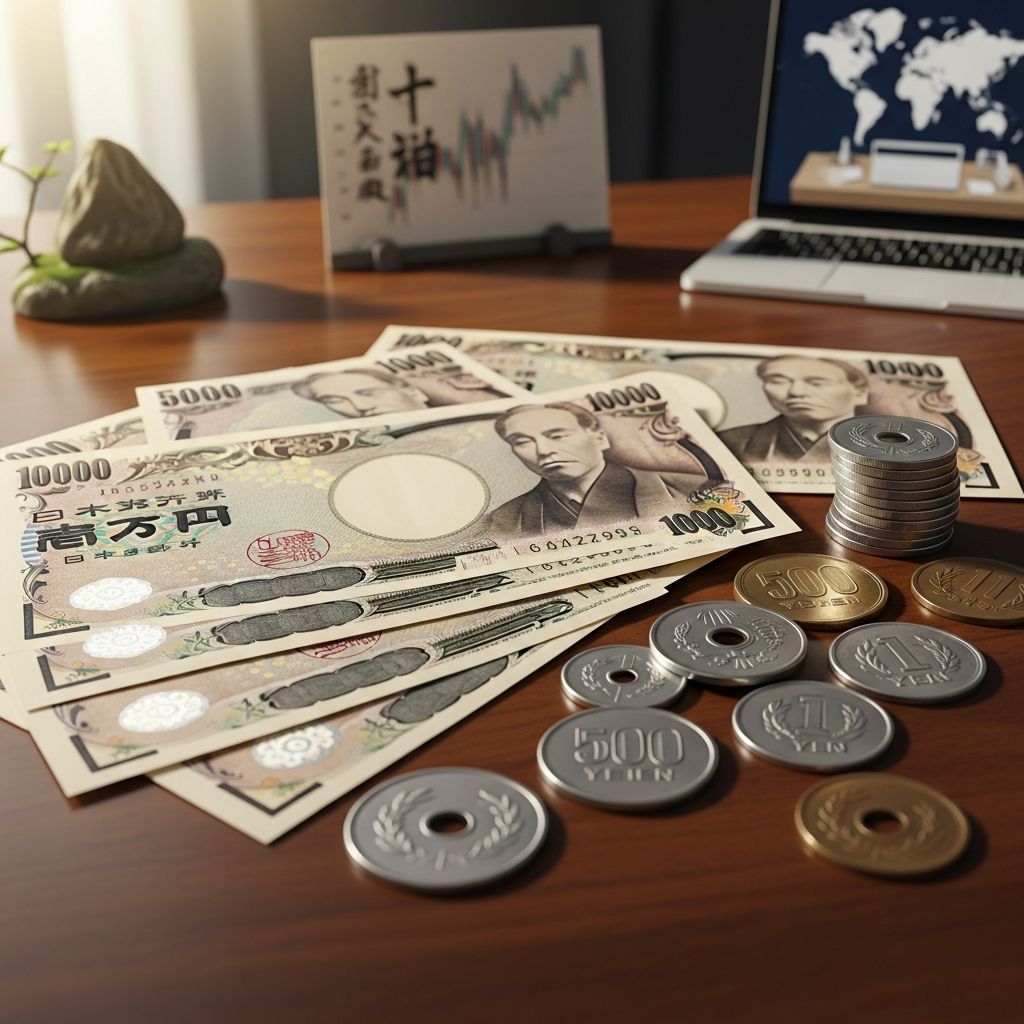
Today, the Japanese Yen remains one of the world’s most important currencies despite Japan’s economic challenges since the 1990s. The currency is available in both coins and paper form, with banknotes ranging from 1,000 to 10,000 yen denominations. The yen continues to serve as a medium of exchange within Japan and plays a significant role in international transactions.
The yen’s status as a reserve currency reflects several factors: Japan’s large and sophisticated financial markets, the political stability of the Japanese government, the strength of Japanese institutions, and historical confidence in the currency. While Japan has experienced economic stagnation and deflation at various points, these factors have not undermined the yen’s fundamental position in the global monetary system.
Frequently Asked Questions About the Japanese Yen
Q: What does the symbol ¥ represent?
A: The ¥ symbol represents the Japanese Yen. The symbol is derived from the Chinese yuan character, reflecting historical trade connections between Japan and China.
Q: Why is the yen considered a major reserve currency?
A: The yen is considered a major reserve currency due to Japan’s large economy, sophisticated financial markets, political stability, and the historical confidence international institutions have placed in the currency and Japan’s institutions.
Q: How did the yen replace feudal currencies?
A: The New Currency Act of 1871 officially established the yen as Japan’s sole currency and suspended the exchange of clan notes and feudal-era paper money. This eliminated hundreds of different denominations that had previously circulated.
Q: What impact does yen appreciation have on Japanese exports?
A: When the yen appreciates (strengthens), Japanese goods become more expensive for foreign buyers, typically reducing export competitiveness and demand. Depreciation has the opposite effect, making exports more price-competitive.
Q: Why did Japan shift from silver to gold standard?
A: As Japan’s trade shifted toward Western nations using the gold standard, the silver peg became disadvantageous due to price fluctuations. Adopting the gold standard in 1897 aligned Japan with major trading partners and strengthened its position in international finance.
Q: What was the significance of the Bretton Woods system for the yen?
A: The Bretton Woods system fixed the yen at 360 per USD from 1949 to 1971, providing exchange rate stability during Japan’s postwar economic reconstruction and helping establish its competitive position in global markets.
References
- Understanding the Japanese Yen: Role in Global Commerce, Volatility and Historical Overview — Grain Finance. 2024. https://www.grainfinance.co/post/understanding-the-japanese-yen-role-in-global-commerce-volatility-and-historical-overview
- Japanese Yen (JPY) – Definition, History, Crisis — Corporate Finance Institute. 2024. https://corporatefinanceinstitute.com/resources/foreign-exchange/japanese-yen-jpy/
- Japanese Yen (JPY) – History, Global Context, FX Pairs — Equals Money. 2024. https://equalsmoney.com/currencies/majors/jpy
- Yen | Exchange rate, value, Japan — Britannica Money. 2024. https://www.britannica.com/money/yen
- Japanese yen — Wikipedia. Accessed 2024. https://en.wikipedia.org/wiki/Japanese_yen
- Japanese Yen – Quote – Chart – Historical Data – News — Trading Economics. 2024. https://tradingeconomics.com/japan/currency
- Japanese Yen History, Facts & Significance — Study.com. 2024. https://study.com/academy/lesson/japanese-yen-overview-origin.html
Similar Articles








Read full bio of Sneha Tete