Subprime Lending: Risks, Benefits, And How To Escape
Explore subprime lending: its definition, risks, benefits, and strategies to improve your credit for better loan terms.

Subprime lending refers to the extension of credit to individuals with lower credit scores or histories of financial difficulties, who pose a higher risk of default to lenders. These borrowers typically do not qualify for standard prime rates, so lenders compensate by charging elevated interest rates and fees.
Understanding the Core Concept of Subprime Credit
At its essence, subprime lending targets consumers whose credit profiles indicate elevated risk. This includes factors like past delinquencies, high debt levels, or limited credit history. Lenders categorize borrowers based on metrics such as FICO scores, where subprime often falls below 620, though thresholds vary by institution—sometimes as low as 580 or up to 660.
Unlike prime lending, which rewards strong credit with favorable terms, subprime options are designed for accessibility but at a premium cost. This practice spans mortgages, auto loans, personal loans, and credit cards, enabling financial participation for underserved groups while allowing lenders to manage risk through pricing.
Credit Score Tiers: From Superprime to Deep Subprime
Credit scores stratify borrowers into risk bands. Here’s a breakdown of common FICO score ranges and their lending classifications:
| Score Range | Classification | Typical Loan Terms |
|---|---|---|
| 800+ | Superprime | Lowest rates, best terms |
| 740-799 | Prime | Competitive rates |
| 661-780 | Near-Prime | Slightly higher rates |
| 620-660 | Subprime | Higher rates, stricter terms |
| 580-619 | Deep Subprime | Very high rates, limited options |
| Below 580 | Ultra Subprime | Extremely high costs, high rejection risk |
These tiers guide lenders in pricing risk. Subprime borrowers face rates that can exceed 20-30% APR on auto loans, compared to under 5% for superprime.
Why Do Lenders Offer Subprime Loans?
Lenders enter subprime markets to tap underserved segments, expanding their customer base. By adjusting rates upward, they offset default probabilities, which are statistically higher—often 2-3 times that of prime borrowers. Regulatory guidance, like the FDIC’s definitions, emphasizes that subprime characteristics include weakened histories such as charge-offs or bankruptcies.
- Risk Compensation: Higher fees and rates cover potential losses.
- Market Expansion: Serves millions excluded from prime lending.
- Portfolio Diversification: Balances low-margin prime loans with higher-yield subprime ones.
However, this model amplifies borrower costs, potentially trapping them in debt cycles if not managed carefully.
Types of Subprime Loans Available Today
Subprime lending manifests across various products:
- Subprime Mortgages: For homebuyers with scores under 620; often feature adjustable rates that spiked during the 2008 crisis.
- Auto Loans: Targeted at scores 580-619; rates can hit 29% or more, per recent studies.
- Credit Cards: Secured or unsecured cards with high limits but APRs over 25%.
- Personal Loans: Short-term options, sometimes resembling payday loans with APRs nearing 400%.
Each type shares higher costs but provides entry points for rebuilding credit through consistent payments.
The Historical Impact: Lessons from the 2008 Crisis
Subprime lending gained notoriety during the mid-2000s housing boom. Lax standards led to widespread issuance of subprime mortgages, bundled into securities that collapsed when defaults surged. Borrowers with scores below 600 received loans with teaser rates that reset higher, triggering foreclosures.
The fallout reshaped regulations: the Dodd-Frank Act introduced stricter oversight via the Consumer Financial Protection Bureau (CFPB), mandating ability-to-repay assessments. Today, subprime volumes are lower, but risks persist in auto and personal lending segments.
Risks and Downsides of Subprime Borrowing
While accessible, subprime loans carry significant pitfalls:
- Escalating Costs: Interest compounds quickly, doubling loan amounts over time.
- Debt Traps: High payments strain budgets, leading to further delinquencies.
- Credit Damage: Defaults deepen negative histories, prolonging subprime status.
- Predatory Practices: Some lenders exploit vulnerability with hidden fees.
State regulators, like Massachusetts, monitor for unfair practices in subprime consumer loans. Borrowers should scrutinize terms and explore alternatives.
Benefits: A Pathway for Credit-Challenged Individuals
Not all subprime experiences are negative. For those with no other options, these loans offer:
- Access to Essentials: Vehicles for work or homes for stability.
- Credit Rebuilding: On-time payments boost scores over 12-24 months.
- Financial Inclusion: Prevents exclusion from credit markets entirely.
Success hinges on affordability assessments and disciplined repayment.
How to Determine If You’re a Subprime Borrower
Check your FICO score via free annual reports from major bureaus. Key red flags include:
- Delinquencies in the last 12 months.
- Debt-to-income ratios over 40%.
- Recent bankruptcies or collections.
- Thin credit files.
Lenders also weigh loan size, collateral, and repayment structure.
Strategies to Avoid or Escape Subprime Status
Improving your profile opens prime doors:
- Pay Bills On Time: Builds positive history (35% of FICO).
- Reduce Utilization: Keep balances under 30% (30% of score).
- Dispute Errors: Review reports for inaccuracies.
- Secure Starter Credit: Use secured cards or credit-builder loans.
- Increase Income/Debt Paydown: Lowers risk metrics.
Aim for 100-point gains in 6-12 months through consistency.
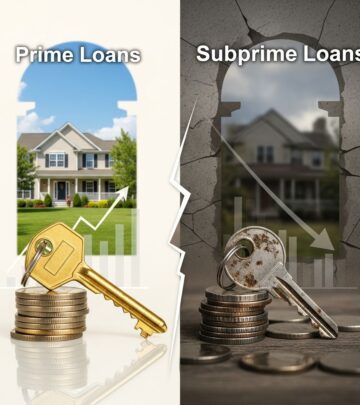
Comparing Prime vs. Subprime: A Cost Analysis
| Aspect | Prime Loan | Subprime Loan |
|---|---|---|
| Interest Rate | 3-7% APR | 15-30%+ APR |
| Default Risk | Low (1-2%) | High (10-20%) |
| Fees | Minimal | High origination/penalty |
| Approval Odds | High | Conditional |
| Long-Term Cost (e.g., $20K Auto, 60 mo) | ~$22K total | ~$30K+ total |
Over five years, subprime can add thousands in extra costs.
Regulatory Safeguards in Modern Subprime Lending
Post-2008 reforms ensure transparency. Key protections:
- CFPB oversight on deceptive practices.
- Truth in Lending Act disclosures.
- State-level caps on rates (e.g., Massachusetts guidelines).
Borrowers should verify lender licensing and read fine print.
Frequently Asked Questions (FAQs)
What credit score qualifies as subprime?
Typically below 620, but ranges from 580-660 depending on the lender.
Are subprime loans worth it?
They provide access but at high cost; use only if essential and affordable long-term.
Can subprime borrowers get prime rates later?
Yes, through credit repair; many graduate to better terms within 1-2 years.
How did subprime cause the 2008 crisis?
Over-issuance of risky mortgages led to mass defaults and market collapse.
What are alternatives to subprime loans?
Credit unions, peer-to-peer lending, or improving credit first.
References
- Subprime Lending: Understanding Its Legal Definition — USLegalForms. Accessed 2026. https://legal-resources.uslegalforms.com/s/subprime-lending
- What Is A Sub-Prime Mortgage? — Georgia Bankruptcy Blog. Accessed 2026. https://www.georgiabankruptcyblog.com/news-and-comments/news-and-comments-what-is-a-subprime-mortgage
- Subprime lending — Wikipedia (citing primary sources). Accessed 2026. https://en.wikipedia.org/wiki/Subprime_lending
- What Is a Subprime Auto Loan, and Do You Need One? — Faith’s Auto. Accessed 2026. https://www.faithsauto.com/blog/what-is-a-subprime-auto-loan-and-do-you-need-one
- Prime vs. Subprime Loans: How Are They Different? — myFICO. Accessed 2026. https://www.myfico.com/credit-education/blog/prime-vs-subprime-loans
- Subprime Lending — Mass.gov. Accessed 2026. https://www.mass.gov/industry-letter/subprime-lending
- ComE-IN Background Definitions — FDIC.gov. Accessed 2026. https://www.fdic.gov/advisory-committees/come-background-definitions
Similar Articles








Read full bio of Sneha Tete