What Is a Stock Ticker? Definition and How It Works
Learn what stock tickers are, how they work, and why they matter for investors.
What Is a Stock Ticker?
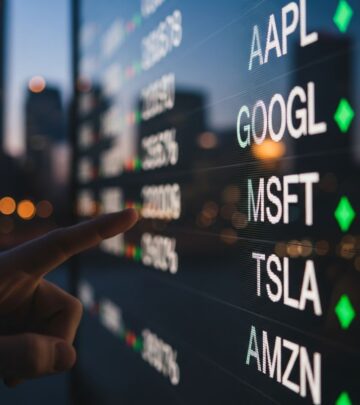
A stock ticker is a unique identifier or symbol assigned to publicly traded companies on stock exchanges. It serves as a concise shorthand for investors to refer to, purchase, and research securities listed on financial markets worldwide. The ticker represents a company’s shares and allows investors to track real-time price movements, trading volumes, and market fluctuations. For example, Apple Inc. trades under the ticker symbol AAPL on the NASDAQ exchange, while Tesla, Inc. uses the symbol TSLA.
In essence, a stock ticker is far more than just an abbreviation. It functions as a gateway to critical market data and investment information. When you view a stock ticker on a financial platform or news channel, you’re accessing real-time information about a company’s stock price, trading volume, price changes, and other essential metrics that help inform investment decisions.
The History and Origin of Stock Tickers
The term “ticker” originates from the mechanical ticker tape machines invented in the late 19th century. These machines were revolutionary devices that printed stock symbols and their corresponding price information on a continuous paper strip, making financial information accessible to traders and investors. The first ticker symbol was used in 1867, following the invention of the ticker tape machine by Edward Calahan, and was used to identify shares of the Union Pacific Railroad Company.
The distinctive name “ticker” comes from the characteristic noise these machines made while printing stock information—a ticking sound that became synonymous with stock market activity. The symbols on ticker tapes were kept as short as possible to reduce the number of characters that needed to be printed and to make them easy to recognize by traders and investors working on trading floors.
While physical ticker tapes are largely symbolic today and have been replaced by digital systems, the concept lives on in the scrolling electronic displays seen on financial news channels and modern trading platforms. The abbreviation format and symbol-based identification system established during the ticker tape era continue to form the foundation of modern stock market identification systems.
How Stock Ticker Symbols Are Structured
Different stock exchanges have established their own conventions and formatting standards for ticker symbols. Understanding these structures helps investors quickly identify where a stock trades and what characteristics it possesses.
United States Stock Exchange Conventions
In the United States, the New York Stock Exchange (NYSE) generally assigns tickers with one to four letters, while those listed on the NASDAQ can have up to five letters. Modern letter-only ticker symbols were developed by Standard & Poor’s to bring national standardization to investing, as previously a single company could have multiple different ticker symbols across various individual stock markets.
The symbols are designed to represent the company name where possible. For instance, Apple Inc. trades as AAPL on NASDAQ, while Ford Motor Company trades as the single-letter ticker F on the NYSE.
Ticker Extensions and Special Designations
Sometimes, additional letters are appended to a ticker symbol to indicate specific characteristics of the stock. These extensions encode important information such as different share classes, bankruptcy status, voting rights, or other special conditions. Common extensions include:
- Share Classes: Different share classes of the same company (e.g., GOOGL and GOOG for Alphabet Inc.’s Class A and Class C shares)
- Warrants: A “W” suffix indicates warrants are attached to the security
- Preferred Stock: Various designations for preferred shares versus common stock
- Debentures and Special Securities: Letters indicating bonds, notes, subscription receipts, and other security types
This system allows investors to identify not just which company they’re investing in, but also what type of security or share class they’re considering. To fully qualify a stock, both the ticker and the exchange or country of listing need to be known, as the same company may trade under different symbols on different exchanges worldwide.
Understanding Real-Time Stock Ticker Displays
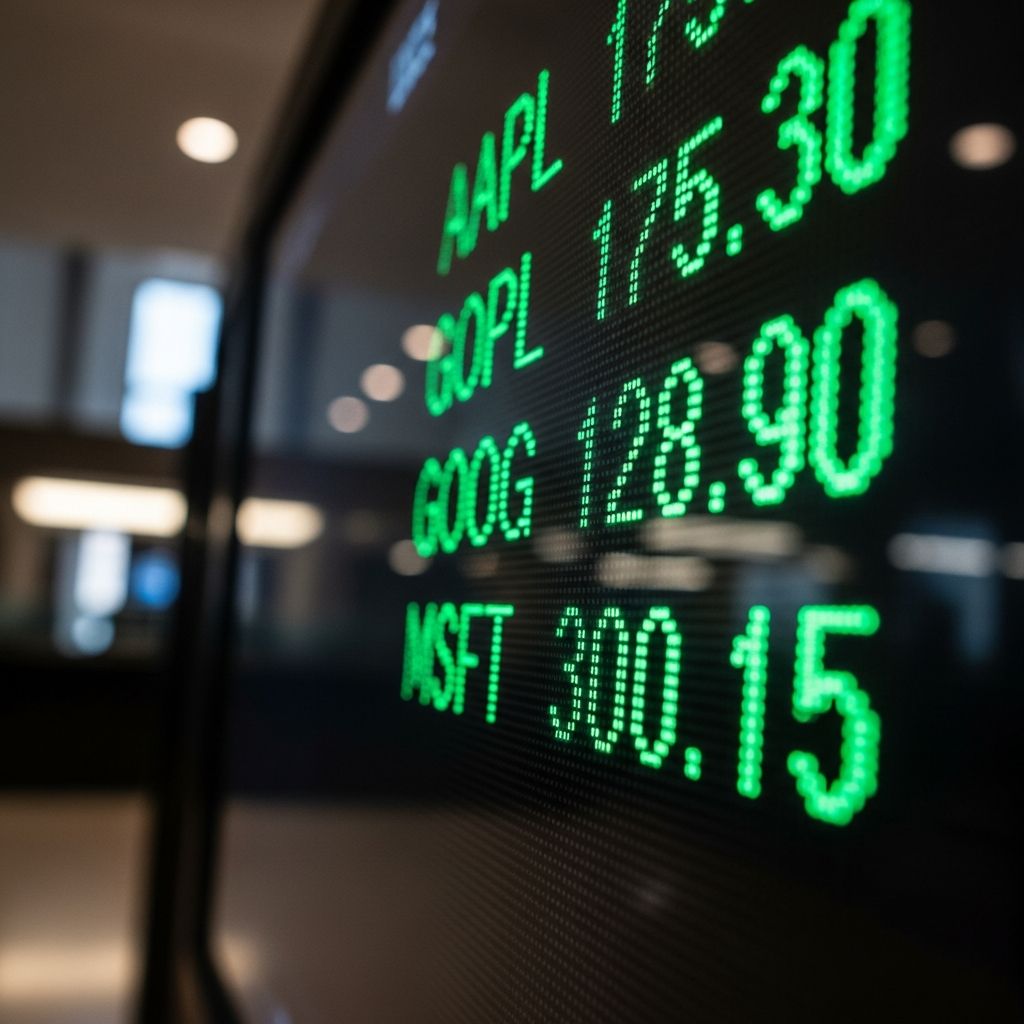
A stock market ticker is a continuous, scrolling display that shows updates about the latest trades of stocks and securities. When a company is publicly traded, its stock symbol appears alongside real-time data that updates constantly throughout market hours. This allows investors and traders to monitor the performance of their investments in real time.
How Live Stock Tickers Work
Live stock ticker systems operate through major exchanges such as the NYSE (New York Stock Exchange) and NASDAQ, which provide real-time price data to ticker displays around the world. Each stock ticker symbol represents a company’s shares, and the price displayed updates according to market fluctuations as trades are executed throughout the trading day.
The infrastructure supporting live tickers includes:
- Real-time Data Feeds: Direct connections to exchange systems providing up-to-the-minute price information
- Market Data Processors: Systems that aggregate and distribute stock information to financial platforms
- Display Terminals: Trading platforms, financial news channels, and investor apps that present ticker information
- Continuous Updates: Information that refreshes multiple times per second during market hours
Live stock tickers are crucial for investors who need up-to-the-minute updates on market performance. These real-time systems provide investors with critical information on stock prices, trading volume, and other key metrics, allowing them to make timely decisions, especially when market volatility is high or during sudden market shifts.
Key Information Displayed on Stock Tickers
When you look at a stock ticker display, you typically see several important pieces of information that together give you a comprehensive view of a stock’s current market activity:
Essential Ticker Components
Stock Symbol: The unique ticker abbreviation that identifies the company (e.g., AAPL for Apple)
Current Price: The most recent trading price at which the stock changed hands
Price Change: The difference between the current price and the previous closing price, often shown in dollars and as a percentage
Trading Volume: The number of shares traded during the current trading session, indicating the level of investor activity
Opening and Closing Prices: The price at which the stock opened at the start of the trading day and, at day’s end, the closing price
High and Low Prices: The highest and lowest prices at which the stock traded during the current trading session
These updates allow investors and traders to react quickly to market changes. The color-coding often used in ticker displays (green for gains, red for losses) provides instant visual cues about a stock’s performance.
How to Find and Use Stock Tickers
Understanding how to track a stock’s performance begins with knowing its ticker symbol. Stock ticker lookup tools are available on many financial platforms, allowing you to easily search for a company’s stock symbol.
Popular Stock Ticker Lookup Platforms
Several reliable platforms offer stock ticker search and tracking capabilities:
- Google Finance: Provides comprehensive stock data and ticker lookup functionality
- MarketWatch: Offers detailed ticker information and market analysis tools
- NASDAQ Official Website: The official exchange site for companies listed on NASDAQ
- NYSE Official Website: Official listings and information for companies trading on the New York Stock Exchange
- Yahoo Finance: Comprehensive financial data and stock tracking services
By using these lookup tools, you can quickly find the ticker symbol for any publicly traded company and monitor its performance throughout the trading day. These tools provide access to real-time data, historical stock prices, and long-term trends that help investors make informed decisions.
Common Stock Ticker Examples
Understanding well-known ticker symbols helps investors become more comfortable with the system. Here are some major companies and their ticker symbols:
| Company Name | Ticker Symbol | Exchange |
|---|---|---|
| Apple Inc. | AAPL | NASDAQ |
| Microsoft Corporation | MSFT | NASDAQ |
| Alphabet Inc. (Google) | GOOGL / GOOG | NASDAQ |
| Amazon.com Inc. | AMZN | NASDAQ |
| Tesla Inc. | TSLA | NASDAQ |
| Ford Motor Company | F | NYSE |
| JPMorgan Chase | JPM | NYSE |
| Coca-Cola Company | KO | NYSE |
Benefits of Stock Tickers for Investors
Stock ticker systems provide numerous advantages for both novice and experienced investors in the financial markets:
Real-Time Decision Making
Investors can react instantly to market developments based on live ticker information. When significant price movements occur, traders can execute transactions immediately rather than relying on delayed information.
Efficient Portfolio Monitoring
Rather than manually checking multiple sources, investors can monitor their entire portfolio through ticker displays that update continuously, providing a comprehensive view of their holdings’ performance.
Simplified Communication
The standardized ticker symbols create a universal language for financial professionals and investors worldwide. Instead of saying “shares of the computer company with headquarters in Cupertino,” investors simply say “AAPL.”
Market Transparency
Publicly displayed ticker information ensures all market participants have access to the same real-time data, promoting fair and efficient markets where prices reflect available information.
Historical Data Access
Beyond real-time prices, modern ticker systems provide access to historical data, allowing investors to analyze long-term trends and make informed decisions based on comprehensive historical context.
Reading and Interpreting Stock Tickers
Understanding how to read a stock ticker is essential for interpreting the information it displays. Here’s a practical example of how to understand ticker information:
Example Ticker Reading
Imagine an investor holding shares of “Tech Innovations Inc.” with the ticker symbol TII. Their trading platform displays the following information:
- Ticker Symbol: TII
- Current Price: $85.32
- Price Change: +$2.15 (+2.58%)
- Opening Price: $83.20
- High: $86.75
- Low: $83.00
- Trading Volume: 2,450,000 shares
This information tells the investor that Tech Innovations Inc. stock opened at $83.20, has traded between $83.00 and $86.75 today, currently stands at $85.32 (up $2.15 or 2.58% from yesterday’s close), and has seen 2.45 million shares traded so far during the session. Such comprehensive information allows investors to assess market sentiment and make trading decisions.
International Ticker Systems
Stock ticker systems vary internationally. While the United States uses primarily alphabetic characters following S&P’s standardization system, other countries employ different conventions. Some international systems use numeric codes or combinations of letters and numbers to identify securities. For comprehensive global trading, investors often need to specify both the ticker symbol and the exchange or country code to uniquely identify a security.
The International Securities Identification Number (ISIN) provides an additional layer of standardization for international trading, though it complements rather than replaces ticker symbols as a unique identifier.
Frequently Asked Questions
Q: What is the meaning of a stock ticker symbol?
A: A stock ticker symbol is a unique abbreviation assigned to each publicly traded company. It uniquely identifies a company’s stock on the stock exchange and serves as shorthand for investors to refer to, purchase, and research securities. For example, AAPL represents Apple Inc.
Q: How can I track stock prices with live tickers?
A: You can track stock prices using live stock tickers available on platforms like Google Finance, Yahoo Finance, MarketWatch, or the official websites of stock exchanges like NASDAQ and NYSE. Simply search for the company name or ticker symbol to access real-time price information and historical data.
Q: Why do some companies have multiple ticker symbols?
A: Companies may have multiple ticker symbols when they have different share classes (such as Class A and Class C shares) or when they trade on different stock exchanges. Additionally, a company might retain its original ticker symbol even if it moves from one exchange to another.
Q: What do the letters after a ticker symbol mean?
A: Letters appended after the main ticker symbol provide additional information about the security type. For example, a “W” typically indicates warrants, while other letters might indicate preferred shares, debentures, or special conditions related to the security.
Q: How often do stock ticker prices update?
A: Stock ticker prices update multiple times per second during regular market hours (typically 9:30 AM to 4:00 PM Eastern Time for U.S. markets). Some platforms provide real-time updates, while others may have slight delays of 15-20 minutes.
References
- Stock Tickers: What They Are and How to Use Them in Stock Market — BiyaPay. 2024. https://www.biyapay.com/blogDetail/1421-stock-tickers-what-they-are-and-how-to-use-them-in
- Ticker symbol — Wikipedia. Last updated 2025. https://en.wikipedia.org/wiki/Ticker_symbol
Similar Articles








Read full bio of Sneha Tete