What Is a Stock Corporation: Definition & How It Works
Understanding stock corporations: structure, benefits, and how they differ from other business entities.

What Is a Stock Corporation?
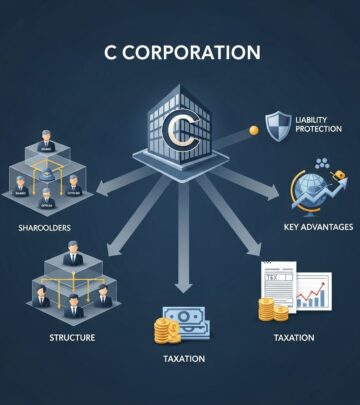
A stock corporation, often referred to as a “C” Corporation, is a legal business entity that exists separately and distinctly from its owners. This type of business structure is created by law and can act under its own name rather than in the name of its stockholders. Stock corporations are among the most common and widely recognized business structures in the United States and globally, particularly for companies planning to raise capital through the issuance of shares, expand through acquisitions, or eventually become publicly traded.
The defining characteristic of a stock corporation is its ability to issue shares of stock to raise capital. These shares represent ownership in the corporation and are typically assigned specific values. Individuals who own these shares are considered shareholders or stockholders, and their stock is regarded as personal property. The shareholders’ ownership stake is proportional to the number of shares they hold.
Key Characteristics of Stock Corporations
Stock corporations possess several distinctive characteristics that set them apart from other business structures:
Separate Legal Existence
One of the most important characteristics of a stock corporation is that it operates as a separate legal entity. This means the corporation can own property, enter into contracts, sue or be sued, and conduct business in its own name. The corporation is responsible for its own activities and obligations, separate from those of its individual shareholders.
Limited Liability Protection
Shareholders in a stock corporation enjoy limited liability protection, meaning their personal assets are protected from the corporation’s debts and obligations. The owners’ liability is limited only to the amount of their investment in the corporation. This protection is one of the primary reasons entrepreneurs choose the corporate structure. However, this protection can be forfeited if shareholders fail to follow proper corporate formalities, a concept known as “piercing the corporate veil.”
Unlimited Shareholders
Unlike some other business structures, stock corporations can have an unlimited number of shareholders. This feature makes them ideal for companies seeking to raise substantial amounts of capital from multiple investors. There are no restrictions on how many people can own shares in a stock corporation.
Continuous Existence
A stock corporation has perpetual existence and continuity of life. The corporation continues to exist regardless of changes in ownership, the death of shareholders, or the withdrawal of investors. The transfer of ownership of shares of stock does not dissolve the corporation, allowing for seamless transitions in ownership.
Capital Acquisition Ability
Stock corporations have a superior ability to acquire capital compared to other business structures. By issuing shares of stock, corporations can raise significant amounts of money from numerous investors. This makes them particularly suitable for capital-intensive ventures that exceed the financial capacity of individual persons.
Share Transferability
Shares of stock in a corporation can typically be transferred without the consent of other shareholders. This liquidity and transferability of ownership interests make stock corporations attractive to investors who may want to exit their investment or adjust their ownership position.
Corporate Governance and Management Structure
Stock corporations operate under a three-tiered management structure with clear separation of powers and responsibilities.
The Three Tiers of Authority
The governance structure of a stock corporation consists of three distinct levels:
Shareholders
Shareholders are the owners of the corporation and hold the ultimate power in the organization. Stockholders elect the board of directors and make major corporate decisions through voting at shareholders’ meetings. Each shareholder typically receives one vote per share of stock owned. Shareholders have the right to:
- Vote on major corporate decisions
- Elect and remove directors
- Amend articles of incorporation and bylaws
- Approve the sale of all or substantially all corporate assets
- Approve mergers and reorganizations
- Dissolve the corporation
- Participate in dividends when declared
- Share in assets in case of liquidation
Board of Directors
The board of directors is elected by shareholders and serves as the intermediary between ownership and management. The board formulates broad policies for the company, sets strategic direction, and is responsible for corporate governance. Directors ensure that proper corporate formalities are maintained, including holding regularly scheduled meetings, documenting decisions through corporate minutes, and maintaining compliance with state statutory requirements.
Officers and Management
Officers of the corporation, selected by the board of directors, execute the policies established by the board and handle day-to-day operations. Officers are responsible for implementing strategic decisions and managing the corporation’s business activities.
Majority vs. Minority Shareholders
Any shareholder who holds a majority of shares from issued stock can effectively control the company and is referred to as a majority shareholder. Majority shareholders bear elevated responsibility to minority shareholders, who generally have no responsibility to the company and have the option to sell their stock whenever they want. Minority shareholders can also assign their votes to anyone they choose.
Advantages of Stock Corporations
Stock corporations offer several significant advantages that make them an attractive choice for many businesses:
- Limited Liability Protection: Shareholders are not personally liable for corporate debts beyond their investment amount
- Easy Capital Raising: The ability to issue multiple classes of stock provides greater access to capital from diverse investors
- Perpetual Existence: The corporation continues regardless of ownership changes or shareholder circumstances
- Professional Management: Structured governance allows for professional management separate from ownership
- Transferable Ownership: Shares can be easily bought and sold without affecting corporate operations
- Credibility: The corporate structure often carries more prestige and credibility with business partners and lenders
- Expansion Opportunities: The structure supports growth through acquisitions and business expansion
- Path to Public Trading: Corporations can more easily transition to becoming publicly traded companies
Disadvantages of Stock Corporations
While stock corporations offer many benefits, they also come with certain drawbacks:
- Double Taxation: Corporations pay corporate income taxes, and shareholders pay taxes on dividends
- Regulatory Complexity: Stock corporations must comply with extensive government regulations and corporate governance requirements
- Formation and Maintenance Costs: Incorporating and maintaining corporate status involves significant legal and administrative expenses
- Administrative Burden: Corporations must file corporate tax returns, maintain corporate bank accounts, hold regular meetings, and keep detailed records
- Loss of Control: Founders may lose control if they don’t maintain majority share ownership
- Public Disclosure Requirements: Some corporate information must be disclosed to regulators and the public
- Formal Procedures Required: Strict adherence to corporate formalities is necessary to maintain liability protection
Stock Corporation vs. Other Business Structures
| Feature | Stock Corporation (C-Corp) | S-Corporation | LLC | Partnership |
|---|---|---|---|---|
| Number of Owners | Unlimited | Limited (100 shareholders max) | Flexible | 2 or more |
| Liability Protection | Limited | Limited | Limited | Unlimited (for general partners) |
| Taxation | Double taxation | Pass-through taxation | Pass-through taxation | Pass-through taxation |
| Stock Types | Multiple classes | One class only | N/A | N/A |
| Regulatory Requirements | Extensive | Moderate | Moderate | Minimal |
| Capital Raising | Excellent | Limited | Good | Limited |
How to Maintain Stock Corporation Status
To preserve the liability protection and maintain stock corporation status, business owners must follow proper corporate formalities:
- Hold regularly scheduled board and shareholder meetings
- Document all decisions through corporate minutes
- Maintain a separate corporate bank account and conduct all business through this account
- File corporate tax returns with the IRS
- Keep detailed financial records
- Stay in compliance with state statutory requirements
- Maintain corporate records and documentation
- Issue stock certificates to shareholders
- Pay corporate wages to any owner-employees
Failure to follow these formalities can result in “piercing the corporate veil,” allowing courts, creditors, and the IRS to hold officers, directors, and shareholders personally liable for corporate debts and obligations.
Types of Stock Corporations
C Corporation
The standard stock corporation is known as a C Corporation (named for Subchapter C of the Internal Revenue Code). This is the most common corporate structure and the default type of corporation formed under state law. C Corporations are subject to corporate income tax and have the flexibility to issue multiple classes of stock to an unlimited number of shareholders.
S Corporation
An S Corporation is a special tax designation available to corporations that meet specific requirements. S Corporations allow for pass-through taxation, meaning shareholders (rather than the corporation itself) pay income taxes on profits. However, S Corporations can only issue one type of stock and are limited to a maximum of 100 shareholders, making it harder to raise venture capital. A general stock corporation can elect to be treated as an S Corporation if all qualifications are met.
Stock Ownership and Shareholders’ Rights
When individuals or entities purchase stock in a corporation, they acquire ownership rights in the company. The rights of shareholders typically include:
- The right to purchase additional shares (preemptive right)
- The right to share in dividends when declared by the board of directors
- The right to share in assets in case of liquidation
- The right to participate in management indirectly through voting at shareholders’ meetings
- One vote for each share of stock owned
The corporation itself has legal capacity to hold property and conduct business, separate from its shareholders’ individual capacities. This separation is fundamental to the corporate structure and is one of its greatest advantages.
Frequently Asked Questions
Q: What is the difference between a stock corporation and a non-stock corporation?
A: A stock corporation is allowed to issue shares of stock to raise capital, while a non-stock corporation cannot issue stock. In a non-stock corporation, ownership is held through membership rather than share ownership.
Q: Can a stock corporation be converted to another business structure?
A: Yes, a stock corporation can be converted to another business structure through merger or reorganization, which must be approved by shareholders. However, this typically involves dissolving the corporation and transferring assets to the new entity.
Q: What happens to a stock corporation if the founder dies?
A: The stock corporation continues to exist perpetually. Ownership of shares transfers according to the founder’s will or estate planning documents, but the corporation itself continues operating without interruption.
Q: Who is responsible for corporate taxes in a stock corporation?
A: The stock corporation itself is responsible for filing corporate tax returns and paying corporate income taxes. Additionally, shareholders must pay personal income taxes on dividends received from the corporation, resulting in double taxation for C Corporations.
Q: Can a single person form a stock corporation?
A: Yes, a single person can form and be the sole shareholder of a stock corporation. There is no minimum number of shareholders required, though incorporators must be natural persons.
Q: What are incorporators?
A: Incorporators are the shareholders or members mentioned in the articles of incorporation as originally forming and composing the corporation. They must be natural persons (human beings) rather than artificial entities and are signatories to the articles of incorporation.
Q: How do shareholders exercise control in a stock corporation?
A: Shareholders exercise control by voting at shareholders’ meetings on major corporate decisions, electing the board of directors, and approving significant corporate actions such as mergers, asset sales, or dissolution.
References
- General Stock Corporation — Advantage Delaware LLC. Accessed November 2025. https://advantage-de.com/information-center/types-of-business-entities/general-stock-corporation/
- Understanding Corporations Stock: Legal Definitions and Types — USLegalForms. Accessed November 2025. https://legal-resources.uslegalforms.com/c/corporations-stock
- Characteristics of Corporations – Financial Accounting — Lumen Learning. Accessed November 2025. https://content.one.lumenlearning.com/financialaccounting/chapter/characteristics-of-corporations/
- Stock Corporation — Max Planck Institute for Comparative and International Private Law. Accessed November 2025. https://max-eup2012.mpipriv.de/index.php/Stock_Corporation
- Corporation: Definition, Features, Disadvantages, Types — StudyFinance. Accessed November 2025. https://studyfinance.com/corporation/
- Corporation — Wikipedia. Accessed November 2025. https://en.wikipedia.org/wiki/Corporation
- Corporation: Definition, Types & Key Characteristics — Carta. Accessed November 2025. https://carta.com/learn/startups/private-companies/corporation/
Similar Articles








Read full bio of medha deb