What Is Stagflation: Causes, Effects, and Economic Impact
Understanding stagflation: How simultaneous inflation and economic stagnation impact your finances.
What Is Stagflation?
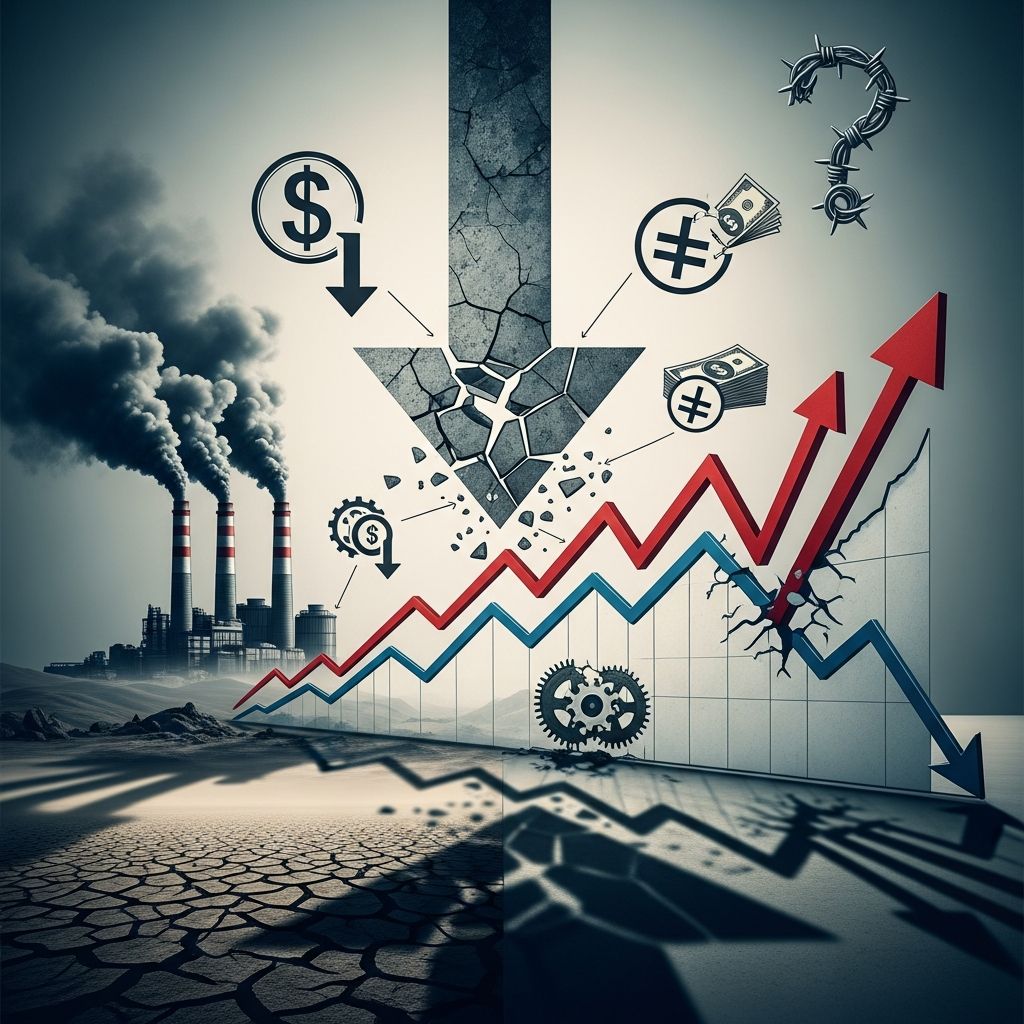
Stagflation is a challenging economic condition that combines three unfavorable elements into a single problematic scenario: high inflation, stagnant economic growth, and elevated unemployment. The term itself is a portmanteau of “stagnation” and “inflation,” reflecting the simultaneous presence of rising prices and a sluggish economy. This creates what economists often describe as an economic “misery,” where consumers face deteriorating purchasing power while job opportunities become increasingly scarce.
In a stagflationary economy, the normal relationship between economic variables breaks down. Typically, when inflation rises, economic growth accelerates, and unemployment falls. Conversely, during recessions, prices stabilize or fall while unemployment increases. Stagflation disrupts this predictable pattern, creating a situation where rising consumer prices coincide with low or even negative economic growth, often accompanied by rising unemployment rates. In extreme cases, an economy experiencing stagflation may actually be in recession, meaning GDP growth is negative despite persistently high inflation.
Understanding the Key Components
To fully comprehend stagflation, it’s essential to understand its three fundamental components and how they interact:
High Inflation: This represents a sustained increase in the general price level of goods and services throughout the economy. During stagflation, consumer price inflation remains elevated, reducing the purchasing power of money. What cost one dollar yesterday costs significantly more today, directly impacting household budgets and real income.
Economic Stagnation: This refers to slow or absent economic growth, measured by Gross Domestic Product (GDP). During stagflation, productivity remains low, business investments decline, and consumer spending weakens. The economy essentially stops growing or grows at a painfully slow rate.
Rising Unemployment: As businesses reduce production and defer expansion plans, job losses mount. Unemployment rises, particularly affecting young people entering the workforce and those in casual or insecure employment positions. Workers struggle to find positions, and those fortunate enough to maintain employment face stagnant or declining real wages.
How Stagflation Works
Stagflation operates through a mechanism that erodes both household and business financial health simultaneously. The combination of inflation and poor productivity creates what economists call a “misery index” situation. Here’s how this destructive process unfolds:
When inflation rises while economic growth stalls, households experience declining real purchasing power. The money people earn buys progressively less, causing their real cost of living to rise. Simultaneously, the weak economy and high unemployment prevent wage growth from compensating for these rising costs. Workers find themselves unable to negotiate higher salaries because job opportunities are scarce, and employers are reluctant to invest in workforce expansion.
Businesses face their own challenges during stagflation. They must maintain high prices to cover increased production costs, yet they cannot expand production significantly because demand remains weak. This creates a squeeze where companies hold down wages, defer hiring, and postpone capital investments. The result is a vicious cycle where reduced business activity leads to higher unemployment, which further weakens consumer spending, which in turn forces businesses to reduce output even more.
This dynamic erodes people’s real income and savings while simultaneously forcing businesses to adopt defensive postures. The economy essentially stalls as both consumers and businesses pull back, yet prices continue climbing.
What Causes Stagflation?
Economists identify two principal causes of stagflation, though they often work together to intensify the condition.
Supply-Side Shocks
A supply-side shock occurs when a sudden disruption reduces the availability or increases the cost of essential economic inputs. The most common example is an abrupt increase in oil prices. When oil prices spike dramatically, production costs for virtually all goods and services increase because energy is fundamental to manufacturing, transportation, and distribution.
When a supply shock occurs, businesses face higher input costs but cannot immediately raise production to meet demand. Instead, they raise prices to maintain profitability despite reduced output. Simultaneously, consumers respond to higher prices and reduced income by cutting spending, particularly on non-essential goods and services. This spending reduction causes economic growth to slow or decline. Businesses, unable to sell more products at existing capacity, reduce output further. The result is the stagflationary combination: rising prices coupled with falling economic growth and rising unemployment.
Historical examples include the 1973 oil crisis, when the Organization of Petroleum Exporting Countries (OPEC) implemented an embargo that constrained worldwide oil supply, and subsequent oil price shocks that continued throughout the 1970s.
Poor Economic Policies
Stagflation can also result from inappropriate monetary and fiscal policies that governments or central banks implement. Several policy errors can trigger stagflation:
Fiscal Policy Mistakes: When governments increase taxes on businesses, sharply raise minimum wages, or substantially increase social spending, businesses face a “double whammy” of higher costs. Confronted with simultaneously higher taxes and higher labor costs, employers have little choice but to raise prices for consumers, increasing inflation. Simultaneously, these higher costs discourage business expansion and hiring, slowing economic growth and raising unemployment.
Monetary Policy Errors: Central banks can inadvertently cause stagflation by keeping interest rates too low when the economy is already running near full capacity. Artificially low interest rates stimulate excessive consumer borrowing and spending, driving prices higher. As inflation expectations rise, workers demand higher wages in anticipation of continued price increases. Employers, expecting to pass increased labor costs to customers through higher prices, agree to wage demands without insisting on productivity improvements. This creates a destructive “wage-price spiral” where prices rise, workers demand higher wages, employers grant them, businesses raise prices further to cover wage costs, and the cycle repeats. Throughout this process, wages rise and prices rise, but actual economic output stagnates, and unemployment increases among those unable to find work in this constrained environment.
Historical Examples of Stagflation
Stagflation, while rare in modern economies, has occurred at critical junctures in economic history. The most significant example remains the 1970s stagflation, which fundamentally challenged prevailing economic theories and policy approaches.
The 1970s Stagflation
The stagflation of the 1970s resulted from a combination of multiple adverse factors occurring simultaneously. High government expenditure, particularly spending on the Vietnam War, combined with low interest rates and the suspension of the gold standard to create inflationary pressures. Additionally, two major oil price shocks—one triggered by the 1973 OPEC embargo and another from geopolitical tensions—dramatically increased energy costs throughout the economy.
The policy response to these shocks often exacerbated the problem. Government wage and price controls, implemented to combat inflation, created artificial shortages and inefficiencies. Powerful labor unions successfully negotiated inflationary wage increases, contributing to the wage-price spiral. In the United Kingdom, a banking crisis added additional economic stress. The combination of supply shocks and policy errors created a prolonged period of simultaneous high inflation and economic stagnation that persisted throughout most of the 1970s and into the early 1980s.
This period had profound consequences for economic policy. The simultaneous occurrence of high inflation and high unemployment contradicted the prevailing Keynesian economic consensus, which suggested that these variables moved in opposite directions. The stagflation of the 1970s led to a reevaluation of economic theories and contributed to the rise of alternative approaches, including monetarism and supply-side economics.
Why Stagflation Is Particularly Damaging
Stagflation presents unique challenges that make it exceptionally difficult for policymakers to address and particularly harmful for ordinary people and businesses.
The Policy Dilemma
Stagflation creates what economists call a “policy dilemma” because traditional remedies for one problem typically worsen the other. To combat inflation, central banks typically implement tightening monetary policy by raising interest rates and reducing money supply growth. These measures can successfully reduce inflation but often come at the cost of slower economic growth and higher unemployment. Conversely, policies aimed at reducing unemployment—such as lowering interest rates and increasing government spending—tend to accelerate inflation.
This leaves policymakers in an impossible position: any action to improve one aspect of stagflation risks worsening another. There is no straightforward policy solution that simultaneously reduces inflation and stimulates growth and employment.
Impact on Households and Businesses
Stagflation is particularly damaging because it simultaneously squeezes both consumers and businesses. Consumers experience declining real purchasing power as prices rise faster than their incomes. Savings lose value in real terms. Finding employment becomes difficult as businesses retrench. Even those with stable employment face pressure as real wages stagnate or decline.
Businesses also suffer tremendously. Revenue growth slows as consumers reduce spending, yet input costs remain elevated. Profit margins compress. Uncertainty about future economic conditions and policy responses discourages capital investment and hiring. The combination of weak demand and high uncertainty often leads to layoffs and reduced hours for workers.
Stagflation vs. Regular Inflation and Recession
| Economic Condition | Inflation Rate | Economic Growth | Unemployment | Policy Challenge |
|---|---|---|---|---|
| Normal Inflation | Moderate to High | Positive and Growing | Declining | Moderate |
| Recession | Low or Declining | Negative | Rising | Moderate |
| Stagflation | High | Low or Negative | High and Rising | Severe and Complex |
Signs You’re in a Stagflationary Environment
Recognizing stagflation as it develops can help individuals and businesses adjust their strategies. Several indicators signal stagflationary conditions:
Rising consumer prices appear in grocery bills, rent, utilities, and gasoline. Simultaneously, job market deteriorates with increasing layoffs, hiring freezes, and fewer job openings. Real wages decline as salary increases lag behind inflation. Consumer confidence weakens as people worry about employment and purchasing power. Business investment declines as companies postpone expansion plans. Unemployment rises despite government efforts to stimulate growth. Interest rates may increase as central banks attempt to combat inflation.
Frequently Asked Questions About Stagflation
Q: How is stagflation different from regular inflation?
A: Regular inflation typically occurs during periods of economic growth when demand for goods and services is strong, wages are rising, and unemployment is falling. Stagflation, by contrast, combines high inflation with stagnant or negative economic growth and rising unemployment. This combination makes stagflation far more damaging to households and businesses.
Q: Can stagflation happen again?
A: Yes, stagflation can recur. While it’s relatively rare, any combination of negative supply shocks (like oil price spikes) and poor monetary or fiscal policy could trigger stagflationary conditions. Modern central banks are generally better equipped to prevent the most severe forms of stagflation through improved policy frameworks, but it remains a theoretical possibility.
Q: How does stagflation affect investment strategies?
A: During stagflation, traditional investment strategies often underperform. Bonds suffer as inflation erodes their real value and rising interest rates reduce bond prices. Stocks may struggle as company profits decline and discount rates rise. Real assets like commodities and inflation-protected securities may provide better protection during stagflationary periods.
Q: What can individuals do to protect themselves during stagflation?
A: During stagflation, consider diversifying income sources, securing stable employment or contracts, investing in tangible assets and inflation-protected securities, maintaining adequate emergency savings in cash, and avoiding large fixed-rate debt that will become more burdensome as real incomes decline.
Q: Why couldn’t policymakers solve 1970s stagflation immediately?
A: The 1970s stagflation persisted because policymakers initially misunderstood the nature of the problem. They pursued policies designed for either inflation or recession, not both simultaneously. Additionally, the combination of supply shocks and entrenched wage-price expectations made the condition particularly resistant to policy solutions. It ultimately required Paul Volcker’s dramatic interest rate increases in the early 1980s to break inflation expectations, though this came at the cost of a severe recession.
Q: Is stagflation the same as a recession?
A: Not exactly, though they can overlap. A recession is defined as two consecutive quarters of negative GDP growth. Stagflation is characterized by the combination of high inflation, stagnant growth, and high unemployment. You can have stagflation without technical recession (if growth is slightly positive but minimal), or a recession without stagflation (if inflation remains low). However, stagflation often includes a recessionary environment.
References
- Stagflation Defined: Risks, Causes, and Cure — NetSuite. Accessed 2025-11-29. https://www.netsuite.com/portal/resource/articles/business-strategy/stagflation.shtml
- Stagflation — Wikipedia. Accessed 2025-11-29. https://en.wikipedia.org/wiki/Stagflation
- Stagflation — EBSCO Research Starters. Accessed 2025-11-29. https://www.ebsco.com/research-starters/economics/stagflation
- What is stagflation? — Fidelity Investments. Accessed 2025-11-29. https://www.fidelity.com/learning-center/smart-money/stagflation
Similar Articles








Read full bio of Sneha Tete