What is Reflation? Definition, Policies, and Examples
Understanding reflation: How governments combat deflation and stimulate economic growth through targeted policies.
What is Reflation? A Complete Guide to Economic Recovery
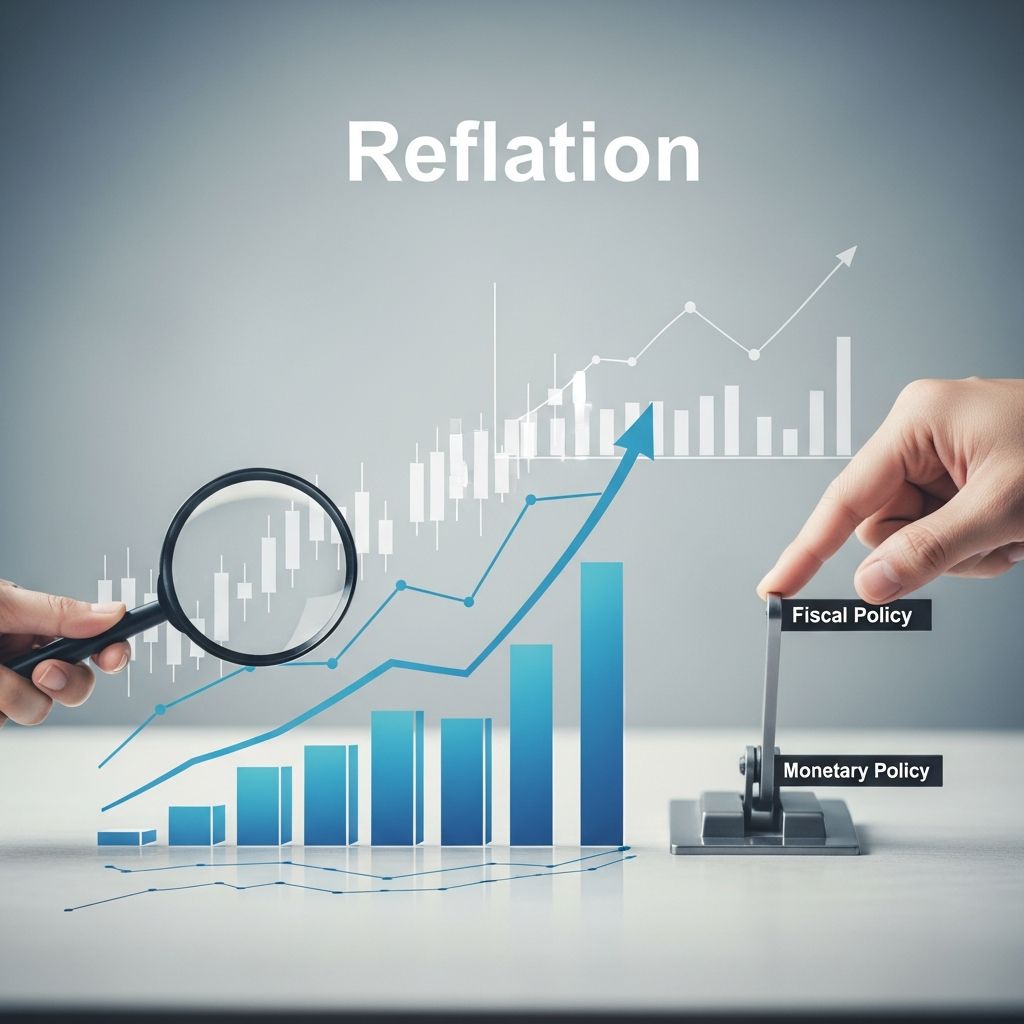
Reflation is a crucial economic concept that describes the deliberate efforts of governments and central banks to stimulate economic activity and restore price levels following a period of deflation or economic contraction. Unlike general inflation, which can erode purchasing power and create economic uncertainty, reflation is often viewed as a controlled and necessary intervention to restore economic health and stability. Understanding reflation is essential for investors, policymakers, and citizens who want to comprehend how economies recover from recessions and deflationary pressures.
Understanding Reflation: Definition and Core Concept
Reflation refers to a return of prices to a previous rate of inflation after they have fallen below the long-term trend line. More specifically, it is the implementation of fiscal or monetary policies designed to stimulate economic activity, increase aggregate demand, and combat the negative effects of deflation. When an economy experiences deflation—a general decline in prices for goods and services where inflation falls below zero percent—it creates a problematic environment characterized by reduced consumer spending, lower business investment, higher unemployment, and decreased output.
The primary goal of reflation is to restore the economy to its long-term growth trend and achieve a level of inflation consistent with sustainable economic expansion. For example, if an economy had been experiencing 3% annual inflation but dropped to 0% inflation for a year, reflation policies would aim to achieve approximately 6% inflation in the following year to return the economy to its long-term trend. This higher-than-normal inflation is considered reflation because it represents a return to the trend, not an exceeding of it.
Reflation vs. Inflation: Key Distinctions
While reflation and inflation are closely related terms, they have important differences that are critical to understand. Both refer to increases in the general price level of goods and services, but their contexts, causes, and consequences differ significantly.
Inflation is a broader term describing a sustained increase in prices over time, often caused by factors such as excess demand, increased money supply, or decreased production. Inflation can occur during any phase of the economic cycle and is not necessarily tied to economic recovery. When inflation runs too high, it erodes the purchasing power of currency and can create negative consequences including higher interest rates and increased costs of living.
Reflation, by contrast, specifically refers to price increases that occur following a period of economic contraction or deflation. It is a targeted response to combat deflationary pressures and stimulate economic growth. Reflation is generally viewed more favorably than general inflation because it occurs when the economy needs stimulus and can help restore employment, increase wages, and promote overall economic recovery.
Comparison Table: Reflation vs. Inflation
| Characteristic | Reflation | Inflation |
|---|---|---|
| Definition | Return to previous inflation rate after deflation | Sustained increase in general price levels |
| Context | Follows economic contraction or deflation | Can occur at any phase of economic cycle |
| Goal | Stimulate growth and end deflation | General increase in price levels |
| Economic View | Generally viewed positively | Can be viewed negatively if too high |
| Effects on Employment | Increases jobs and wages | May reduce purchasing power |
Reflation Policies and Implementation Methods
Governments and central banks employ various reflationary policies to stimulate economic activity and combat deflation. These policies can be broadly categorized into fiscal and monetary measures, each playing a distinct but complementary role in economic recovery.
Monetary Policy Tools
Monetary policies are implemented by central banks to influence the money supply and credit conditions in the economy. Key monetary reflation tools include:
- Lowering Interest Rates: Reducing the interest rates charged for borrowing makes it cheaper for businesses and consumers to access credit, encouraging investment and spending. Lower rates also make saving less attractive, incentivizing people to spend money rather than hold it in savings accounts.
- Increasing Money Supply: Central banks can increase the amount of currency and liquidity available in the banking system through open market operations and quantitative easing. This reduces the cost of money and encourages lending, investment, and consumer spending.
- Quantitative Easing (QE): During severe economic contractions, central banks may purchase long-term securities to inject liquidity directly into the financial system, boosting the money supply and encouraging lending.
Fiscal Policy Tools
Fiscal policies are implemented by governments through taxation and spending decisions. Key fiscal reflation tools include:
- Reducing Taxes: Lowering tax rates puts more money directly into the pockets of consumers and businesses, increasing disposable income and encouraging spending and investment. This increased demand helps lift prices and stimulate economic activity.
- Increasing Government Spending: Government investment in infrastructure, public services, and capital projects creates jobs and increases demand for goods and services, stimulating the broader economy.
- Transfer Payments: Direct assistance programs and stimulus payments provide immediate purchasing power to individuals, boosting consumer spending.
Why Reflation Matters: Economic Significance
Reflation is important for several fundamental reasons related to deflation prevention and sustainable economic growth. First, reflation serves as a tool to stop or reverse deflationary trends. Deflation is particularly problematic because it discourages spending and investment—when consumers expect prices to fall, they delay purchases, and when businesses expect lower revenues, they reduce investment and hiring. This creates a vicious cycle of declining demand, output, and employment.
Second, reflation helps reduce unemployment and increase wages. As reflationary policies boost aggregate demand, businesses increase production and hire more workers. This expanding employment base increases household incomes and spending power, creating further economic momentum.
Third, reflation supports asset prices and investment returns. During deflationary periods, asset values often decline as economic uncertainty increases. Reflation policies help stabilize and recover asset prices, protecting investors’ wealth and encouraging new investment in equities, commodities, and real estate.
Finally, reflation helps restore confidence in the economy. After periods of contraction and uncertainty, successful reflation demonstrates that policymakers are taking effective action, which can restore consumer and business confidence and accelerate recovery.
The Reflation Trade: Investment Strategy
Investors have developed specific strategies to capitalize on reflationary environments, known as the “reflation trade.” This strategy involves positioning investments in assets likely to benefit most from rising prices and increased economic activity. Common reflation trade assets include commodities such as oil, metals, and agricultural products, which typically rise in value as inflation increases; infrastructure stocks, which benefit from increased government spending; cyclical stocks in sectors like industrials, transportation, and retail; and value stocks, which often outperform during reflationary periods.
Historical Examples of Reflation
Throughout economic history, governments and central banks have implemented reflation policies with varying degrees of success. Understanding these historical examples provides insight into how reflation works in practice and its potential outcomes.
The 2008 Financial Crisis Response: Following the global financial crisis, major central banks, particularly the U.S. Federal Reserve, implemented unprecedented reflation policies including near-zero interest rates and multiple rounds of quantitative easing. These measures were designed to combat deflationary pressures and stimulate credit creation and spending. The Fed purchased trillions of dollars in securities, dramatically increasing the money supply and helping to stabilize financial markets and begin economic recovery.
COVID-19 Pandemic Response: When the COVID-19 pandemic triggered sharp economic contractions in 2020, governments and central banks responded with aggressive reflationary measures. This included interest rate cuts, quantitative easing, direct stimulus payments to individuals, and increased government spending on relief and recovery programs. These coordinated policies helped prevent deflation and supported relatively rapid economic recovery in many developed economies.
Challenges and Risks of Reflation
While reflation is generally viewed as necessary and beneficial during deflationary periods, it carries potential risks and challenges. If reflation policies are too aggressive or maintained too long, they can contribute to excessive inflation that exceeds the long-term trend. This can erode purchasing power, increase interest rates, and create economic uncertainty. Additionally, reflation policies may benefit certain groups more than others, potentially increasing income inequality. Asset price inflation during reflation can also create new bubbles in real estate, stocks, or commodities that may eventually burst.
Frequently Asked Questions About Reflation
Q: How is reflation different from stimulus?
A: While related, reflation and stimulus are not identical concepts. Reflation specifically refers to restoring price levels to a previous trend after deflation, while stimulus is a broader term for any policy designed to boost economic activity. All reflation involves stimulus, but not all stimulus is reflation.
Q: Can reflation lead to hyperinflation?
A: Yes, if reflation policies are excessively aggressive or poorly managed, they can contribute to runaway inflation. However, well-designed and monitored reflation policies generally avoid this by targeting a return to trend inflation rather than unlimited price increases.
Q: Who benefits most from reflation?
A: Reflation typically benefits workers through job creation and wage growth, businesses through increased consumer demand, borrowers through lower interest rates, and holders of hard assets and commodities. Savers may benefit less as returns on savings accounts decline.
Q: How long does reflation typically last?
A: The duration of reflation varies depending on the severity of the preceding deflation and the effectiveness of policy responses. It can last from months to several years, with the goal being to return the economy to sustainable growth within a reasonable timeframe.
Q: Is reflation always successful?
A: Reflation policies are often successful but not guaranteed. Success depends on factors including the severity of deflation, policy coordination, global economic conditions, and structural factors in the economy. Some reflation efforts have taken longer than expected or required additional policy adjustments.
Q: How do I invest during reflation?
A: During reflation, investors often focus on assets expected to benefit from rising prices and economic growth, including commodities, infrastructure stocks, cyclical stocks, and value equities. Consulting with a financial advisor about your specific situation is recommended before making investment decisions.
References
- Reflation – Overview, How It Works, Economic Impact — Corporate Finance Institute. https://corporatefinanceinstitute.com/resources/economics/reflation/
- Reflation — Wikipedia. https://en.wikipedia.org/wiki/Reflation
- Reflation Overview, Trade & Examples | What is Reflation? — Study.com. https://study.com/academy/lesson/reflation-overview-trade-examples.html
- REFLATION | definition in the Cambridge English Dictionary — Cambridge University Press. https://dictionary.cambridge.org/us/dictionary/english/reflation
- Understanding Reflation — Tata Mutual Fund. https://www.tatamutualfund.com/system/files/2023-06/understanding-reflation.pdf
Similar Articles








Read full bio of Sneha Tete