Undefined: Profit Explained And 3 Key Types
Master profit fundamentals: Learn how businesses calculate earnings and achieve financial success.

What Is Profit and How Does It Work?
Profit represents the financial benefit a business achieves when its revenue exceeds its expenses, costs, and taxes. At its core, profit is what remains after a company pays all its bills and operational costs. This fundamental concept serves as the cornerstone of business success, indicating whether a company is thriving or struggling financially. Understanding profit is essential for entrepreneurs, business owners, and investors who want to evaluate a company’s financial health and make informed decisions.
The basic profit formula is straightforward: Profit = Revenue – Expenses. However, calculating profit accurately requires understanding the different components and types of profit, each offering unique insights into various aspects of a company’s operations and overall financial position.
Understanding the Profit Formula
The fundamental profit equation appears simple on the surface, but its application becomes more complex when dealing with real-world business scenarios. Revenue includes all income generated from selling goods or services, while expenses encompass the total costs required to operate the business.
Expenses include several categories:
– Cost of goods sold (COGS): Direct production costs- Employee salaries: Compensation for staff- Rent and utilities: Facility-related expenses- Taxes: Mandatory government payments- Administrative costs: Office and management expenses- Marketing and promotional expenses: Customer acquisition costs
Accurately tracking these expenses is critical for proper profit calculation and maintaining financial health. Many businesses use accounting software and financial management systems to ensure precise expense categorization and tracking.
Why Profit Matters for Business
Profit is not merely a number on a financial statement; it serves multiple critical functions for business sustainability and growth.
Long-Term Sustainability
Without profit, a business cannot survive long-term. Profit provides the financial cushion that allows companies to weather economic downturns, unexpected expenses, and market fluctuations. It ensures the business has resources to continue operations regardless of external circumstances.
Funding Growth and Expansion
Profit generates the capital necessary for business expansion and improvement. Companies reinvest profits into new equipment, technology, infrastructure, and product development, enabling them to scale operations and reach new markets.
Attracting Investment and Financing
Profitable companies are significantly more attractive to investors and lenders. Banks and investors evaluate profit margins and profitability trends when deciding whether to provide loans or investment capital. A strong profit history demonstrates competent management and viable business models.
Creating Employment Opportunities
As businesses grow and generate profits, they typically hire more employees, contributing to job creation and economic development. Profit growth often correlates with business expansion and increased hiring capacity.
Contributing to Economic Growth
Profitable businesses strengthen the broader economy through tax payments, consumer spending, and capital investment. They contribute to GDP growth and support communities through various economic activities.
The Three Types of Profit
Businesses calculate profit at different stages of their income statement, with each type revealing different aspects of financial performance. Understanding these distinctions is crucial for comprehensive financial analysis.
Gross Profit
Gross profit represents the initial profit calculation and is determined by subtracting the cost of goods sold (COGS) from total revenue.
Gross Profit = Revenue – Cost of Goods Sold
Gross profit reveals production efficiency and the viability of core products or services. It shows how much money remains after accounting for direct production costs but before considering operating expenses. A healthy gross profit margin indicates that a company can efficiently produce or purchase goods at reasonable costs.
Gross profit is particularly important because it:
– Helps determine appropriate pricing strategies- Indicates operational efficiency in production- Identifies opportunities to optimize production costs- Signals production viability to investors
Operating Profit
Operating profit, also called operating income, is calculated by subtracting operating expenses from gross profit. Operating expenses include administrative costs, rent, salaries, marketing expenses, and other costs related to running daily business operations.
Operating Profit = Gross Profit – Operating Expenses
This measurement is valuable because it shows how well a company manages its core operations independent of financing structure or tax situation. Operating profit reveals whether the company’s fundamental business model is profitable before considering external financial factors.
Net Profit
Net profit, often called the “bottom line,” is the final profit calculation shown on the income statement. It represents the remaining revenue after accounting for every business expense, including taxes, interest payments, and all operational costs.
Net Profit = Operating Profit – Tax and Interest Costs
Net profit provides the most comprehensive view of a company’s financial health. It shows exactly how much money the business keeps after all obligations are met. This figure is crucial for shareholders, investors, and business owners because it represents the actual profit available for distribution, reinvestment, or retained earnings.
Profit Margins and Profitability Ratios
Beyond absolute profit numbers, profitability ratios provide context by showing profit as a percentage of revenue. These ratios enable meaningful comparisons across companies of different sizes and industries.
Gross Profit Margin
Formula: (Gross Profit / Revenue) × 100
This metric reveals the percentage of revenue remaining after covering COGS. A higher gross profit margin indicates efficient production and strong pricing power, suggesting the company can cover production costs effectively while maintaining healthy profit levels.
Operating Profit Margin
Formula: (Operating Profit / Revenue) × 100
This ratio shows the percentage of revenue left after covering both COGS and operating expenses. A higher operating profit margin indicates better management of operational costs and more efficient business operations overall.
Net Profit Margin
Formula: (Net Profit / Revenue) × 100
This fundamental profitability metric indicates the percentage of revenue that translates into actual profit after all expenses. Net profit margin is often used to benchmark company performance against competitors and industry standards. A company with a 10% net profit margin, for example, generates $10 in profit for every $100 in revenue.
Key Differences: Gross Profit vs. Net Profit
| Factor | Gross Profit | Net Profit |
|---|---|---|
| Calculation | Revenue – COGS | Revenue – All Expenses |
| Expenses Considered | Production costs only | All business expenses |
| What It Reveals | Production efficiency | Overall profitability |
| Uses | Pricing strategy, production analysis | Financial health, investor assessment |
| Scope | Limited operational view | Complete financial picture |
Strategies to Increase Profit
Businesses can improve profitability through two primary approaches: increasing revenue and decreasing expenses. Most successful companies employ strategies from both categories.
Increase Revenue
Companies might boost revenue through several methods:
– Raising prices when market research indicates customers are willing to pay more- Diversifying product offerings to encourage increased purchases- Expanding marketing efforts to reach new customer segments- Launching new products or services- Improving customer retention and repeat purchase rates
More revenue directly translates to higher profits provided operating costs remain stable or grow at a slower rate than revenue.
Decrease Expenses
Reducing expenses directly improves profit without requiring additional sales. Cost reduction strategies include:
– Purchasing supplies in bulk to minimize per-unit costs- Negotiating better rates with suppliers- Reducing administrative overhead- Implementing energy-efficient practices- Automating repetitive processes- Streamlining operations to eliminate inefficiencies
Improving Operational Efficiency
Enhanced operational efficiency boosts profit margins without sacrificing quality. Key strategies include:
– Streamlining processes to eliminate bottlenecks- Investing in employee training for improved productivity- Implementing lean management principles to reduce waste- Utilizing data analytics for informed decision-making- Monitoring and controlling operational expenses regularly- Investing in technology to automate and optimize workflows
Optimize Pricing Strategy
Strategic pricing balances profit maximization with market competitiveness. Businesses should regularly analyze market conditions, competitor pricing, and customer willingness to pay to establish optimal price points that maximize both sales volume and profit margins.
Industry-Specific Profit Considerations
Manufacturing Businesses
Manufacturing companies face unique profit challenges including:
– Production efficiency to minimize waste and maximize output- Managing fluctuations in raw material costs- Balancing equipment maintenance costs against production downtime- Leveraging economies of scale to reduce per-unit production costs- Managing inventory levels to optimize cash flow
Service-Based Businesses
Service companies focus on different profit drivers:
– Labor efficiency and employee productivity- Service pricing based on value delivered- Scalability of service delivery- Client retention and lifetime value- Managing operating expenses like facilities and technology
Retail Businesses
Retail profitability depends on:
– Inventory management and turnover rates- Supplier relationships and purchasing power- Operational efficiency across locations- Customer acquisition costs and lifetime value- Managing rent and overhead expenses
Additional Profitability Metrics
EBITDA
Earnings Before Interest, Taxes, Depreciation, and Amortization (EBITDA) provides insight into operational profitability without financing and accounting structure effects. This metric is useful for comparing companies with different capital structures or tax situations, making it particularly valuable for evaluating acquisition targets or comparing companies across different countries.
EBITDA = Net Income + Interest + Taxes + Depreciation + Amortization
Return on Investment (ROI)
ROI measures whether specific investments generate financial benefits. By dividing financial benefits by investment costs, businesses determine whether capital expenditures are justified. For example, a bakery investing $2,000 in a website that generates $5,000 in additional monthly revenue has realized a strong ROI on that investment.
Profit vs. Revenue: Critical Distinctions
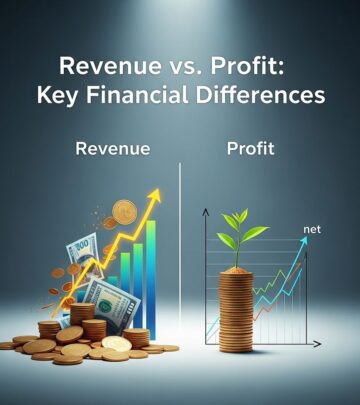
Revenue and profit are fundamentally different concepts often confused by those new to business finance. Revenue represents the total income generated from all sales before any expenses are deducted. Profit, by contrast, is revenue minus expenses. A company can generate significant revenue while operating at a loss if expenses exceed revenues. Understanding this distinction is essential for accurate financial analysis and strategy development.
Frequently Asked Questions
Q: What is the simplest way to calculate profit?
A: The simplest calculation is Revenue minus Expenses equals Profit. However, more detailed profit analysis requires categorizing expenses by type and calculating gross, operating, and net profit separately to gain complete financial insight.
Q: Why do some companies with high revenue have low profit?
A: Companies can have high revenue but low profit if operating expenses are disproportionately high relative to revenue. High rent, salaries, marketing costs, or taxes can consume most revenue, leaving minimal net profit despite strong sales performance.
Q: How can a small business improve profit without increasing sales?
A: Small businesses can improve profit by reducing operating expenses, negotiating better supplier rates, implementing more efficient processes, automating tasks, reducing waste, and optimizing inventory management to free up cash flow.
Q: What profit margin is considered healthy?
A: Healthy profit margins vary significantly by industry. Retail typically operates on 2-5% net margins, while professional services might achieve 10-20%. Businesses should benchmark against industry standards and competitors to assess whether their margins are competitive.
Q: How does profit relate to business valuation?
A: Businesses are often valued based on their profit history and projected future profitability. Higher profits and consistent profit growth increase business valuation, making the company more attractive to potential buyers, investors, and lenders.
References
- What Is Profit? (With 3 Important Profit Equations) — Indeed Career Advice. 2025. https://www.indeed.com/career-advice/career-development/what-is-profit
- Profit in Business Explained: Definition, Types, and Examples — Cost Analysts. 2025. https://www.costanalysts.com/business-profit/
- What Is Profit? Definition and Meaning — NetSuite. 2025. https://www.netsuite.com/portal/resource/articles/accounting/profit.shtml
- Revenue vs. Profit: Key Differences Explained — BillingPlatform. 2025. https://billingplatform.com/blog/revenue-vs-profit
- Gross Profit vs. Net Profit Explained Simply — Salesforce. 2025. https://www.salesforce.com/ap/sales/gross-profit-vs-net-profit/
- The Basics of Generating Profits and Building a Thriving Business — First Citizens Bank. 2025. https://www.firstcitizens.com/small-business/insights/finance/how-to-generate-profits
Similar Articles








Read full bio of Sneha Tete