What Is a Petrodollar: Definition and History
Understanding petrodollars: the currency system linking oil exports to U.S. dollars.
What Is a Petrodollar?
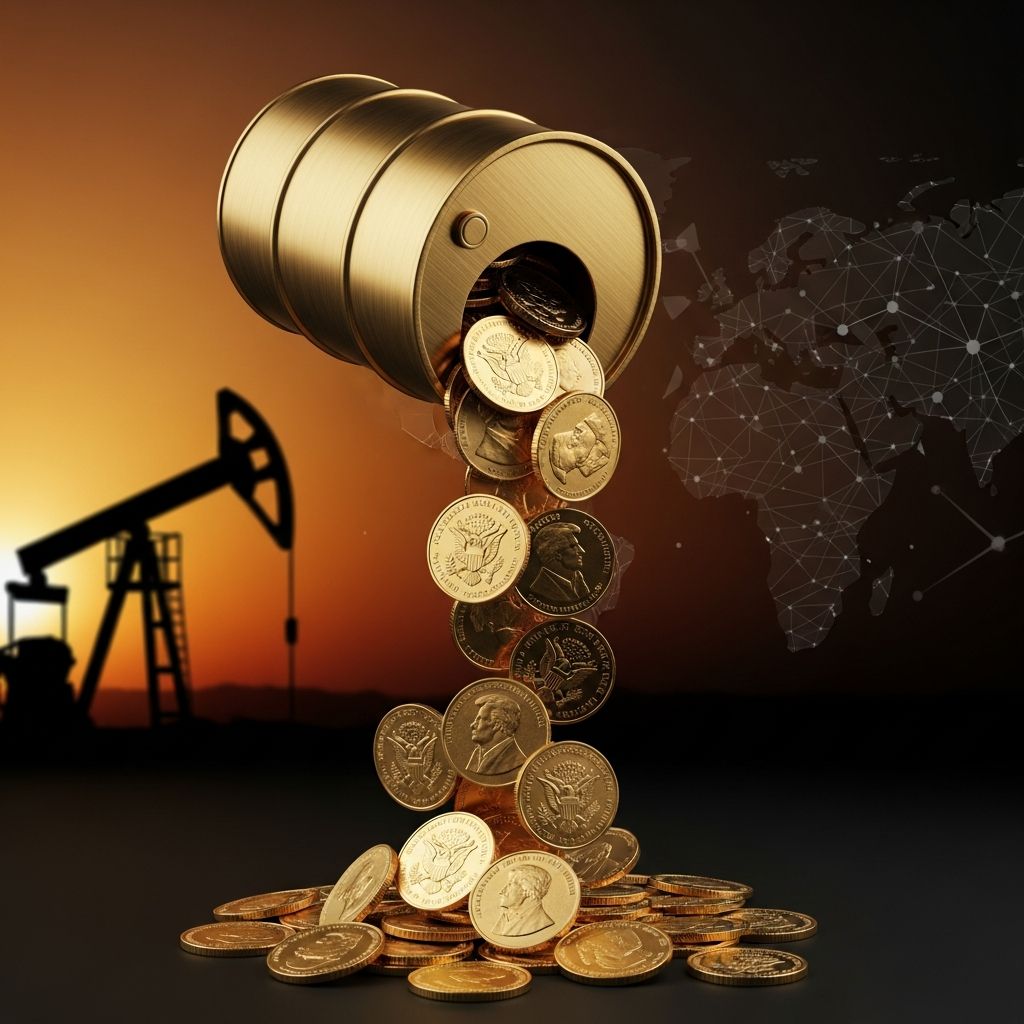
A petrodollar is a U.S. dollar that an oil-exporting country receives as payment for selling crude oil on the international market. The term gained widespread recognition in the 1970s when the global oil crisis dramatically increased crude oil prices and fundamentally reshaped international trade relationships. While a simple definition might describe petrodollars as “U.S. dollars paid to oil-exporting countries,” this explanation overlooks the historical significance and complex economic implications of how this system came into existence and why it became so influential in shaping global finance and geopolitics.
The petrodollar system represents more than just a currency exchange mechanism—it reflects a deliberate economic arrangement that emerged from specific geopolitical circumstances and has profoundly influenced international commerce, investment patterns, and the relative power of nations in the global economy. Understanding petrodollars requires examining the historical events that led to their creation and the mechanisms through which they continue to operate today.
The Origins of the Petrodollar System
The petrodollar system did not emerge spontaneously but rather resulted from three pivotal events that occurred during the early 1970s. These events converged to create the conditions necessary for establishing a new economic relationship between the United States and oil-exporting nations, fundamentally altering the structure of international finance.
The End of the Bretton-Woods System (1971)
The Bretton-Woods agreement, signed in 1945 following World War II, established a monetary management framework for the United Kingdom, United States, France, Germany, and approximately 40 other nations. This system was built on the principle that currencies would be pegged to the U.S. dollar, which itself was fixed to gold at a rate of $35 per ounce. This arrangement essentially placed the entire world on an indirect gold standard, where nations did not need to maintain large gold reserves themselves because they could rely on the stability provided by the U.S. dollar’s gold backing.
However, by the early 1970s, the U.S. faced mounting economic pressures, including significant trade deficits and rising inflation. The nation’s gold reserves had declined substantially as countries began redeeming dollars for gold, creating concerns about the U.S. government’s ability to maintain the gold peg. On August 15, 1971, President Richard Nixon made the historic decision to end the Bretton-Woods system by canceling the gold peg of the U.S. dollar. While initially framed as a temporary measure intended to strengthen the American economy, this move fundamentally restructured the global monetary system and had immediate reverberations throughout international markets.
The 1973 Oil Crisis and OPEC Embargo
The second critical event that precipitated the petrodollar system was the 1973 oil embargo declared by OPEC nations. In response to U.S. support for Israel during the Yom Kippur War, six OPEC member countries—including Saudi Arabia, Kuwait, Abu Dhabi, Qatar, Libya, and Algeria—declared an embargo on oil exports to the United States and the Netherlands. This embargo came at a particularly vulnerable moment for Western economies, as it followed the recent devaluation of the U.S. dollar caused by the collapse of the Bretton-Woods system.
The consequences were dramatic and immediate. Crude oil prices did not merely increase; they doubled, then quadrupled over a short period. Western industrialized countries faced their first significant oil shortages in decades, triggering widespread economic disruption. The combination of the dollar’s devaluation and skyrocketing oil prices created a phenomenon known as stagflation—simultaneous high inflation and economic stagnation—that plagued the U.S. economy and created urgent pressure to resolve the oil crisis.
The U.S.-Saudi Arabia Petrodollar Agreement (1973)
The third and most consequential event was the negotiation of a groundbreaking agreement between the United States and Saudi Arabia. In 1973, U.S. Secretary of State Henry Kissinger brokered a landmark deal with the House of Saud. In exchange for advanced military equipment, military training, and security guarantees—including an implicit commitment that the U.S. would defend Saudi Arabia militarily if the kingdom faced invasion—Saudi Arabia agreed to price and sell its oil exclusively in U.S. dollars.
This agreement was transformative because it addressed multiple challenges simultaneously. For the United States, it ensured stable access to vital oil supplies priced in American currency. For Saudi Arabia, it provided military protection and economic support during a period of regional instability. By 1975, other OPEC countries had followed Saudi Arabia’s example and adopted the petrodollar system, even though they had not negotiated individual security agreements with the United States as favorable as Saudi Arabia’s original deal.
Petrodollar Recycling
The creation of the petrodollar system immediately generated a new challenge that required creative economic thinking. When oil prices surged during the 1970s, oil-exporting nations accumulated vast quantities of U.S. dollars far exceeding their capacity to spend domestically. In 1974, The Economist famously asked in its first issue of the year: “What are the Arabs going to do with it all?” The “it” referred to the enormous sums of dollars flowing to OPEC nations.
The Concept of Petrodollar Recycling
Henry Kissinger, recognizing the potential problem and opportunity inherent in these massive dollar accumulations, promoted what became known as “petrodollar recycling.” This term describes the process by which oil-exporting countries, particularly those in the Gulf region, invest their surplus oil revenues into foreign assets and economies rather than attempting to spend them immediately in domestic markets.
Kissinger strategically suggested to Saudi King Faisal that, while Saudi Arabia could charge whatever prices it wished for oil, the kingdom would be well-served to invest its surplus revenues in U.S. government debt—Treasury bonds and other American financial instruments. The implicit understanding was that maintaining robust U.S. Treasury investments would reinforce the security relationship between the two nations and encourage continued American commitment to Saudi Arabia’s defense.
Global Investment Patterns
Petrodollar recycling fundamentally transformed international capital flows and investment patterns. Oil-exporting nations, constrained by limited opportunities for domestic investment and seeking to preserve and grow their wealth, directed massive capital flows toward developed economies. These investments took multiple forms, including:
- U.S. Treasury bonds and government securities
- Equities in major stock markets
- Real estate and commercial property
- Infrastructure projects and development initiatives
- Private equity investments and corporate acquisitions
During periods of high oil prices, Gulf nations established sovereign wealth funds such as the Abu Dhabi Investment Authority and the Qatar Investment Authority, which expanded their global portfolios significantly across the United States, Europe, and Asia. These investments had profound effects on recipient economies, providing capital for infrastructure development, corporate expansion, and financial market stability.
The Global Impact of Petrodollars
The petrodollar system created interconnected global economic relationships that extended far beyond simple oil commerce. By making the U.S. dollar the essential currency for international oil transactions, the system reinforced American economic dominance and created worldwide demand for dollar reserves. Every nation requiring energy imports needed to maintain substantial dollar holdings to purchase oil on the international market.
This arrangement provided significant advantages to the United States, including the ability to finance budget deficits and maintain lower interest rates than would otherwise be possible. However, it also created vulnerabilities for oil-importing nations that faced rising energy costs and currency pressures when oil prices increased.
The Evolution and Decline of the Petrodollar Monopoly
For approximately 45 years following its establishment, the petrodollar system maintained near-complete dominance over OPEC oil trading. However, this monopoly began to erode in the 2010s as geopolitical relationships shifted and alternative currency arrangements became feasible. In 2018, Saudi Arabia conducted its first oil sale priced in a currency other than the U.S. dollar, marking a symbolic break from the exclusive petrodollar arrangement that had governed for nearly five decades.
Several factors contributed to this gradual decline, including the development of alternative currencies like the Chinese yuan, renewed tensions between the United States and various oil-producing nations, and the emergence of bilateral trade arrangements that bypassed traditional dollar-denominated commerce. Some nations began settling oil transactions in alternative currencies or barter arrangements, signaling that the absolute dominance of the petrodollar was no longer assured.
Is the Petrodollar Dead?
Despite the emergence of alternative currency arrangements and high-profile transactions in other currencies, the petrodollar system remains resilient and functional, though no longer absolute. OPEC nations still predominantly accept U.S. dollars for oil sales, and the vast majority of international oil trading continues to be denominated in dollars. While the exclusivity of the petrodollar arrangement has diminished, its fundamental role in global oil commerce persists.
The system is more accurately described as evolving rather than dying. Nations increasingly have the flexibility to transact in multiple currencies, and the geopolitical context that initially created the petrodollar system has transformed. Nevertheless, the dollar’s entrenchment as the primary international oil currency, combined with the depth and liquidity of American financial markets, means the petrodollar remains a cornerstone of global trade and finance.
Historical Significance and Lasting Effects
The petrodollar system represents a fascinating intersection of economic policy, geopolitical strategy, and international finance. It emerged from specific historical circumstances—the collapse of the gold standard, the oil embargo, and calculated diplomacy—but created enduring structures that shaped decades of global commerce and investment patterns. The sovereign wealth funds that accumulated through petrodollar recycling continue to influence international asset prices and economic relationships.
Understanding the petrodollar requires appreciating how economic systems reflect both pragmatic problem-solving and strategic national interest. The arrangement solved immediate crises—stabilizing oil supplies for the West while providing security guarantees to Saudi Arabia—but also created long-term structural relationships that continue to define international economics.
Frequently Asked Questions
Q: When was the petrodollar system established?
A: The petrodollar system was formally established in 1973 through an agreement between the United States and Saudi Arabia, though the broader OPEC adoption occurred by 1975.
Q: Why did oil-exporting countries choose to accept U.S. dollars?
A: Oil-exporting countries, particularly Saudi Arabia, accepted U.S. dollars in exchange for military support, security guarantees, and access to advanced technology and training from the United States.
Q: What is petrodollar recycling?
A: Petrodollar recycling refers to the process where oil-exporting nations invest their surplus oil revenues into foreign assets, including U.S. Treasury bonds, equities, real estate, and infrastructure projects in developed economies.
Q: Does the petrodollar system still exist today?
A: Yes, the petrodollar system remains in place, though it is no longer exclusive. OPEC nations still predominantly accept U.S. dollars for oil, but increasingly have the flexibility to transact in alternative currencies.
Q: How did the end of the Bretton-Woods system relate to petrodollar creation?
A: When the Bretton-Woods system collapsed in 1971 and the U.S. dollar lost its gold backing, the petrodollar system provided an alternative basis for the dollar’s international demand and value.
Q: Which countries were most affected by the 1973 oil embargo?
A: The United States and the Netherlands were the primary targets of the 1973 OPEC oil embargo, which was declared in response to their support for Israel during the Yom Kippur War.
References
- Petrodollar Collapse: The Invention, Rise and Fall of the Petrodollar — Birch Gold Group. 2024. https://www.birchgold.com/blog/finance/petrodollar-collapse/
- Understanding the Petrodollar — AvaTrade. 2024. https://www.avatrade.com/education/market-terms/what-is-the-petrodollar
- Petrodollar (History of the Middle East – 1800 to Present) — Fiveable. 2024. https://fiveable.me/key-terms/history-middle-east-since-1800/petrodollar
- The Nixon Shock and the Birth of the Petrodollar — In Gold We Trust Report. 2024. https://ingoldwetrust.report/timeline-posts/the-nixon-shock-and-the-birth-of-the-petrodollar/
- Petrocurrency — Wikipedia. 2024. https://en.wikipedia.org/wiki/Petrocurrency
Similar Articles








Read full bio of medha deb