What Is Percentage Change and How to Calculate It
Master percentage change calculations with formulas, examples, and practical applications for financial analysis.
What Is Percentage Change?
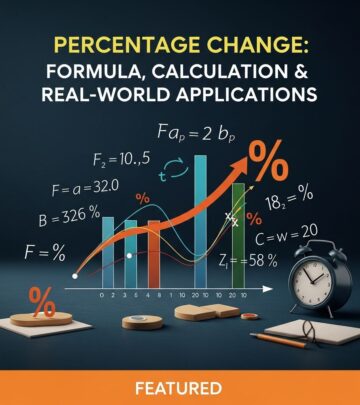
Percentage change is a fundamental financial and mathematical concept that measures how much a quantity has changed relative to its original value, expressed as a percentage. This metric is essential for comparing values across different scales and time periods, making it invaluable in finance, investing, economics, and business analysis. Unlike absolute changes that simply show the difference between two numbers, percentage change provides context by relating that difference to the starting point.
The percentage change gives you insight into the rate of growth or decay of a quantity. When you invest $1,000 in a stock and it grows to $1,100, you might say it increased by $100. However, if you had invested $100,000 and it grew to $101,000, both showed the same absolute increase of $100, but the percentage changes are vastly different. The first represents a 10% gain while the second represents just a 0.1% gain. This is why percentage change is so crucial—it normalizes changes across different starting values.
Understanding the Percentage Change Formula
The standard formula for calculating percentage change is straightforward and forms the foundation for all percentage change calculations:
Percentage Change = ((Final Value – Initial Value) ÷ Initial Value) × 100
Breaking down this formula:
- Final Value: The ending or new value after the change has occurred
- Initial Value: The starting or original value before any change
- The Difference: (Final Value – Initial Value) represents the absolute change amount
- Division by Initial Value: This normalizes the change relative to where you started
- Multiplication by 100: Converts the decimal to a percentage
Understanding each component helps you apply the formula correctly and interpret results accurately. The initial value serves as the reference point, which is why it appears in the denominator—it anchors the comparison.
How to Calculate Percentage Change Step by Step
Calculating percentage change involves a systematic approach that anyone can master with practice. Here’s how to calculate it properly:
Step 1: Identify Your Values
First, clearly identify which value is your initial (original) value and which is your final (new) value. This distinction is critical because reversing them will give you an incorrect result. The initial value is always what you started with, while the final value is what you ended with after the change.
Step 2: Calculate the Difference
Subtract the initial value from the final value. This gives you the absolute change amount. If the result is positive, the value increased. If negative, the value decreased.
Step 3: Divide by the Initial Value
Take your difference and divide it by the initial value. This step is essential because it expresses the change as a ratio of the starting point, making it comparable across different scales.
Step 4: Multiply by 100
Convert your decimal result to a percentage by multiplying by 100. This final step transforms the ratio into a percentage format that’s easy to understand and communicate.
Example Calculation:
If a stock price increases from $50 to $75:
- Difference: $75 – $50 = $25
- Divide by initial: $25 ÷ $50 = 0.5
- Multiply by 100: 0.5 × 100 = 50%
The stock increased by 50%, which is more meaningful than simply saying it increased by $25.
Percentage Increase vs. Percentage Decrease
Percentage change can go in two directions: increases and decreases. Understanding both scenarios is important for comprehensive financial analysis.
Percentage Increase: When the final value is greater than the initial value, you have a percentage increase. The result will be a positive number. For example, if your salary increases from $50,000 to $55,000, you have a 10% increase.
Percentage Decrease: When the final value is less than the initial value, you have a percentage decrease. The result will be a negative number. For example, if a product’s price drops from $100 to $80, you have a -20% decrease.
Both types of changes use the same formula—the sign of the result automatically indicates whether it’s an increase or decrease.
Real-World Applications of Percentage Change
Stock Market and Investments
Stock market reports frequently quote percentage changes to show how individual securities or indices have performed. When a stock is reported to have increased by 5% since the previous close, this represents the percentage change from yesterday’s closing price to today’s price. This normalization allows investors to compare the performance of a $5 stock that gained $0.25 with a $500 stock that gained $25—both represent 5% gains.
Financial Analysis and Business Metrics
Companies use percentage change to evaluate business performance over time. Revenue growth, profit margins, expense reductions, and customer base expansion are all frequently expressed as percentage changes. This helps stakeholders understand not just the absolute numbers, but the rate of change relative to the baseline.
Economic Indicators
Government agencies and economists use percentage changes to track inflation, unemployment rates, GDP growth, and other economic metrics. These measurements help policymakers make informed decisions about the economy’s health and direction.
Personal Finance
Individual investors use percentage change to track investment returns, evaluate savings growth, and assess changes in net worth. If your investment portfolio grows from $100,000 to $110,000, the 10% increase is more meaningful than the $10,000 absolute increase when comparing it to your starting baseline.
Percentage Difference vs. Percentage Change
While these terms sound similar, they represent different concepts that shouldn’t be confused.
| Aspect | Percentage Change | Percentage Difference |
|---|---|---|
| Definition | Change relative to the initial value | Difference between two values |
| Direction | Has directional meaning (increase/decrease) | No directional meaning |
| Reference Point | Uses initial value as reference | Uses average of both values |
| Formula | ((Final – Initial) ÷ Initial) × 100 | |Value1 – Value2| ÷ ((Value1 + Value2) ÷ 2) × 100 |
| Use Case | Tracking growth or decline over time | Comparing two similar values |
Understanding this distinction helps you choose the right metric for your analysis. Percentage change is appropriate when you have a clear starting point and ending point. Percentage difference is better when comparing two values without a clear temporal sequence.
Important Considerations When Calculating Percentage Change
Always Use Absolute Value for Initial Value
When calculating percentage change, use the absolute value of the initial value. This prevents mathematical errors when dealing with negative numbers or unusual scenarios.
Clarify Change Amount vs. Change Rate
The change amount refers to the simple difference (final minus initial), while the change rate refers to the percentage change. These are distinct concepts that serve different purposes. Always specify which one you’re discussing to avoid confusion.
Consecutive Percentage Changes Are Not Additive
If a value increases by 10% in year one and decreases by 6% in year two, the overall change is not simply 4%. If you started with $100, after a 10% increase you’d have $110. After a 6% decrease on that amount, you’d have $103.40, representing a 3.4% overall increase. Each percentage is applied to a different base amount.
The Order Matters
In calculations involving multiple percentage changes, the order in which changes occur affects the final result. This is another reason why consecutive percentage changes cannot be simply added or subtracted.
Advanced Applications: Compound Percentage Changes
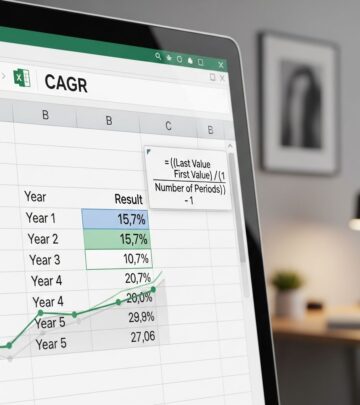
When tracking changes over multiple periods, such as investment returns over several years, you may need to calculate the periodic percentage change or compound annual growth rate (CAGR). The formula for periodic percent change is:
Periodic Percent Change = ((New Amount ÷ Original Amount)^(1/Number of Periods) – 1)
This advanced calculation provides a more accurate picture of growth across multiple time periods, smoothing out volatility and showing the average rate of change per period. It’s particularly useful when comparing investments or economic indicators across different time frames.
Frequently Asked Questions
What is the difference between percentage change and absolute change?
Absolute change is simply the difference between final and initial values (Final – Initial). Percentage change expresses this difference as a percentage of the initial value, making it comparable across different scales and magnitudes.
Can percentage change be calculated for percentages themselves?
Yes. If your profit margin increases from 15% to 18%, you can calculate the percentage change using the same formula: (18 – 15) ÷ 15 × 100 = 20%. This indicates a 20% increase in your profit margin.
How do I interpret a negative percentage change?
A negative percentage change indicates a decrease from the initial value. For example, a -15% change means the final value is 15% lower than the initial value. The negative sign conveys the direction of change.
Why is percentage change important in investing?
Percentage change normalizes investment returns across different initial investment amounts, allowing fair comparison of performance. A stock that gains 5% and another that gains 5% have performed equally well regardless of their absolute share prices.
How do I calculate the original value if I know the percentage change?
Rearrange the formula: Initial Value = Final Value ÷ (1 + (Percentage Change ÷ 100)). For example, if you know a value increased by 20% to reach $1,200, the original value was $1,200 ÷ 1.2 = $1,000.
What is compound annual growth rate (CAGR)?
CAGR represents the smoothed annual rate of return for an investment over multiple years. It accounts for compounding by calculating the geometric mean of annual growth rates, providing a more realistic picture than simple average percentage change.
References
- Percentage Change – Definition, Formula, Examples — Cuemath. Accessed November 2025. https://www.cuemath.com/commercial-math/percentage-change/
- Percent Change Meaning — Stockopedia. Accessed November 2025. https://www.stockopedia.com/ratios/percent-change-983/
- How To Calculate Percentage Difference — Indeed Career Advice. Accessed November 2025. https://www.indeed.com/career-advice/career-development/how-to-calculate-percentage-difference
- 2.1 Percent Change – Fundamentals of Business Math — eCampus Ontario Pressbooks. Accessed November 2025. https://ecampusontario.pressbooks.pub/fundamentalsofbusinessmath/chapter/section-2-1-percent-change/
- Calculating percent changes — U.S. Bureau of Labor Statistics. Accessed November 2025. https://www.bls.gov/cpi/factsheets/calculating-percent-changes.htm
Similar Articles








Read full bio of Sneha Tete