What is Money: Definition, Functions, and Types
Understanding money: Explore its definition, core functions, and diverse forms in the modern economy.

What is Money?
Money is one of the most fundamental concepts in economics and finance, yet many people take its existence for granted without fully understanding what it is or how it functions. At its core, money is a medium of exchange that allows individuals and businesses to conduct transactions efficiently. However, this simple definition belies the complex role that money plays in modern economies and the intricate systems that support its circulation and valuation.
Historically, money has taken many forms. Before the invention of currency, societies relied on barter systems, where goods were directly exchanged for other goods. This system had significant limitations, as it required a “double coincidence of wants”—both parties had to want exactly what the other was offering. The introduction of money solved this fundamental problem, creating a universally accepted medium that could be used to facilitate any transaction.
The Definition of Money
Money can be defined as anything that is widely accepted as a means of payment for goods and services within an economy. More formally, economists define money as any asset that serves as a store of value, a medium of exchange, and a unit of account. This definition encompasses not only physical currency but also digital money, cryptocurrencies, and other forms of financial instruments that fulfill these key criteria.
The essential characteristic of money is that it must be accepted by the majority of people in an economy. Without widespread acceptance, an asset cannot function as money. For example, while gold was historically used as money because people widely accepted it as valuable, today’s fiat currencies maintain their value primarily through government decree and public confidence in the monetary system.
The Three Primary Functions of Money
Money serves three critical functions in any economy. Understanding these functions is essential to grasping why money is so important and how it enables economic activity:
1. Medium of Exchange
The most important function of money is serving as a medium of exchange. This means money can be used to purchase goods and services without requiring a direct barter arrangement. By accepting money as payment, sellers know they can use it to buy whatever they need later. This function eliminates the inefficiencies of barter and allows economies to operate smoothly and efficiently. When you go to a grocery store and pay with currency or a card, you’re utilizing money’s fundamental function as a medium of exchange.
2. Store of Value
Money also functions as a store of value, meaning it can be held and used in the future without losing its purchasing power. Unlike perishable goods that deteriorate over time, money retains its usefulness. This function allows individuals to save money today and spend it tomorrow, next month, or even years in the future. While inflation can erode the purchasing power of money over time, it remains one of the most reliable stores of value available to ordinary people. This function is crucial for long-term financial planning and economic stability.
3. Unit of Account
The third function of money is serving as a unit of account, providing a standard measure of value for goods and services. Instead of stating that a car is worth ten cows or fifty sheep, we can express its value in a common currency unit. This function simplifies price comparisons and makes it easier for individuals and businesses to plan budgets, set prices, and conduct financial calculations. Without a standardized unit of account, comparing the value of different goods and services would be extremely difficult.
Types of Money
Throughout history and in modern times, several different types of money have emerged. Each type has distinct characteristics and serves different roles in the financial system:
Commodity Money
Commodity money is money whose value derives from the intrinsic worth of the physical material from which it is made. Gold and silver coins are classic examples of commodity money. The value of a gold coin was based on the actual gold content within it. Commodity money was prevalent throughout history because the material itself had intrinsic value, which gave people confidence in accepting it as payment. However, commodity money systems are limited because their expansion is constrained by the availability of the underlying commodity.
Fiat Money
Fiat money is currency that has value primarily because a government has declared it to be legal tender, not because it is backed by a physical commodity. Modern currencies like the U.S. dollar, the Euro, and the British pound are all fiat money. The value of fiat money depends on the stability of the issuing government and public confidence in the monetary system. Unlike commodity money, fiat money has no intrinsic value; its value is based entirely on supply and demand dynamics and the confidence people have in the issuing authority.
Fiduciary Money
Fiduciary money refers to money whose value depends on the confidence that it can be exchanged for something of value. Bank notes and checks are examples of fiduciary money. A check represents a claim on actual funds held in a bank account, and its value depends on the credibility of the issuing bank and the account holder’s ability to cover it.
Digital and Cryptocurrency
In the modern era, digital money and cryptocurrencies represent newer forms of money. Digital money includes electronic transfers, credit card transactions, and bank account balances. Cryptocurrencies like Bitcoin and Ethereum operate on blockchain technology and offer decentralized alternatives to traditional government-issued currencies. While still emerging and volatile, cryptocurrencies represent an important evolution in how money functions in the digital age.
Money Supply and Monetary Policy
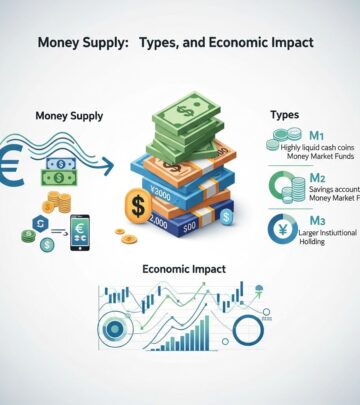
The total amount of money in circulation within an economy is called the money supply. Central banks, such as the Federal Reserve in the United States, carefully manage the money supply to promote economic stability and achieve policy objectives. The money supply is typically measured in different ways:
- M1: Includes physical currency in circulation and demand deposits that can be withdrawn on demand
- M2: Includes M1 plus savings deposits and money market accounts
- M3: Includes M2 plus larger time deposits and other less liquid assets
Monetary policy, controlled by central banks, involves adjusting the money supply and interest rates to influence economic activity. By increasing the money supply, central banks can stimulate borrowing and spending, potentially promoting economic growth. Conversely, reducing the money supply can help control inflation by reducing the amount of money chasing goods and services.
The Value of Money
The value of money is determined by several factors, including supply and demand, inflation rates, interest rates, and international exchange rates. When the money supply increases faster than economic output, inflation typically rises, eroding the purchasing power of money. Conversely, when the money supply grows slower than the economy, deflation may occur, increasing the value of money but potentially discouraging spending and investment.
Exchange rates determine the value of one currency relative to another in international markets. A strong dollar, for example, means that U.S. dollars can purchase more foreign currency, while a weak dollar means they can purchase less. These exchange rates fluctuate based on differences in interest rates, inflation, economic growth, and market sentiment regarding different currencies.
Historical Evolution of Money
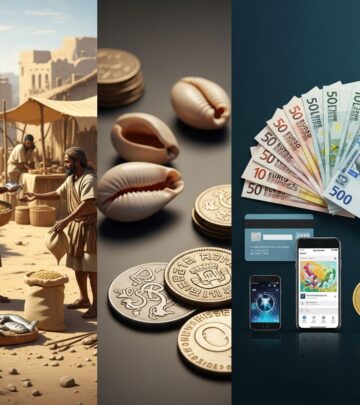
Money has evolved significantly throughout human history. Early societies used commodity money such as shells, beads, and metals. As civilizations advanced, they developed metal coins with standardized weights and values. The development of banking and paper money represented a major innovation, allowing people to conduct transactions without physically carrying heavy metals. Modern banking systems enabled the creation of credit and the expansion of the money supply beyond physical currency.
The gold standard, which linked currency values directly to gold reserves, dominated international monetary systems for much of the modern era. However, most countries abandoned the gold standard during the 20th century, transitioning to purely fiat currency systems. Today’s monetary systems rely entirely on the credibility of governments and central banks to maintain the value of money.
Frequently Asked Questions
Q: What gives money its value?
A: The value of fiat money is derived from government decree and public confidence in the monetary system. For commodity money, value comes from the intrinsic worth of the physical material. Ultimately, money has value because people accept it in exchange for goods and services.
Q: Can money be created indefinitely?
A: While central banks can theoretically create unlimited amounts of money, doing so has consequences. Excessive money creation leads to inflation, which erodes purchasing power and can destabilize the economy. Central banks must balance money supply growth with economic output to maintain price stability.
Q: Why do some countries have weak currencies?
A: Currency strength depends on factors like inflation rates, interest rates, economic growth, political stability, and capital flows. Countries with high inflation, political instability, or weak economic fundamentals typically have weaker currencies that lose value relative to other currencies.
Q: Is cryptocurrency real money?
A: Cryptocurrencies possess some characteristics of money, particularly as a medium of exchange and store of value. However, they lack the widespread acceptance and government backing of traditional currencies, and their volatility makes them less reliable as units of account.
Q: How does inflation affect the value of money?
A: Inflation reduces the purchasing power of money, meaning each unit of currency can buy fewer goods and services over time. This erosion of value occurs when the money supply grows faster than the economy or when production costs increase, pushing up prices.
Q: What role do banks play in money creation?
A: Commercial banks create money through the lending process. When a bank extends a loan, it credits the borrower’s account with newly created bank deposits, effectively increasing the money supply. This process is limited by reserve requirements and central bank regulations.
References
- The Functions of Money — Board of Governors of the Federal Reserve System. 2024. https://www.federalreserve.gov/
- Monetary Policy and Money Supply — U.S. Department of the Treasury. 2024. https://home.treasury.gov/
- What is Money? Definition and Role in Economy — International Monetary Fund (IMF). 2024. https://www.imf.org/
- Fiat Money and Its Economic Implications — World Bank Economics. 2024. https://www.worldbank.org/
- Digital Money and Cryptocurrency: Emerging Forms of Currency — Financial Conduct Authority (FCA). 2024. https://www.fca.org.uk/
Similar Articles








Read full bio of Sneha Tete