Gross National Product (GNP): 3 Key Components Explained
Understanding GNP: A comprehensive guide to measuring national economic output.

What Is Gross National Product (GNP)?
Gross National Product (GNP) is a significant macroeconomic indicator that reflects a country’s overall economic performance and health. It measures the total monetary value of all final goods and services produced by a country’s citizens and companies, regardless of their geographical location. Unlike measures that focus solely on what happens within a nation’s borders, GNP captures the economic output of a country’s residents both domestically and internationally, making it a comprehensive tool for understanding national economic activity.
GNP attempts to measure a country’s total income because it takes economic activity from all citizens of a country into account, whether they are producing goods and services at home or abroad. This makes GNP particularly valuable for nations with significant international operations, investments, or a large diaspora workforce. By including income earned by citizens from foreign investments and work done overseas, while excluding income earned by foreign residents within the domestic economy, GNP provides a more complete picture of a nation’s economic output than alternative measures.
Understanding GNP: Key Characteristics
GNP encompasses the value of goods and services produced by citizens and companies within the country’s borders as well as those produced by its citizens and companies abroad. This dual focus distinguishes GNP from other economic measures and makes it particularly useful for understanding the true economic reach of a nation.
The calculation of GNP involves adding up all the final goods and services produced by the citizens and businesses of a country in a given period, regardless of where they are produced. This includes tangible goods such as vehicles, agricultural products, and machinery, as well as the provision of services like healthcare, business consultancy, and education. GNP also includes taxes and depreciation in its calculation.
The GNP Formula and Calculation
The formula for calculating GNP is fundamental to understanding how economists measure national economic output:
GNP = PCE + GDPI + TGE + NE + IEO
Where the components are defined as follows:
| Component | Definition |
|---|---|
| PCE | Personal Consumption Expenditures – household spending on goods and services |
| GDPI | Gross Private Domestic Investment – business spending on capital goods and R&D |
| TGE | Total Government Expenditures – government spending on goods and services |
| NE | Net Exports – exports minus imports |
| IEO | Income Earned Overseas – net factor income from abroad |
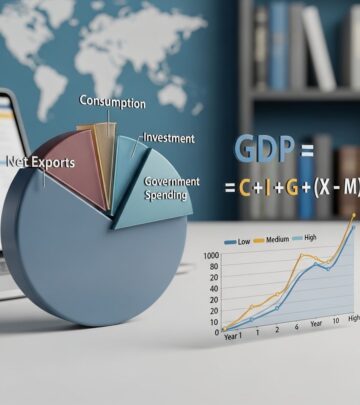
An alternative formula for calculating GNP is: GNP = C + I + G + NX + Z, where C represents consumption spending, I represents investment spending, G represents government spending, NX represents net exports, and Z represents net factor income from abroad.
GNP can also be calculated as the country’s GDP plus net income from abroad. Net income from abroad is calculated by taking the income earned by residents in foreign investments and subtracting the income earned inside the country by foreign residents.
The Three Main Components of GNP
GNP consists of three primary spending categories that drive economic activity and growth. Understanding each component is essential for comprehending how nations generate their total economic output.
Consumption
Consumption refers to household spending on goods and services, encompassing both essential purchases and discretionary spending. This includes spending on necessities such as food, clothing, housing, and healthcare, as well as purchases of luxury items and entertainment services. Consumption is the largest component of GNP, accounting for more than two-thirds of the total economic output. This dominance reflects the reality that households are the largest consumers in any economy, and their spending patterns significantly drive overall economic activity.
Investment
Investment includes spending by businesses on capital goods, such as machinery, equipment, buildings, and research and development initiatives. These expenditures represent long-term investments that generate future economic returns. Investment typically accounts for approximately 15-20% of GNP and reflects the business sector’s confidence in economic growth and future profitability.
Government Spending
Government spending comprises the expenditure by the government on goods and services, including education, healthcare, infrastructure, and defense. This component typically accounts for about 20-25% of GNP and represents the public sector’s contribution to overall economic activity. Government spending can be particularly important during economic downturns, when the government may increase spending to stimulate economic growth.
GNP vs. GDP: Understanding the Key Differences
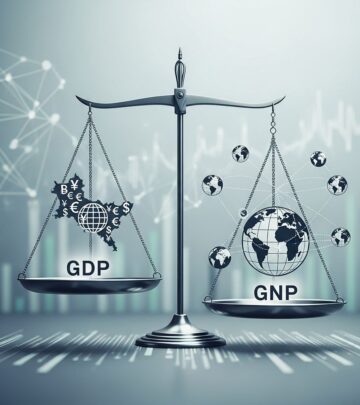
While GNP and GDP are often used interchangeably in casual discussion, important distinctions exist between these two measures. The primary difference lies in their treatment of international economic activity.
| Component | GDP | GNP |
|---|---|---|
| Consumption Spending | Included | Included |
| Investment Spending | Included | Included |
| Government Spending | Included | Included |
| Net Exports | Included | Included |
| Net Factor Income | Not Included | Included |
GDP, or Gross Domestic Product, measures the total value of goods and services produced within a country’s geographical boundaries in a given year. GDP does not include factor income from abroad and focuses purely on domestic production regardless of who owns or operates the businesses.
GNP, conversely, takes into account the income earned by a country’s citizens and companies from investments or work done abroad, while excluding income earned by foreign residents within the domestic economy. This means GNP is a more comprehensive measure of a country’s economic output than GDP, particularly for nations with substantial international economic activities.
For example, if a Japanese company produces vehicles in Japan, the value would be included in both Japan’s GDP and Japan’s GNP. However, if a Japanese company produces vehicles in the United States, that production would be included in the U.S. GDP but not the U.S. GDP; instead, it would be included in Japan’s GNP because Japanese citizens own and operate the company.
Uses of GNP in Economic Analysis
GNP serves multiple important functions in economic analysis and policy-making. By measuring the output of goods and services produced by a country’s citizens and companies, GNP can be used to evaluate a country’s living standard and economic health. Policymakers rely on GNP data to understand economic trends, make informed decisions about monetary and fiscal policy, and compare economic performance across different time periods.
GNP also enables international comparisons of economic output and living standards between nations. By standardizing how economic activity is measured, GNP allows economists and policymakers to assess which nations are growing faster, which are more productive, and how economic development is progressing globally.
Criticisms and Limitations of GNP
Despite its utility as an economic measure, GNP has faced significant criticism from economists and policymakers. One major criticism is that GNP fails to account for non-economic factors that contribute to human well-being, such as education quality, health outcomes, and environmental sustainability. A country could have high GNP while its citizens experience poor health, limited educational opportunities, or severe environmental degradation.
Additionally, GNP does not consider income distribution within a country, which can lead to significant poverty and inequality even in nations with high overall GNP. Two countries with identical GNP could have vastly different standards of living if one has more equal income distribution than the other.
Furthermore, GNP excludes the value of intermediate goods to eliminate the chances of double counting, as these goods are included in the value of final products and services. While this prevents distortion, it also means that important economic activity in supply chains and production processes is not directly reflected in GNP figures.
Alternatives to GNP
Recognizing the limitations of GNP, economists have developed alternative measures to provide a more comprehensive understanding of economic well-being. These alternatives attempt to address GNP’s shortcomings by incorporating factors such as environmental impact, income distribution, and quality of life.
Gross National Income (GNI) represents one such alternative, measuring the income received by a country’s residents, including net income from abroad. Other alternatives include the Human Development Index (HDI), which incorporates health and education alongside income, and the Genuine Progress Indicator (GPI), which adjusts GDP for environmental and social factors.
Despite these alternatives, GNP remains widely used in economic analysis and policy-making, as it provides a standardized, comparable measure of national economic output that is relatively straightforward to calculate and interpret.
Frequently Asked Questions About GNP
Q: How does GNP differ from GDP?
A: GNP measures the total value of goods and services produced by a country’s citizens regardless of location, while GDP measures only those produced within a country’s borders. GNP includes net factor income from abroad, whereas GDP does not.
Q: What are the main components of GNP?
A: The three main components of GNP are consumption (household spending), investment (business spending on capital goods), and government spending. These components account for the vast majority of national economic output, with consumption representing more than two-thirds of total GNP.
Q: Why is GNP important for measuring economic health?
A: GNP provides a comprehensive measure of a country’s total economic output and income, allowing policymakers and economists to assess economic growth, living standards, and overall economic performance. It enables comparisons between nations and helps identify economic trends over time.
Q: What is the formula for calculating GNP?
A: GNP is calculated using the formula: GNP = PCE + GDPI + TGE + NE + IEO, where PCE is personal consumption expenditures, GDPI is gross private domestic investment, TGE is total government expenditures, NE is net exports, and IEO is income earned overseas.
Q: What are the main criticisms of GNP as an economic measure?
A: GNP is criticized for not accounting for non-economic factors affecting well-being such as health and environment, not considering income distribution within countries, and potentially masking inequality and poverty despite high overall economic output.
Q: Can a country have high GNP but low living standards?
A: Yes. A country could have high GNP while its citizens experience poor health, limited education, environmental problems, or severe income inequality. This is why alternative measures like the Human Development Index are sometimes used alongside GNP.
Conclusion
Gross National Product remains a fundamental macroeconomic indicator for measuring national economic output and understanding a country’s economic performance. By encompassing the total value of goods and services produced by a nation’s citizens and companies, both domestically and internationally, GNP provides valuable insights into economic health and enables meaningful comparisons between nations.
While GNP has limitations—particularly its failure to account for income distribution, environmental factors, and quality of life measures—it continues to serve as an essential tool for economists, policymakers, and business leaders. Understanding GNP, its components, calculation methods, and its relationship to alternative measures like GDP is crucial for anyone seeking to comprehend national economic dynamics and make informed decisions about economic policy and investment.
As economies continue to evolve and become increasingly interconnected, GNP’s focus on the economic activities of a nation’s residents, regardless of location, makes it particularly relevant for understanding the true scope of national economic reach and influence in an increasingly globalized world.
References
- Gross National Product (GNP) | Definition, Formula, Components — Finance Strategists. 2025. https://www.financestrategists.com/wealth-management/macroeconomics/gross-national-product/
- Gross National Product | GNP Definition, Formula & Example – Lesson — Study.com. 2025. https://study.com/academy/lesson/gnp-definition-formula.html
- Gross National Product (GNP) — Britannica. 2025. https://www.britannica.com/money/gross-national-product
- Gross National Product – Learn How to Calculate GNP of a Country — Corporate Finance Institute. 2025. https://corporatefinanceinstitute.com/resources/economics/gross-national-product-gnp/
- Gross National Product (GNP) – Meaning & Key Components — Lakshya Commerce. 2025. https://lakshyacommerce.com/academics/gross-national-product-gnp
Similar Articles








Read full bio of medha deb