What Is the Gold Standard? History & Impact
Understanding the gold standard: A monetary system that shaped global economics and finance.

What Is the Gold Standard?
The gold standard is a monetary system in which the standard economic unit of account of a country is based on a fixed quantity of gold. Under this system, a nation’s currency is directly linked to gold, meaning that the government agrees to exchange paper money for a specified amount of gold on demand. This creates a fixed relationship between the currency and gold, which in turn establishes fixed exchange rates between different currencies of countries that adopt the gold standard.
The foundational principle of the gold standard is that currency value is anchored to a tangible, universally recognized commodity. Rather than allowing currency value to fluctuate based on market sentiment or government policy alone, the gold standard provides an objective measure of value. This theoretical stability was meant to prevent excessive inflation, maintain purchasing power, and create confidence in monetary systems across nations.
Definition and Core Principles
At its essence, a gold standard monetary system operates on several core principles. First, a government establishes a fixed price at which it will buy and sell gold in exchange for its currency. Second, the money supply is directly linked to the quantity of gold reserves held by the central bank, typically with legal minimum ratios of gold to currency in circulation. Third, individuals and businesses can freely convert fiat currency into gold and vice versa at the established rate.
The gold standard creates what economists call the “price-specie flow mechanism,” a self-correcting process first described by 18th-century philosopher David Hume. Under this mechanism, when a country experiences a balance of payments deficit, it loses gold reserves, causing the money supply to contract, domestic prices to fall, and the country’s exports to become more competitive until the deficit is corrected. Conversely, countries with trade surpluses accumulate gold, expanding their money supplies and prices until equilibrium is restored.
Historical Development and Timeline
Early Implementation
The United Kingdom was the first major nation to formally implement the gold standard in 1821, establishing the foundation for what would become the international monetary system. However, prior to this period, silver had dominated as the principal world monetary metal. Gold had been used intermittently for coinage throughout history but was never consistently applied as the universal standard of value.
The initial British implementation occurred through a gold specie standard, where gold coins circulated freely as domestic currency. The Bank Charter Act of 1844 further institutionalized this system by establishing a fixed ratio between gold reserves held by the Bank of England and the banknotes it could issue, significantly constraining the ability of other British banks to issue currency.
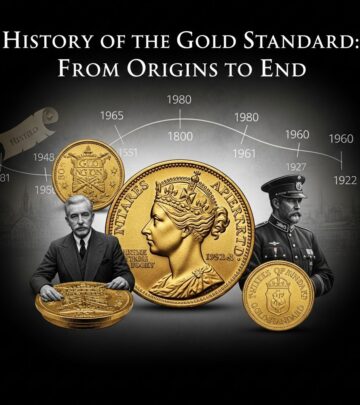
The Classical Gold Standard Era (1870s–1914)
The classical gold standard emerged in the 1870s following Germany’s decision to adopt gold as its monetary standard in 1871. Germany had recently received substantial reparations from France following the Franco-Prussian War of 1870, providing it with significant gold reserves to back such a transition. Germany’s economic and political dominance, combined with the appeal of accessing London’s financial markets, encouraged other nations to adopt gold as well.
By the 1870s, France and the United States also transitioned to the gold standard, a shift facilitated by gold discoveries in western North America that made the precious metal more abundant than previously. The international classical gold standard formally commenced in 1873 and became the basis for the international monetary system, with countries settling on gold as the foundation for their money supplies and establishing firmly pegged exchange rates.
During this period, from the 1870s through the outbreak of World War I in 1914, the gold standard was characterized by free convertibility of currencies into gold, unlimited import and export of gold bullion, and gold coins circulating as domestic currency alongside other denominations. This era represented the purest implementation of the gold standard principle.
Interwar Period and Modifications
Following World War I, the classical gold standard weakened as nations struggled with war debts and economic disruption. In 1925, the British Gold Standard Act introduced the gold bullion standard, a modified version where gold coins no longer circulated, but authorities agreed to exchange paper currency for gold bullion at a fixed price. This represented a shift from the specie standard to a bullion standard, available only in large quantities suitable for international settlement rather than domestic circulation.
The Bretton Woods System (1944–1971)
After World War II, the Bretton Woods system was established in 1944, creating a modified gold standard for the international monetary system. Under Bretton Woods, the United States dollar was directly convertible to gold at a fixed rate of $35 per ounce, while other currencies maintained fixed exchange rates against the dollar. The International Monetary Fund was established to facilitate exchange processes and help nations maintain fixed rates through credit mechanisms that cushioned adjustment processes and helped countries avoid deflationary pressures.
This system represented a compromise between a pure gold standard and a fiat money system. Most countries defined their currencies in terms of dollars rather than directly to gold, creating a dollar-based international monetary order backed by American gold reserves. However, by the late 1950s, exchange restrictions were gradually dropped, and gold became increasingly important in international financial settlements.
The End of the Gold Standard
The Bretton Woods system deteriorated throughout the 1960s as the United States experienced mounting balance of payments deficits and dwindling gold reserves. Countries began exchanging dollars for gold at accelerating rates, depleting American reserves. On August 15, 1971, President Richard Nixon announced that the United States would suspend the free convertibility of dollars into gold at fixed exchange rates. This unilateral action effectively ended the Bretton Woods system and the international gold standard, marking the transition to a fiat money system where currency value is not backed by any physical commodity.
How the Gold Standard Works
Monetary Policy Mechanisms
Under a gold standard, a country’s money supply is directly constrained by its gold reserves. Central banks must maintain sufficient gold holdings to back the currency in circulation, typically through legal minimum ratios. When a central bank wants to increase the money supply, it must first acquire additional gold reserves. Conversely, if gold reserves decline, the money supply automatically contracts.
This constraint fundamentally differs from modern fiat systems, where central banks can expand money supplies through open market operations without regard to commodity reserves. Under the gold standard, the money supply cannot grow faster than the stock of gold reserves, which grows slowly through new mining discoveries and production.
Exchange Rate Determination
Fixed exchange rates are a natural consequence of the gold standard. When each currency is defined in terms of a specific quantity of gold, the exchange rate between any two currencies is mathematically determined by their respective gold content. For example, if the pound is defined as 113.0016 grains of fine gold and the dollar as 23.22 grains of fine gold, the pound-dollar exchange rate is fixed at approximately 4.87 dollars per pound.
This fixed rate eliminates currency speculation and creates certainty for international trade and investment. Merchants and investors know exactly how much one currency will exchange for another, facilitating commerce across borders and encouraging long-term international investments.
Balance of Payments Adjustment
International settlements under the gold standard operate through gold flows. Countries with balance of payments surpluses receive gold inflows from deficit countries. This automatic adjustment mechanism functions through the price-specie flow mechanism: deficit countries lose gold, reducing their money supplies, lowering domestic prices, and making exports more competitive until the deficit is corrected.
Advantages of the Gold Standard
Proponents of the gold standard highlight several theoretical advantages. The system provides price stability by constraining money supply growth to the rate of gold production, preventing the kind of hyperinflation or excessive monetary expansion possible under fiat systems. The automatic adjustment mechanism theoretically eliminates the need for discretionary monetary policy, as balance of payments imbalances correct themselves through gold flows.
Additionally, the gold standard promotes international trade and investment by providing exchange rate certainty. Fixed rates eliminate currency risk and allow merchants and investors to plan long-term commitments without fear of currency value fluctuations. The requirement to maintain gold reserves also disciplines governments, preventing them from running excessive budget deficits or engaging in reckless monetary expansion.
Disadvantages and Criticisms
The gold standard also faced significant criticisms and practical limitations. The system’s rigidity can prevent governments from responding flexibly to economic crises or recessions. During the Great Depression, countries adhering to the gold standard were unable to expand money supplies to stimulate demand, deepening and prolonging the crisis. The need to maintain fixed ratios of gold to currency limits the money supply to what gold reserves allow, potentially constraining economic growth.
Furthermore, the automatic adjustment mechanism through the price-specie flow can be painful, requiring wages and prices to fall in deficit countries to restore competitiveness. This deflationary pressure creates hardship for workers and businesses. Countries may resist this adjustment process through trade restrictions or capital controls, undermining the system’s theoretical self-correcting properties.
The Gold Standard in the United States
Early American Monetary System
In the 1780s, Thomas Jefferson, Robert Morris, and Alexander Hamilton recommended that the United States adopt a decimal currency system. The initial 1785 recommendation proposed a silver standard based on the Spanish milled dollar, containing 371.25 grains of fine silver. However, Hamilton’s final recommendation in the Coinage Act of 1792 also included a $10 gold eagle containing 247.5 grains of fine gold, establishing a bimetallic system with both gold and silver standards.
Shift to Monometallic Gold Standard
The United States maintained a bimetallic standard throughout much of the 19th century. However, in the 1870s, following gold discoveries in western North America and the adoption of gold by other major economies, the United States transitioned to a monometallic gold standard. This shift aligned American monetary policy with the emerging international classical gold standard system.
Why the Gold Standard Ended
The gold standard ultimately proved unsustainable in the modern economy. As nations developed economically and trade volumes expanded, the supply of newly mined gold could not keep pace with the growth in money supply demanded by expanding economies. The system’s rigidity prevented governments from responding effectively to economic crises with monetary policy tools.
The Bretton Woods system collapsed in 1971 when American gold reserves became insufficient to maintain the $35-per-ounce conversion rate. The United States’ mounting balance of payments deficits and excessive military spending, particularly on the Vietnam War, depleted gold reserves faster than they could be replenished. Once the gold standard was abandoned, the international monetary system transitioned to floating exchange rates and fiat money backed by government authority rather than gold reserves.
Gold Reserves Today
Although the gold standard as a monetary system ended in 1971, nations continue to hold substantial gold reserves. Central banks maintain gold as a store of value, a hedge against inflation, and a symbol of moneta
Similar Articles








Read full bio of Sneha Tete