What Is GDP? Definition of Gross Domestic Product
Understanding GDP: The complete guide to measuring economic activity and growth.
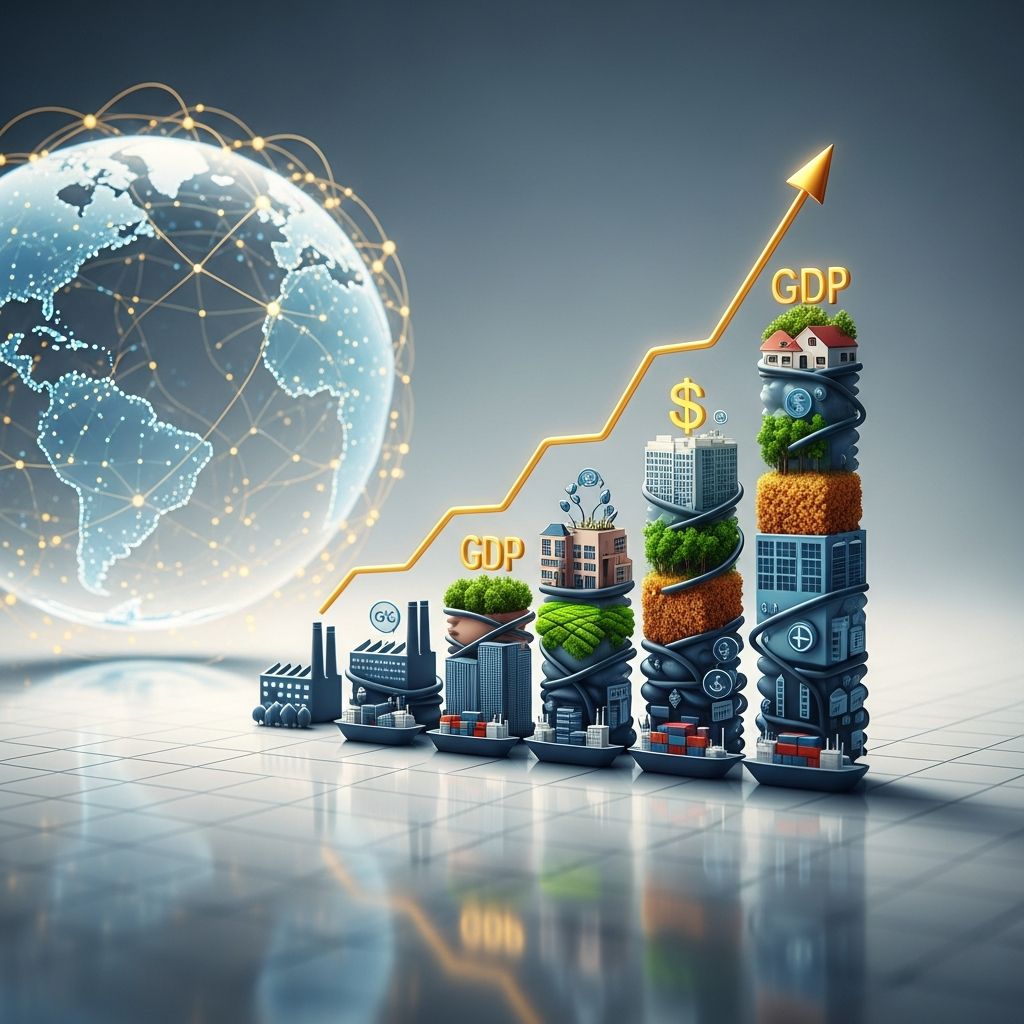
Gross Domestic Product (GDP) represents the total market value of all final goods and services produced within a nation’s borders during a specific time period. It serves as one of the most critical indicators of a country’s economic health and overall development. GDP measures the economic output of a nation, encompassing everything from consumer purchases to business investments and government spending. Understanding GDP is essential for policymakers, investors, and anyone interested in comprehending the strength and trajectory of an economy.
The concept of GDP has evolved significantly over the decades, becoming the primary metric used by governments, financial institutions, and economists worldwide to evaluate economic performance. Whether assessing the health of a developed nation or tracking the progress of an emerging economy, GDP provides a standardized framework for comparison and analysis.
The Formula for Calculating GDP
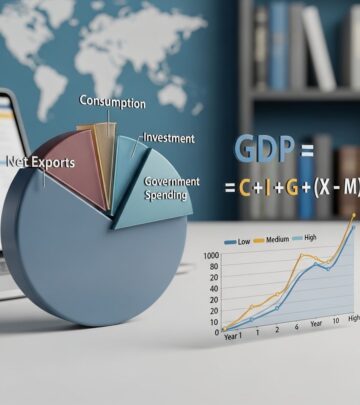
The most commonly used formula for calculating GDP employs the expenditure approach, which is expressed as:
GDP = C + I + G + (X – M)
In this formula, each component represents a distinct category of spending:
- C (Consumption) – The total value of goods and services purchased by households
- I (Investment) – Business spending on capital goods and residential construction
- G (Government Spending) – Federal, state, and local government expenditures
- X (Exports) – Goods and services produced domestically and sold abroad
- M (Imports) – Goods and services produced abroad and consumed domestically
This straightforward equation captures the entire scope of economic activity within a country’s borders. Net exports (X – M) are calculated by subtracting imports from exports, as imports represent money flowing out of the country while exports represent money flowing in.
The Four Main Components of GDP
Understanding the four primary components of GDP provides insight into how different sectors and economic activities contribute to overall economic output.
1. Consumption (C)
Consumption represents the largest component of GDP in most developed economies, typically accounting for approximately two-thirds of total GDP. It encompasses all spending by households on final goods and services, including:
- Food, groceries, and household supplies
- Automobiles and transportation costs
- Housing, rent, and utilities
- Clothing and personal items
- Healthcare and medical services
- Entertainment and recreation
- Technology and electronics
Consumer spending is particularly important because it reflects the confidence and purchasing power of households. Strong consumption typically indicates a healthy economy with rising incomes and consumer confidence. Conversely, declining consumption often signals economic challenges or recession.
2. Investment (I)
Investment refers to business spending on capital goods and infrastructure that will be used to produce future goods and services. Key elements of investment include:
- Construction of new factories and manufacturing facilities
- Purchase of machinery and equipment
- Residential construction and new housing development
- Changes in business inventory levels
- Technology infrastructure and software
Business investment is crucial for long-term economic growth, as it increases production capacity and productivity. When companies invest heavily, they create jobs and lay the groundwork for future economic expansion. Investment spending is generally more volatile than consumption and can fluctuate significantly based on business confidence and interest rates.
3. Government Spending (G)
Government spending encompasses expenditures by federal, state, and local governments on goods and services. This includes:
- National defense and military expenditures
- Social security and social programs
- Education and public schools
- Infrastructure development and maintenance
- Healthcare services
- Administrative and operational expenses
Government spending plays a stabilizing role in the economy, particularly during downturns. During recessions, increased government spending can help stimulate economic activity and employment. However, excessive government spending or budget deficits can also lead to inflation or financial instability if not managed carefully.
4. Net Exports (X – M)
Net exports represent the difference between the value of goods and services a country exports and the value it imports. This component can be either positive or negative:
- Positive Net Exports – When a country exports more than it imports, contributing positively to GDP
- Negative Net Exports – When a country imports more than it exports, reducing GDP
International trade dynamics significantly influence GDP calculations. Countries with strong manufacturing sectors and competitive advantages tend to have positive net exports, while countries with strong consumer demand often import more goods, resulting in trade deficits.
Three Methods for Measuring GDP
While the expenditure approach is most commonly used, economists employ three distinct methodologies to calculate GDP, each offering unique perspectives on economic activity.
The Expenditure Approach
The expenditure approach, also known as the spending approach, is the most straightforward and widely used method. It calculates GDP by summing all spending on final goods and services within the economy using the C + I + G + (X – M) formula. This method is preferred because comprehensive spending data is readily available from government statistics and is relatively easy to understand.
The Income Approach
The income approach calculates GDP by measuring all incomes earned in producing goods and services. This includes wages, salaries, corporate profits, interest income, and entrepreneurial income. The underlying principle is that the value of all output produced must equal the total income earned by all factors of production. Income components include:
- Wages, salaries, and supplementary labor income
- Corporate profits
- Interest and investment income
- Income earned by self-employed individuals
- Rental income from property
The Production Approach
The production approach calculates GDP by summing the value added by each sector of the economy. This method examines how much value each industry adds to the economy by subtracting the cost of intermediate goods from gross output. It prevents double-counting by measuring only the value added at each stage of production.
Important GDP Concepts and Adjustments
Nominal vs. Real GDP
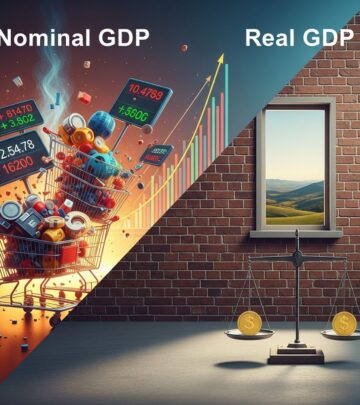
GDP can be expressed in two ways. Nominal GDP measures the value of output using current prices, while real GDP adjusts for inflation to show output measured in constant dollars. Real GDP provides a more accurate picture of economic growth by removing the effects of price changes.
Purchasing Power Parity (PPP)
Purchasing Power Parity is a measure that adjusts GDP for differences in prices between countries. PPP allows for more accurate comparisons of living standards and economic productivity across different nations by accounting for variations in price levels.
GDP Growth Rate
The GDP growth rate represents the percentage change in GDP from one year to the next. This metric is crucial for assessing economic expansion or contraction and is widely used by policymakers to evaluate economic performance.
Why GDP Matters
GDP serves multiple critical functions in economic analysis and policy decision-making. It provides a comprehensive snapshot of economic activity, allowing policymakers to implement appropriate fiscal and monetary policies. Investors use GDP data to make investment decisions and assess market opportunities. GDP trends influence employment levels, inflation rates, and interest rates, making it relevant to virtually all economic stakeholders.
Additionally, GDP comparisons between countries help identify economic leaders, emerging markets, and developing nations. International organizations use GDP data to allocate resources, assess development needs, and evaluate economic progress across the globe.
Limitations and Criticisms of GDP
Despite its widespread use, GDP has several notable limitations that economists and policymakers acknowledge:
- Ignores Informal Economy – Underground and informal economic activities are not captured in official GDP figures
- Excludes Nonmarket Activities – Unpaid household work, volunteer labor, and leisure activities are not counted
- Cannot Measure Wealth Distribution – GDP doesn’t reflect inequality or how wealth is distributed among the population
- Environmental Impact Not Considered – GDP doesn’t account for environmental degradation or natural resource depletion
- Quality of Life Issues – Health, education quality, and social well-being are not fully reflected in GDP calculations
These limitations have led many economists to propose supplementary or alternative measures such as Gross National Happiness, the Human Development Index, or green GDP that account for environmental and social factors.
Example GDP Calculation
Consider a hypothetical economy with the following annual spending data:
| Component | Value (in trillions) |
|---|---|
| Consumption (C) | $10 trillion |
| Investment (I) | $2 trillion |
| Government Spending (G) | $3 trillion |
| Exports (X) | $1.5 trillion |
| Imports (M) | $0.5 trillion |
Using the GDP formula:
GDP = $10T + $2T + $3T + ($1.5T – $0.5T) = $16 trillion
Frequently Asked Questions About GDP
What is the difference between GDP and GNP?
Gross Domestic Product (GDP) measures output produced within a country’s borders regardless of ownership, while Gross National Product (GNP) measures output produced by a country’s citizens regardless of where they are located. For most countries, these figures are relatively similar, but they can differ significantly for nations with substantial foreign investment or expatriate income flows.
How often is GDP reported?
GDP data is typically reported quarterly and annually by government statistical agencies. In the United States, the Bureau of Economic Analysis releases preliminary GDP estimates about a month after each quarter ends, with revisions released in subsequent months.
Can GDP be negative?
Yes, GDP growth can be negative, which occurs during economic recessions or contractions when the total output of goods and services decreases compared to the previous period. Negative growth indicates economic decline and is typically associated with rising unemployment and reduced consumer spending.
Why is consumption the largest component of GDP?
Consumption represents the largest GDP component because households drive economic activity in developed economies. People purchase food, housing, transportation, and services continuously, making consumer spending inherently substantial. In developed nations, consumption often accounts for 60-70% of total GDP.
How do economists use GDP data?
Economists use GDP data to assess economic health, predict future trends, formulate policy recommendations, and conduct comparative analysis between countries and time periods. Central banks often consider GDP trends when making interest rate decisions, while governments use this data to evaluate the effectiveness of fiscal policies.
What factors can cause GDP to change?
GDP can change due to various factors including consumer confidence fluctuations, business investment decisions, government policy changes, international trade dynamics, technological innovation, natural disasters, and geopolitical events. Economic cycles, inflation, and employment levels also significantly influence GDP movements.
References
- Gross Domestic Product | GDP Definition, Components & Examples — Study.com Academy. 2025. https://study.com/academy/lesson/gross-domestic-product-definition-and-components.html
- Gross Domestic Product (GDP) — IMF Publications. 2025. https://www.imf.org/en/publications/fandd/issues/series/back-to-basics/gross-domestic-product-gdp
- The Expenditures Approach to Measuring GDP — Bureau of Economic Analysis, U.S. Department of Commerce. 2025-06-03. https://www.bea.gov/news/blog/2025-06-03/expenditures-approach-measuring-gdp
- GDP as Expenditure: The Components of GDP — The Economy 2.0, CORE Economics. 2025. https://books.core-econ.org/the-economy/macroeconomics/03-aggregate-demand-03-components-of-gdp.html
- Gross Domestic Product Growth Glossary — World Bank DataBank. 2025. https://databank.worldbank.org/metadataglossary/world-development-indicators/series/NY.GDP.MKTP.KD.ZG
Similar Articles








Read full bio of medha deb