What Is Financial Capital: Definition, Types, and Examples
Learn what financial capital is, its types, sources, and why it matters for business growth.

What Is Financial Capital?
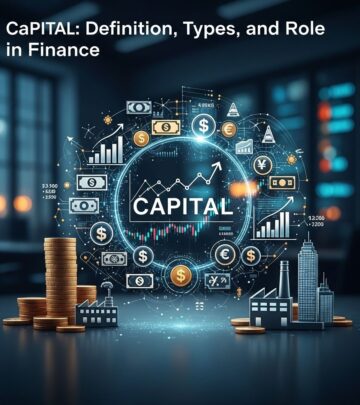
Financial capital is any economic resource measured in terms of money that businesses and entrepreneurs use to purchase what they need to make products or provide services. In essence, financial capital represents the lifeblood of any organization, enabling companies to acquire assets, fund operations, and generate revenue. Also known as investment capital or simply capital in finance and accounting contexts, financial capital encompasses all monetary resources that a company can deploy to create value and achieve its business objectives.
The concept of financial capital extends beyond merely having cash on hand. It includes various forms of economic resources that can be converted into money or used directly to purchase assets necessary for business operations. Understanding financial capital is crucial for entrepreneurs, business managers, and investors alike, as it directly impacts a company’s ability to survive, compete, and grow in today’s dynamic business environment.
Understanding Financial Capital Versus Money
While many people use the terms interchangeably, financial capital and money are fundamentally different concepts. Money is currency used to complete purchases or sales of assets that a company employs to increase its value. Financial capital, however, is a much broader term that encompasses all aspects of a business that can be used to generate revenue and income, including the company’s people, investments, patents, trademarks, and other resources.
Think of it this way: money is a tool used within the financial capital framework. A company might have substantial financial capital but limited money at any given moment, or conversely, it might have significant cash reserves but inadequate other forms of capital. True financial strength requires a balanced portfolio of different capital resources working together synergistically.
The Two Primary Sources of Financial Capital
Businesses typically obtain financial capital through two main channels: debt and equity. Each source has distinct characteristics, advantages, and implications for a company’s financial structure and operations.
Debt Capital
Debt represents a loan or financial obligation that must be repaid in the future. When a company borrows money, it incurs an interest expense, which is the cost of borrowing money. The cash received from borrowing is then used to purchase assets and fund business operations, ultimately generating revenues for the company. Common sources of debt capital include bank loans, bonds, debentures, and lines of credit.
The cost of debt is calculated based on the coupon rate, interest rate, and yield to maturity of the borrowed funds. For example, if a company borrows five million dollars and must pay five hundred thousand dollars in annual interest, its cost of debt would be ten percent. However, since interest expenses are tax-deductible, the after-tax cost of debt is lower. Using the same example with a twenty-five percent tax rate, the after-tax cost of debt would be 7.5 percent (10% × (1 – 25%)).
Debt capital offers certain advantages, including tax benefits and the ability to leverage assets without diluting ownership. However, it also creates mandatory repayment obligations and increases financial risk, particularly if a company struggles to generate sufficient revenue.
Equity Capital
Equity represents an ownership stake in a company. Equity investors will receive the residual value of the company in the event it is sold or wound down. Unlike debt, equity does not have to be repaid and doesn’t have an interest expense associated with it. Instead, equity holders participate in company profits and growth potential.
Sources of equity capital include retained earnings, stock sales, venture capital investments, and partnerships. When shareholders invest in a company, they gain voting rights and a claim on the company’s future profits. The cost of equity is typically higher than the cost of debt because it carries more risk; in the event of insolvency, debt holders are repaid before equity holders.
The cost of equity is calculated using the Capital Asset Pricing Model (CAPM), which uses the riskiness of an investment as a means of determining how much it should cost per year. This model accounts for the volatility of returns and market conditions, providing investors with a fair required return on their investment.
Additional Sources of Financial Capital
Beyond traditional debt and equity, businesses can access financial capital through several other channels:
- Profits: Retained earnings generated from profitable operations represent internal capital
- Loans and Bonds: Various borrowing instruments available through financial institutions
- Corporate Stock: Shares issued to raise capital from investors
- Initial Public Offerings (IPOs): The process of offering shares to the public for the first time
- Partnerships: Capital contributed by business partners
Time-Based Classification of Capital Sources
Financial capital can also be categorized based on the duration of the funding commitment:
Long-Term Capital (Above 7 Years)
Long-term capital sources include share capital, mortgage loans, retained profits, venture capital, debentures, and project finance. These sources provide stable, extended funding for major investments and infrastructure development.
Medium-Term Capital (2-7 Years)
Medium-term sources encompass term loans, revenue-based financing, leasing arrangements, and hire purchase agreements. These options bridge the gap between short-term operational needs and long-term strategic investments.
Short-Term Capital (Under 2 Years)
Short-term capital includes bank overdrafts, trade credit, deferred expenses, and factoring arrangements. These sources help businesses manage immediate operational expenses and working capital needs.
Measuring the Cost of Capital
Understanding and calculating the cost of capital is essential for business decision-making. The cost of capital represents what a company must pay to access and use financial resources. Businesses typically use the Weighted Average Cost of Capital (WACC) to assess their overall cost of capital, which blends the costs of debt and equity based on their proportions in the company’s capital structure.
Lower costs of capital enable companies to undertake more profitable projects and grow more rapidly. Conversely, higher costs of capital restrict the number of viable investment opportunities and may limit growth potential. Managers focus extensively on optimizing the capital structure to minimize the cost of capital while maintaining appropriate risk levels.
Why Financial Capital Matters for Business
Financial capital is absolutely essential to business operation. Without adequate funding, a company may not be able to afford the assets it needs to operate and survive, nor be able to outperform its competitors. Financial analysts perform extensive analysis to assess how well funded a business is, how efficient its operations are, and how well it generates returns for investors.
Companies use financial capital to fund daily operations, purchase equipment and property, invest in research and development, expand into new markets, and weather economic downturns. The availability and cost of financial capital directly influence strategic decisions, competitive positioning, and long-term viability.
Key Performance Metrics and Ratios
Managers and analysts examine multiple financial metrics to evaluate how effectively a company uses its capital:
- Return on Invested Capital (ROIC)
- Return on Equity (ROE)
- Return on Assets (ROA)
- Debt-to-Equity Ratio
- Interest Coverage Ratio
- Capital Efficiency Ratios
These metrics help stakeholders understand whether management is deploying capital efficiently and generating appropriate returns for the risk undertaken.
Financial Capital in Different Market Contexts
Capital Market
The capital market is where long-term funds are bought and sold, including shares, debentures, long-term loans with mortgage bonds as security, and reserve funds. This market enables companies to raise substantial capital for major investments and expansion initiatives.
Money Market
The money market facilitates short-term lending, where financial institutions use short-term savings to lend out in the form of short-term loans. This market includes commercial paper, credit on open account, bank overdrafts, short-term loans, bills of exchange, and factoring of debtors.
Classification of Capital by Ownership
Financial capital can also be distinguished based on whether it is borrowed or owned:
Borrowed Capital
Borrowed capital includes debentures (redeemable, irredeemable, to bearer, ordinary), bonds, deposits, and loans. This capital must be repaid with interest and creates obligations for the borrowing company.
Own Capital
Own capital, also called owners’ equity, is private capital that owners provide, sometimes through preferred shares (ordinary, cumulative, or participating), ordinary shares, bonus shares, and founders’ shares. Preferred shares typically have preference over common shares, meaning preference shareholders receive payments before equity shareholders.
Related Concepts: Productive and Signaling Capital
Academics further subcategorize financial capital into productive capital, which is necessary for operations, and signaling capital, which signals a company’s financial strength to shareholders and potential investors. Additionally, regulatory capital fulfills specific capital requirements mandated by financial regulators and industry standards. These distinctions help stakeholders understand different dimensions of a company’s financial position and risk profile.
Frequently Asked Questions
Q: What is the difference between financial capital and human capital?
A: Financial capital consists of monetary resources and economic assets used to purchase what businesses need. Human capital, by contrast, refers to the employees, skills, knowledge, and expertise within an organization that create value and generate revenue.
Q: Can a company have plenty of financial capital but still fail?
A: Yes. While adequate financial capital is necessary, it is not sufficient for success. Poor management decisions, inadequate market demand, inefficient operations, or failure to adapt to changing conditions can lead to business failure despite substantial capital resources.
Q: How do startups typically access financial capital?
A: Startups often access capital through founder investments, angel investors, venture capital firms, bank loans, crowdfunding, and strategic partnerships. As they grow and establish track records, they may eventually access public capital markets through IPOs.
Q: Why is the cost of equity typically higher than the cost of debt?
A: Equity carries more risk than debt because equity holders are paid last in case of company insolvency. Additionally, equity returns depend on company performance and growth, creating greater uncertainty compared to fixed debt payments.
Q: What role does financial capital play in competitive advantage?
A: Financial capital enables companies to invest in technology, research and development, talent acquisition, and market expansion. Companies with superior access to capital at lower costs can outinvest competitors and achieve competitive advantages.
Q: How do companies optimize their capital structure?
A: Companies optimize capital structure by balancing debt and equity to minimize the weighted average cost of capital while maintaining acceptable risk levels. This involves considering tax benefits of debt, financial risk tolerance, industry norms, and growth objectives.
References
- Definition, Types, Money vs Capital — Corporate Finance Institute. 2024. https://corporatefinanceinstitute.com/resources/accounting/capital/
- 9 Types of Capital and Examples — Indeed Career Advice. 2024. https://www.indeed.com/career-advice/career-development/types-of-capitals
- Financial Capital: Sources and Classification — Encyclopædia Britannica. 2024. https://en.wikipedia.org/wiki/Financial_capital
- Financial Capital: Definition, Types, Example, Importance — Wall Street Mojo. 2024. https://www.wallstreetmojo.com/financial-capital/
Similar Articles








Read full bio of Sneha Tete