Downside Deviation: A Practical Guide For Investors
Understanding downside deviation: a key metric for measuring investment risk and portfolio losses.
What Is Downside Deviation?
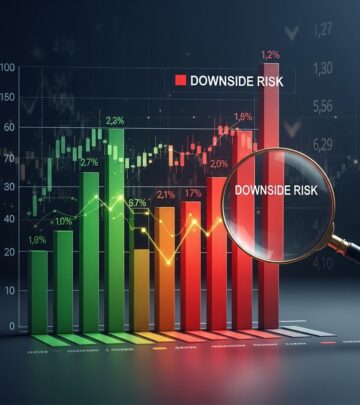
Downside deviation is a statistical measure that focuses specifically on the risk of negative returns in an investment or portfolio. Unlike traditional risk measures such as standard deviation, which captures both upside and downside volatility, downside deviation concentrates exclusively on the fluctuations below a target return threshold. This metric is particularly valuable for investors who are more concerned about losses than they are about missing out on gains, making it a practical tool for assessing true investment risk.
The concept of downside deviation was formally developed and popularized by Dr. Frank Sortino in the early 1980s as a superior alternative to standard deviation for measuring investment risk. Since then, it has become the industry standard for risk management among professional investors and portfolio managers. The metric provides a more nuanced understanding of portfolio performance by isolating the volatility that actually matters to investors: the potential for losses.
Understanding Downside Risk vs. Standard Deviation
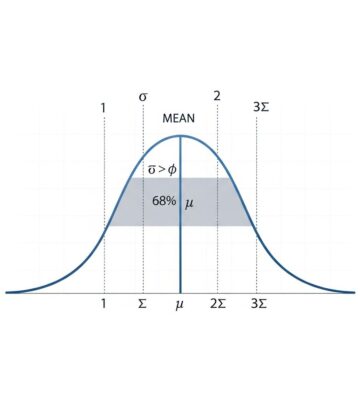
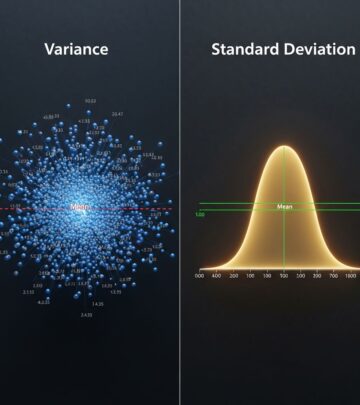
To fully grasp the importance of downside deviation, it is essential to understand how it differs fundamentally from standard deviation, the traditional measure of investment volatility. Standard deviation measures the total volatility of an investment, treating both upside and downside movements equally. This means it penalizes investments for positive surprises just as much as it rewards them for negative surprises, which does not align with how investors actually perceive risk.
Downside deviation, on the other hand, focuses only on the negative deviations from a specified target return or minimum acceptable return (MAR). If an investment outperforms expectations, downside deviation does not count this as risk. Only when returns fall below the target threshold does this metric register concern. This distinction is crucial because investors are fundamentally asymmetrical in how they view risk: they fear losses far more than they celebrate equivalent gains.
Research has shown that standard deviation significantly underestimates downside risk. Studies indicate that around two-thirds of the time, standard beta would underestimate the actual downside risk of an investment. This makes downside deviation a more accurate reflection of the risk that truly impacts investor wealth and portfolio performance.
How Downside Deviation Is Calculated
The calculation of downside deviation involves several straightforward steps that any investor can follow. The process begins with identifying a target return or minimum acceptable return (MAR), which represents the lowest level of performance an investor is willing to accept. This benchmark might be a specific percentage, zero percent, or even an inflation rate, depending on the investor’s objectives and risk tolerance.
Once the target is established, the calculation proceeds as follows:
Step 1: Gather historical return data for the investment or portfolio over a specified period.
Step 2: For each period, calculate the difference between the actual return and the target return.
Step 3: Identify only the periods where this difference is negative (returns fall short of the target).
Step 4: Square each negative deviation.
Step 5: Sum all the squared negative deviations.
Step 6: Divide the total by the number of periods analyzed.
Step 7: Take the square root of this result to obtain the downside deviation.
This process is also known as calculating the semi-variance, which is the expected squared deviation from the mean calculated only over those points that fall below the mean. The square root of the semi-variance is the semi-deviation, which is another term for downside deviation.
The Mathematical Formula
While downside deviation may sound complex, the underlying mathematics is relatively simple. The formula can be expressed as:
Downside Deviation = √[Σ(min(Ri – Target, 0))² / n]
Where:
Ri = Return in period i
Target = The target or minimum acceptable return
n = Number of periods
The key aspect of this formula is the “min” function, which ensures that only negative deviations (when actual returns fall below the target) are included in the calculation. Periods where returns exceed the target contribute zero to the downside deviation.
Downside Deviation vs. Capital Asset Pricing Model
The Capital Asset Pricing Model (CAPM) has long been the standard framework for calculating investment risk and expected returns. However, CAPM has a fundamental limitation: it assumes that security distributions are symmetrical, meaning that downside and upside risks are equal. This assumption does not reflect market reality.
In practice, security returns follow non-normal and non-symmetrical distributions. This means there are different probabilities for losses than for gains. The probability of losses is reflected in the downside risk of an investment, specifically the lower portion of the distribution of returns. CAPM, however, includes both halves of the distribution in its calculation of risk, which can lead to misleading assessments.
Because of this fundamental flaw, many experts argue that it is crucial not to rely solely on CAPM. Instead, investors should distinguish between downside risk (the risk concerning the extent of losses) and upside risk (the risk concerning the extent of gains). This is why downside deviation and downside beta have become increasingly important tools in modern portfolio management, allowing investors to correctly reflect what they actually perceive as risk.
Why Downside Deviation Matters for Investors
Understanding downside deviation is essential for any serious investor because it addresses a fundamental truth about investing: losses hurt more than gains help. Psychologically and mathematically, investors need to recover from a 50% loss with a 100% gain, creating an asymmetrical relationship between risk and return.
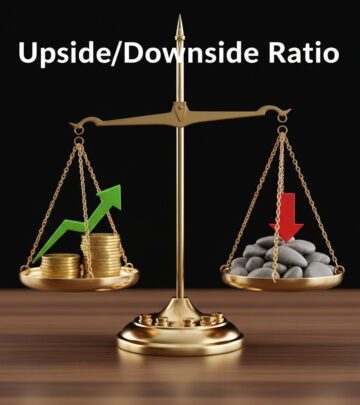
When evaluating investment opportunities, downside deviation provides crucial information about the worst-case scenarios. This metric helps investors understand not just the typical volatility of an investment, but specifically how much it tends to decline during downturns. Securities with high downside risk should compensate investors with high expected returns to justify the additional risk of significant losses.
For portfolio managers, downside deviation offers a more sophisticated framework for portfolio construction and risk management. By focusing on downside risk, managers can make more informed decisions about asset allocation, diversification, and hedging strategies that are specifically designed to protect against the losses that investors fear most.
Practical Applications of Downside Deviation
Downside deviation has become a standard metric in professional investment management across multiple disciplines. Portfolio managers use it to evaluate fund performance and compare different investment strategies on a risk-adjusted basis. Financial advisors employ downside deviation to construct portfolios that better align with client risk tolerance, particularly for investors approaching or in retirement who cannot afford significant portfolio declines.
Risk management professionals use downside deviation to monitor portfolio exposure to losses and to trigger rebalancing actions when downside risk exceeds acceptable thresholds. Hedge fund managers often emphasize downside deviation as a key performance metric because protecting capital during market downturns is a primary objective.
Investment researchers use downside deviation to analyze historical returns and identify investment strategies that deliver strong performance while minimizing exposure to losses. This has led to the development of various downside risk management strategies and alternative investment approaches that prioritize downside protection.
Managing Downside Deviation and Risk
Once investors understand their portfolio’s downside deviation, they can implement various strategies to manage and reduce this risk. Diversification is one of the most traditional and effective approaches. By spreading investments across multiple asset classes, sectors, and geographic regions, investors can reduce the overall downside risk of their portfolio. Adding alternative assets that have lower correlations with traditional stocks and bonds helps dilute sensitivity to market movements.
Another strategy involves selecting equities with low sensitivity to market movements, indicated by low beta values. During market downturns, these stocks tend not to decline as sharply as the broader market. This requires skill in stock selection and careful monitoring of market dynamics.
Reducing exposure to risky assets is another direct approach. Investors can shift allocations from volatile stocks toward more stable fixed-income instruments based on market conditions and personal risk tolerance. Derivative instruments, such as put options and collars, can also be used to hedge against downside risk and limit potential losses from market downturns.
Volatility cap strategies represent a rules-based approach where an investor sets maximum acceptable volatility levels and limits exposures if those limits are breached. These disciplined approaches help protect capital while maintaining appropriate market exposure for long-term growth.
Limitations of Downside Deviation
While downside deviation is a superior risk measure to standard deviation, it does have limitations that investors should understand. Most importantly, downside deviation relies on historical data, and past patterns may not predict future performance. An investment that exhibited low downside risk historically might perform very differently in future market environments.
Additionally, the choice of target return significantly affects the downside deviation calculation. Different investors may select different minimum acceptable returns, leading to varying assessments of the same investment. This subjectivity, while allowing for personalized analysis, can also complicate comparisons between different investments and managers.
Downside deviation also does not account for extreme tail risks or black swan events that fall far outside historical patterns. An investment might have shown limited downside deviation historically but could experience catastrophic losses during unprecedented market crises.
Real-World Example
Consider a hypothetical scenario involving a company called City Electric Inc., with annual returns from 2012 to 2019 varying from year to year. If investors set a minimum acceptable return of 9%, they would calculate downside deviation by looking only at years when returns fell below 9%. After squaring these negative deviations, summing them, dividing by the number of years, and taking the square root, they would arrive at the downside deviation figure.
When compared to the standard deviation of the same returns, the downside deviation would typically be significantly lower, particularly for investments that have experienced strong positive performance over time. In fact, for some assets during certain periods, downside deviation might be 33% lower than standard deviation, reflecting the reality that much of the total volatility came from upside movements that investors don’t actually perceive as risk.
Key Takeaways
Downside deviation is a sophisticated risk measure that focuses exclusively on negative returns and portfolio declines below a target threshold. Unlike standard deviation, which treats all volatility equally, downside deviation aligns more closely with how investors actually perceive and experience risk.
The metric has become the industry standard for professional risk management since its formal development by Dr. Frank Sortino in the early 1980s. By providing a more accurate picture of the type of risk that matters most—the risk of losing money—downside deviation enables better investment decision-making and portfolio construction.
Investors who understand and employ downside deviation in their analysis are better equipped to identify investments appropriate for their risk tolerance, construct more resilient portfolios, and implement more effective risk management strategies. While downside deviation has limitations, particularly its reliance on historical data, it remains an invaluable tool for anyone seeking to build and protect investment wealth.
Frequently Asked Questions
What is the difference between downside deviation and standard deviation?
Standard deviation measures all volatility in investment returns, treating upside and downside movements equally. Downside deviation focuses only on returns that fall below a specified target, ignoring positive surprises. This makes downside deviation a better reflection of the risk investors actually care about—potential losses.
Who developed downside deviation, and when did it become widely used?
Dr. Frank Sortino formally developed and defined downside deviation as a measure of investment risk in the early 1980s. Since then, it has become the industry standard for risk management among professional investors and portfolio managers.
How do I calculate downside deviation for my portfolio?
To calculate downside deviation, first establish your minimum acceptable return (MAR). Then, for each period, calculate the difference between actual return and the MAR. Square only the negative differences, sum them, divide by the number of periods, and take the square root of the result.
Can downside deviation be used with the Capital Asset Pricing Model?
Yes, downside deviation can be incorporated into CAPM through the use of downside beta instead of regular beta. This modification allows CAPM to better reflect non-symmetrical security distributions and provide more accurate risk assessments.
What are the main strategies for reducing downside deviation in my portfolio?
Key strategies include diversification across asset classes and geographies, selecting low-beta stocks that move less with the market, reducing exposure to volatile assets, using derivative instruments for hedging, and implementing volatility cap strategies that automatically rebalance when risk exceeds acceptable levels.
Why should I care about downside deviation if I have a long investment timeline?
Even with a long time horizon, downside deviation matters because significant portfolio declines can force you to sell at losses to meet expenses, and recovering from major losses requires disproportionately large gains. Understanding downside risk helps you build a portfolio appropriate for your actual risk tolerance and financial needs.
References
- Downside Risk — Wikipedia. Accessed November 2025. https://en.wikipedia.org/wiki/Downside_risk
- Downside Risk: Overview, How To Calculate and Manage — Corporate Finance Institute. Accessed November 2025. https://corporatefinanceinstitute.com/resources/career-map/sell-side/capital-markets/downside-risk/
- Downside Deviation — Morningstar UK Glossary. Accessed November 2025. https://www.morningstar.co.uk/uk/glossary/98549/downside-deviation.aspx
- Downside Deviation Explained: CFA Level 1 — AnalystPrep. Accessed November 2025. https://analystprep.com/cfa-level-1-exam/quantitative-methods/downside-deviation/
- How to Power Trading Portfolio Risk Analysis with Downside Deviation — PyQuant News. Accessed November 2025. https://www.pyquantnews.com/the-pyquant-newsletter/trading-portfolio-risk-analysis-downside-deviation
Similar Articles








Read full bio of medha deb