Economic Depression: Causes, Effects, And How To Prepare
Understand economic depressions: prolonged declines in GDP, rising unemployment, and strategies to protect your finances during tough times.

Highlights:
- An
economic depression
is a sustained period of significant economic decline that sees a nation’s GDP drop, unemployment rates rise and consumer confidence suffer. - A
recession
also describes a period of economic decline but is generally much shorter and less severe than an economic depression. - You can prepare for the negative effects of an economic depression by building up your
emergency fund
, paying down debt and keeping a careful eye on your credit reports and credit scores.
What is an economic depression?
An
economic depression
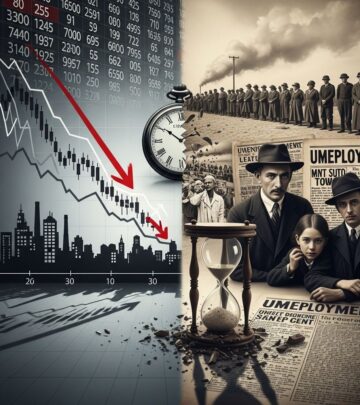
is a sustained period of sudden, significant economic decline. Unlike milder downturns, it persists for years, reshaping economies on a profound scale. During a depression, corporate investment may dwindle as businesses hesitate to expand amid uncertainty. Manufacturers often cut back on production due to reduced demand, leading to widespread layoffs.Gross domestic product (**GDP**), which measures the total value of goods and services produced within a country, experiences a sharp and prolonged drop. Unemployment rates spike dramatically as companies slash jobs to survive. Consumer confidence plummets, with people holding back on spending out of fear for the future. This creates a vicious cycle: less spending leads to more business failures, further job losses, and even deeper economic contraction.
Historians often point to the
Great Depression
(1929-1939) as the archetype. Triggered by the 1929 stock market crash, U.S. GDP fell by nearly 30%, unemployment hit 25%, and global trade collapsed. Banks failed en masse, wiping out savings and credit access for millions. Recovery required massive government intervention, including New Deal programs.How does an economic depression impact the economy?
An economic depression can radically reshape a country’s economy for years, if not decades. The most immediate effect is a huge decline in
consumer confidence
. People become far less willing to spend, prioritizing essentials over discretionary purchases. Home sales plummet as families delay moves or face foreclosures. Large-ticket items like cars and appliances see demand evaporate, forcing retailers and manufacturers into cutbacks.Nationwide production of goods and services drops significantly, causing a sharp
GDP decline
. The stock market typically suffers devastating losses; during the Great Depression, the Dow Jones Industrial Average lost 89% of its value from peak to trough. Investors face severe portfolio erosion, eroding retirement savings and wealth broadly.Two areas bear outsized impacts:
unemployment
andinterest rates
. Unemployment surges as businesses downsize. In severe cases, it can exceed 20-25%, leading to long-term joblessness. Governments often respond by slashing interest rates to near zero to stimulate borrowing and spending. However, if rates are already low, this tool becomes ineffective, prolonging the downturn. Central banks may turn to unconventional measures like quantitative easing.| Indicator | Normal Economy | Depression (e.g., Great Depression) |
|---|---|---|
| GDP Growth | 2-3% annually | -10% to -30% cumulative |
| Unemployment Rate | 4-6% | 20-25%+ |
| Consumer Spending | Stable/increasing | Sharp decline (50%+ drop) |
| Stock Market | Moderate gains | 80-90% losses |
This table illustrates the stark differences, highlighting why depressions demand aggressive policy responses.
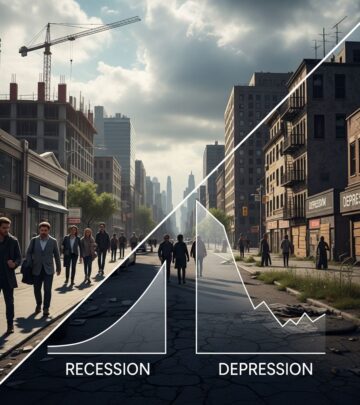
Depression vs. recession: What’s the difference?
While both signal economic trouble, a
recession
is generally much shorter and less severe than an economic depression. Economists define a recession as two consecutive quarters of negative GDP growth. It typically lasts 6-18 months, with GDP contracting by 2-5% and unemployment rising to 8-10%.Depressions, by contrast, involve GDP drops of 10% or more, lasting years, with unemployment often doubling or tripling pre-crisis levels. The U.S. has experienced 33 recessions since 1854, but only one undisputed depression (1929-1939). The 2008 financial crisis was a severe recession, with 4.3% GDP contraction and 10% unemployment, but swift interventions prevented depression status.
- Duration: Recession: months; Depression: years.
- Severity: Recession: mild-moderate; Depression: extreme.
- Scope: Recession: national; Depression: often global.
Causes of economic depressions
Depressions rarely stem from single events; they arise from complex interactions. Common triggers include:
- Asset Bubbles Bursting: Overinflated stock or real estate markets collapse, as in 1929.
- Banking Crises: Widespread bank failures halt lending, starving businesses of capital.
- Monetary Policy Errors: Tight money supply exacerbates downturns; the Fed’s 1930s gold standard adherence worsened the Great Depression.
- External Shocks: Wars, pandemics, or trade wars disrupt supply chains and demand.
- Debt Overhangs: High private or public debt levels amplify contractions.
Modern safeguards like deposit insurance, automatic stabilizers (unemployment benefits), and proactive central banks make true depressions rarer.
Historical examples of economic depressions
The Great Depression (1929-1939)
The benchmark event began with the Wall Street Crash. U.S. GDP fell 30%, industrial production halved, and deflation gripped the economy. Global contagion spread via trade links and gold standard ties. President Roosevelt’s New Deal introduced social security, banking reforms, and infrastructure spending, aiding recovery by 1939.
Other Notable Depressions
- Long Depression (1873-1896): Triggered by European bank failures, it featured deflation and slow growth across industrialized nations.
- 1937-1938 Recession within Depression: Policy tightening caused a secondary plunge.
- Post-WWI Depressions: In Europe, hyperinflation and reparations led to severe slumps.
Effects on individuals and families
Depressions devastate households. Job losses force reliance on savings, which deplete quickly. Home foreclosures rise, disrupting lives. Credit tightens, making borrowing impossible even for the qualified. Mental health suffers amid uncertainty; studies link economic distress to higher anxiety and depression rates.
Families cut non-essentials, straining budgets. Children face nutritional risks, and education suffers from school cuts. Long-term, scarred workers earn less and face persistent unemployment.
How to prepare for an economic depression
While you can’t prevent macro events, personal resilience buffers impacts:
- Build an Emergency Fund: Aim for 6-12 months of expenses in liquid savings.
- Pay Down High-Interest Debt: Reduce credit card balances to free cash flow.
- Diversify Income: Side gigs or skills training provide fallbacks.
- Monitor Credit: Regular checks via Equifax ensure strong scores for future needs.
- Invest Conservatively: Balance stocks with bonds; avoid leverage.
Frequently Asked Questions (FAQs)
What is the main difference between a depression and a recession?
A recession is shorter (months) and milder; a depression lasts years with deeper GDP falls and higher unemployment.
Are we in an economic depression now?
No major economy is in depression as of 2026; recent slowdowns qualify as recessions at most.
How long do economic depressions typically last?
3-10 years, depending on policy responses.
Can governments prevent depressions?
Not always, but fiscal/monetary tools mitigate severity.
Does debt worsen during depressions?
Yes, job losses and tight credit amplify debt stress, linking to mental health issues.
References
- Debt and Mental Health in the Workplace — Equifax/YouGov. 2023. https://www.equifax.co.uk/efx_pdf/Equifax_Debt_and_mental_health_Final.pdf
- What is an Economic Depression? — Equifax. 2024. https://www.equifax.com/personal/education/personal-finance/articles/-/learn/what-is-depression/
- How Can Debt and Money Issues Impact Your Mental Health? — Equifax. 2024. https://www.equifax.com/personal/education/credit-cards/articles/-/learn/impacts-debt-mental-health/
- Debts and Despair Report — Money and Mental Health Policy Institute. 2023-12-01. https://www.moneyandmentalhealth.org/wp-content/uploads/2023/12/Debts-and-despair-report.pdf
- Area-level credit scores and symptoms of depression and anxiety — PMC/NCBI. 2024. https://pmc.ncbi.nlm.nih.gov/articles/PMC12055470/
Similar Articles








Read full bio of medha deb