Cost-Push Inflation: Definition, Causes & Effects
Understanding cost-push inflation: causes, effects, and how it impacts your economy and purchasing power.
What is Cost-Push Inflation?
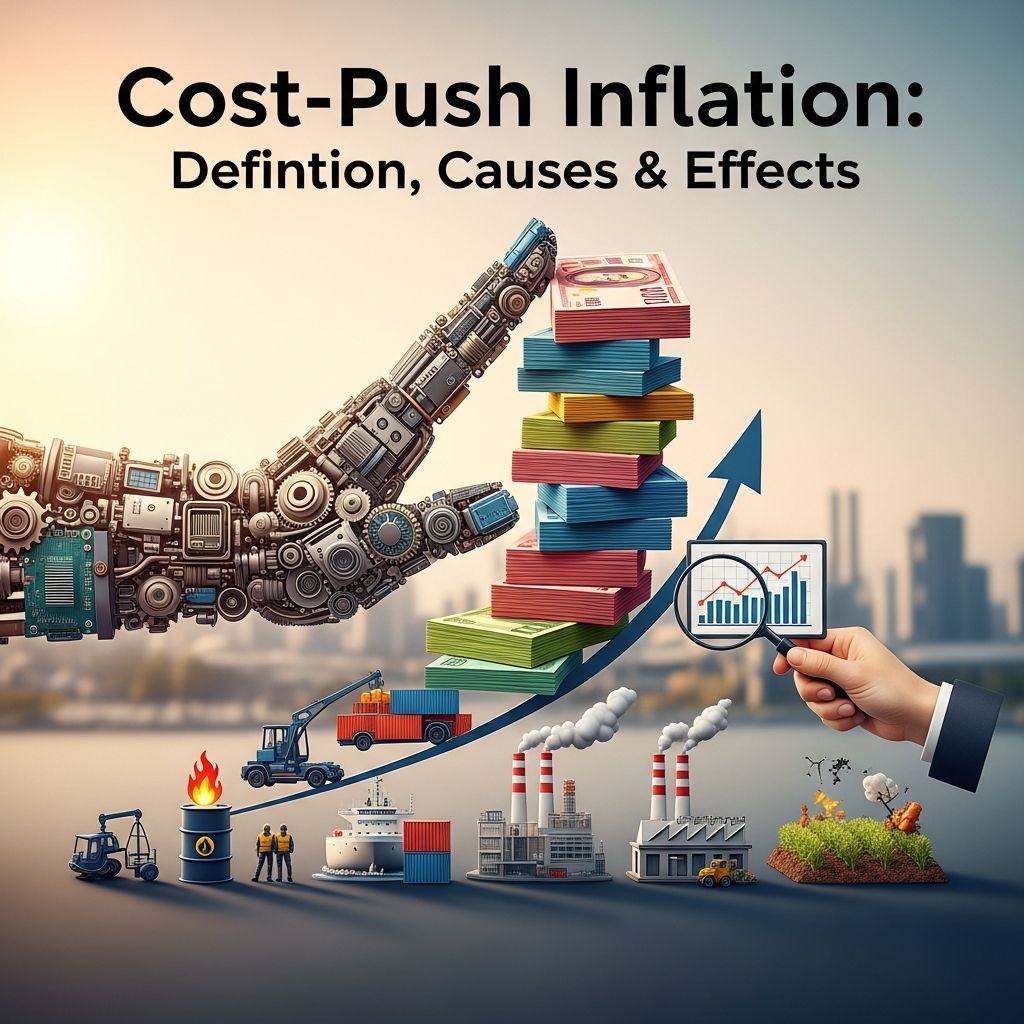
Cost-push inflation occurs when the overall prices of goods and services rise throughout the economy due to increasing production costs. Unlike other forms of inflation driven by excessive consumer demand, cost-push inflation emerges from the supply side of the economy when businesses face higher expenses for inputs such as raw materials, labor, and energy. This type of inflation represents a significant economic phenomenon that affects both consumers and businesses, often resulting in reduced purchasing power and economic challenges.
When production costs increase, companies typically transfer these elevated expenses to consumers through higher prices. This mechanism creates a domino effect throughout the economy, where increased costs in one sector can ripple across multiple industries. Cost-push inflation is particularly concerning because it can occur even when consumer demand remains stable or weak, making it difficult for policymakers to address through traditional demand management strategies.
Understanding the Mechanics of Cost-Push Inflation
The fundamental mechanism behind cost-push inflation involves a leftward shift in the aggregate supply curve. When aggregate supply decreases while aggregate demand remains constant or increases, upward pressure on prices intensifies. This supply-demand imbalance creates an environment where businesses have limited options but to raise prices to maintain profitability and offset their increased operational costs.
Cost-push inflation differs fundamentally from demand-pull inflation, which occurs when consumer demand exceeds available supply. In cost-push scenarios, the economy may actually be experiencing weak demand, yet prices still rise because production constraints and higher input costs force businesses to increase their prices. This distinction is crucial for understanding economic policy responses and the overall health of an economy.
Primary Causes of Cost-Push Inflation
Rising Wage Costs
One of the most significant contributors to cost-push inflation is increasing labor costs. When workers demand higher wages through collective bargaining, labor strikes, or simply due to tight labor market conditions, businesses face substantial cost increases. Wages represent a major component of production costs across virtually all industries. As companies pay more to retain and attract skilled workers, they must either absorb these costs, reducing profit margins, or pass them along to consumers through price increases. Historical examples, such as the 1970s wage-price spiral, demonstrate how rising wages can become embedded in inflation expectations and create persistent inflationary pressures.
Increased Raw Material and Commodity Prices
Fluctuations in raw material prices significantly impact production costs across numerous sectors. Rising oil prices represent a particularly influential factor because petroleum products affect transportation, manufacturing, and energy costs throughout the economy. When crude oil prices surge, companies experience higher costs for fuel, shipping, and production of petroleum-derived materials. Similarly, increases in prices for metals, agricultural products, and other commodities transmitted through global supply chains can trigger widespread cost-push inflation. The 2008 global food and fuel crisis exemplified how commodity price shocks can rapidly transmit inflationary pressures across international economies.
Higher Import Prices and Exchange Rate Depreciation
In an interconnected global economy, exchange rate movements significantly affect import costs. When a country’s currency depreciates, imported goods become more expensive in domestic currency terms. This imported inflation increases production costs for businesses relying on foreign materials and components. Companies manufacturing goods with substantial imported inputs face immediate cost pressures, which they must address through price increases or margin compression. Global trade dependencies mean that currency fluctuations in one country can quickly translate into cost-push inflation elsewhere.
Increased Taxes and Government Regulations
Tax increases, particularly on production or consumption, directly raise business costs. Higher corporate income taxes, excise duties, value-added taxes, and regulatory compliance costs all contribute to increased production expenses. When governments implement new environmental regulations, safety standards, or licensing requirements, businesses must invest in compliance measures, driving up operational costs. These policy-driven cost increases are then typically passed to consumers through higher prices, creating a direct link between fiscal policy and cost-push inflation.
Supply Chain Disruptions and Natural Disasters
Unexpected supply shocks, including natural disasters, pandemics, geopolitical events, and transportation disruptions, can severely constrain aggregate supply. When production capacity falls due to factory closures, agricultural failures, or logistics bottlenecks, businesses cannot maintain previous production levels despite stable or increased demand. These supply disruptions force prices higher as limited goods compete for consumer spending. The COVID-19 pandemic provided a recent example of how supply chain disruptions could create significant cost-push inflation across multiple sectors simultaneously.
Profit-Push Inflation
When firms gain increased monopoly power or market concentration, they can raise prices beyond what cost increases would justify. This profit-push inflation occurs when businesses leverage stronger market positions to expand profit margins rather than merely offsetting higher costs. Reduced competition eliminates pricing discipline, allowing firms to pass through cost increases and add additional markups, intensifying inflationary pressures on consumers.
Comparing Cost-Push and Demand-Pull Inflation
Understanding the distinction between cost-push and demand-pull inflation is essential for economic analysis and policy formulation. While both result in rising price levels, their origins and implications differ substantially.
| Characteristic | Cost-Push Inflation | Demand-Pull Inflation |
|---|---|---|
| Primary Cause | Rising production costs (wages, materials, energy) | Aggregate demand exceeds aggregate supply |
| Supply-Demand Dynamic | Aggregate supply decreases | Aggregate demand increases faster than supply |
| Economic Conditions | Can occur during weak demand periods | Typically occurs during economic expansions |
| Real GDP Impact | Often accompanied by lower real GDP | Often accompanied by higher real GDP |
| Policy Response | Limited traditional monetary policy tools | Central banks can use contractionary policies |
| Historical Example | 1970s oil crisis inflation | Post-pandemic demand surge 2021-2022 |
Economic Effects of Cost-Push Inflation
Impact on Economic Growth
Cost-push inflation often coincides with reduced economic growth, creating a phenomenon known as stagflation when combined with stagnant or negative growth. As businesses face compressed profit margins and consumer purchasing power declines, investment and spending patterns weaken. This stagflationary environment presents particularly challenging policy dilemmas because traditional tools for combating inflation through demand destruction may exacerbate economic weakness.
Effects on Living Standards
Cost-push inflation erodes purchasing power, reducing the real value of wages and savings. Consumers find their money buys fewer goods and services, effectively lowering living standards. This impact falls particularly heavily on fixed-income earners, retirees, and low-income households with limited ability to negotiate wage increases or adjust spending patterns. In developing economies where food represents a larger budget share, food-price-driven cost-push inflation can have severe humanitarian consequences.
Business Profitability Challenges
Companies face difficult choices when production costs rise due to cost-push factors. They can accept lower profit margins, raise prices and risk demand destruction, reduce workforce size, or relocate production to lower-cost regions. These responses each carry economic and social consequences. Small businesses with limited pricing power face particular vulnerability, while large corporations with market dominance can more easily pass costs to consumers.
Inflation Expectations and Persistence
Perhaps most concerning, temporary cost-push inflation can become persistent if it influences inflation expectations. When workers observe rising prices, they bargain for higher wages to maintain real income. Businesses, anticipating further cost increases and expecting higher future inflation, raise prices preemptively. These wage-price spirals can transform temporary supply shocks into sustained inflation, embedding higher price growth into the economy’s trajectory. The 1970s demonstrated this dynamic clearly, as workers’ responses to initial oil shocks extended inflation well beyond the original supply disruption.
Real-World Examples of Cost-Push Inflation
The 1970s oil embargo provides a classic cost-push inflation example. OPEC’s decision to restrict oil supplies caused crude oil prices to quadruple, immediately increasing transportation, manufacturing, and energy costs across all sectors. These production cost increases forced businesses to raise prices substantially, creating widespread inflation despite weak consumer demand. Simultaneously, workers demanded wage increases to offset inflation, creating a wage-price spiral that extended inflationary pressures throughout the decade.
More recently, the 2008 commodity price spike created global cost-push inflation as food and energy prices surged. Supply constraints combined with increased demand drove prices higher, affecting production costs for manufacturers dependent on these inputs. The resulting inflation occurred despite financial crisis conditions that should have created deflationary pressures.
Post-pandemic supply chain disruptions (2021-2022) created significant cost-push inflation as shipping costs exploded, semiconductor shortages constrained production, and labor availability remained limited despite wage increases. These supply-side constraints forced price increases across technology, automotive, and consumer goods sectors.
Policy Responses to Cost-Push Inflation
Addressing cost-push inflation presents policymakers with difficult choices. Traditional monetary policy tightening, while potentially reducing inflation, can worsen economic growth and unemployment—the stagflation problem. Supply-side policies targeting productivity improvements, reducing regulatory burdens, or facilitating supply increases may provide better long-term solutions. Some economists advocate targeted fiscal measures addressing specific supply constraints, while others emphasize the importance of anchoring inflation expectations to prevent temporary cost shocks from becoming persistent.
Protecting Against Cost-Push Inflation
Investors and households can employ several strategies to protect wealth during cost-push inflationary episodes. Real assets including real estate, commodities, and inflation-protected securities can preserve purchasing power as prices rise. Diversified equity portfolios, particularly stocks in sectors serving essential goods and services, historically provide inflation hedges. Treasury Inflation-Protected Securities (TIPS) automatically adjust principal values with inflation measures. Strategic positioning in companies with strong pricing power and efficient operations can provide superior returns during cost-push inflation periods.
Frequently Asked Questions
Q: How does cost-push inflation differ from demand-pull inflation?
A: Cost-push inflation results from rising production costs that decrease aggregate supply, while demand-pull inflation occurs when aggregate demand exceeds available supply. Cost-push inflation can happen during economic weakness, whereas demand-pull typically accompanies economic expansion.
Q: Can cost-push inflation be permanent?
A: While initially temporary when caused by specific cost shocks, cost-push inflation can become persistent if it influences wage expectations and business pricing behavior. The 1970s demonstrated how temporary supply shocks can create lasting inflation if wage-price spirals develop.
Q: What is the relationship between supply chains and cost-push inflation?
A: Disruptions to supply chains increase production costs and reduce aggregate supply, triggering cost-push inflation. Global supply chain interdependencies mean disruptions propagate across countries, as evidenced by post-pandemic inflation experiences.
Q: How do central banks address cost-push inflation?
A: Central banks face policy dilemmas during cost-push inflation because traditional contractionary measures can worsen economic growth. Some emphasize inflation expectation management, while others support supply-side policies addressing root cost drivers.
Q: Which investments protect against cost-push inflation?
A: Inflation-hedging investments include real estate, commodities, TIPS, dividend-paying stocks, and companies with strong pricing power in essential sectors. Gold and diversified equity portfolios also provide historical inflation protection.
References
- Cost-Push Inflation: Meaning, Causes, Examples and Measurement — GeeksforGeeks. 2024. https://www.geeksforgeeks.org/macroeconomics/cost-push-inflation-meaning-causes-examples-and-measurement/
- Cost-Push Inflation — Fiveable AP Macroeconomics. 2024. https://fiveable.me/key-terms/ap-macro/cost-push-inflation
- Cost-Push Inflation — Economics Help. 2024. https://www.economicshelp.org/blog/2006/economics/cost-push-inflation-2/
- Cost Push Inflation: Meaning, Causes, Effects & Examples — Bajaj Finserv. 2024. https://www.bajajfinserv.in/cost-push-inflation
- Causes of Inflation — Reserve Bank of Australia Education. 2024. https://www.rba.gov.au/education/resources/explainers/causes-of-inflation.html
- Inflation: Prices on the Rise — International Monetary Fund. 2024. https://www.imf.org/en/publications/fandd/issues/series/back-to-basics/inflation
Similar Articles








Read full bio of Sneha Tete