Book Value: 5-Step Guide To Calculate Company And Asset Worth
Learn how book value determines asset worth on financial statements and balance sheets.

What Is the Book Value of an Asset?
Book value, also known as carrying value or net book value, represents the value of an asset as it appears on a company’s balance sheet. It reflects the original cost of an asset minus accumulated depreciation and any impairment charges. Understanding book value is essential for investors, accountants, and business owners who need to assess the true accounting value of their assets and determine their company’s financial position.
Book value differs significantly from market value. While market value represents what an asset could sell for in today’s market, book value shows the theoretical accounting value based on historical costs and standard depreciation methods. An asset’s book value may be higher, lower, or equal to its fair market value depending on various factors, including market conditions, asset condition, and economic changes.
Understanding Book Value Basics
Book value serves as a fundamental accounting concept that helps organizations track the net worth of their assets over time. When a company purchases an asset, it records the original cost on the balance sheet. As the asset ages and is used in business operations, its value decreases through depreciation. The book value reflects this gradual reduction in asset value.
Depreciation represents the systematic allocation of an asset’s cost over its useful economic life. Different assets depreciate at different rates. For example, vehicles typically depreciate faster than buildings, and technology equipment may depreciate at rates different from manufacturing machinery. The depreciation method chosen by a company can affect how quickly book value decreases.
The Book Value Formula for Individual Assets
Calculating the book value of a specific asset is straightforward using the following formula:
Book Value of an Asset = Purchase Price – Accumulated Depreciation – Impairment
To apply this formula, follow these steps:
- Identify the original purchase price of the asset, including all costs necessary to make it operational (such as transportation and installation)
- Determine the accumulated depreciation, which is the total depreciation expense recorded since the asset was purchased
- Account for any impairment charges that reduced the asset’s value due to damage, obsolescence, or market changes
- Subtract both accumulated depreciation and impairment from the original purchase price
Example: If you purchased equipment for $50,000, and the accumulated depreciation is $15,000 with no impairment charges, the book value would be $35,000 ($50,000 – $15,000).
Book Value vs. Market Value
A critical distinction exists between book value and market value. Book value represents an accounting measurement based on historical costs and standardized depreciation schedules. Market value, conversely, reflects what a buyer would actually pay for an asset in today’s marketplace.
Several factors can cause differences between book value and market value:
- Economic conditions: Market demand and economic factors significantly influence what buyers will pay for assets
- Asset condition: An asset in excellent condition may have a higher market value than its book value suggests
- Technological advancement: New technology can make older assets less valuable in the market than their book values indicate
- Supply and demand: Scarce assets may command premium prices above their book values
- Location: For real estate and certain assets, location dramatically affects market value independent of book value
Book Value of a Company
Beyond individual assets, investors and analysts often calculate the book value of an entire company. This represents the company’s total net worth based on its financial statements.
Net Book Value Formula for a Company:
Book Value = Total Assets – Total Liabilities
This calculation reveals what shareholders would theoretically receive if the company were liquidated and all debts were paid off. The formula encompasses:
- Current assets (cash, inventory, accounts receivable)
- Non-current assets (property, equipment, long-term investments)
- Intangible assets (patents, trademarks, goodwill) in some calculations
- Current liabilities (accounts payable, short-term debt)
- Non-current liabilities (long-term bonds, pension obligations)
Example: If a company has total assets of $2,000,000 and total liabilities of $500,000, the book value would be $1,500,000. This represents the company’s shareholders’ equity.
Book Value Per Share
Investors frequently use book value per share (BVPS) to evaluate individual stocks and compare companies of different sizes.
Book Value Per Share Formula:
Book Value Per Share = Shareholders’ Equity ÷ Common Shares Outstanding
This metric provides a per-share accounting value that helps investors determine whether a stock trades at a premium or discount to its underlying asset value.
Calculation Example: If a company has shareholders’ equity of $200,000 and 50,000 common shares outstanding, the book value per share would be $4.00 ($200,000 ÷ 50,000 shares).
When comparing this to the actual stock price, investors gain insight into the stock’s valuation. If the stock trades at $3.00 per share while the BVPS is $4.00, the stock trades at a discount to book value (75% of book value), potentially indicating it’s undervalued in the market.
Calculating Book Value: Step-by-Step Process
To calculate a company’s book value accurately, follow this systematic approach:
Step 1: Locate Total Assets
Review the company’s most recent balance sheet and identify the “Total Assets” line item. This includes all assets the company owns: cash, marketable securities, accounts receivable, inventory, equipment, buildings, vehicles, and long-term investments.
Step 2: Find Total Liabilities
On the same balance sheet, locate “Total Liabilities.” This encompasses both short-term obligations (accounts payable, taxes owed, current portion of debt) and long-term liabilities (bonds, long-term loans, pension obligations, deferred tax liabilities).
Step 3: Subtract Liabilities from Assets
Calculate book value by subtracting total liabilities from total assets. The result equals shareholders’ equity, which is the company’s book value.
Step 4: Adjust for Preferred Stock
If the company has issued preferred stock, subtract the preferred stock value from shareholders’ equity. This adjustment is necessary because preferred shareholders have priority claims on assets over common shareholders.
Step 5: Calculate Book Value Per Share (Optional)
Divide the adjusted shareholders’ equity by the number of common shares outstanding to determine book value per share.
Why Book Value Matters
Book value serves multiple important purposes in financial analysis and business management:
Asset Tracking and Accountability
Book value helps companies maintain accurate records of their assets’ worth over time. This is essential for internal financial management, loan applications, and insurance valuations.
Investment Analysis
Investors use book value per share to identify potentially undervalued stocks. Comparing stock price to BVPS helps determine whether a company’s shares represent good value.
Industry-Specific Relevance
Book value is particularly useful for analyzing industries whose operations depend heavily on assets, including banks, precious metals companies, oil and gas producers, and real estate firms. These industries typically have high proportions of tangible assets relative to intangible assets.
Lending and Credit Decisions
Banks and creditors often evaluate book value to assess a company’s net worth and ability to repay loans. A strong book value suggests the company has substantial assets backing its obligations.
Liquidation Analysis
Book value provides insight into how much shareholders would theoretically receive if the company were liquidated, though actual proceeds may differ from book value.
Tangible vs. Intangible Assets and Book Value
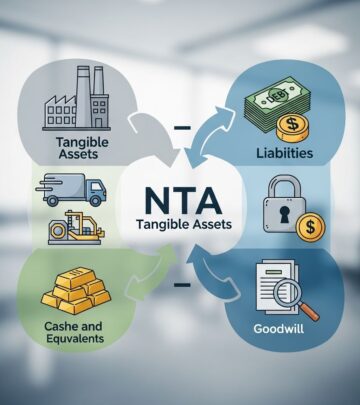
The distinction between tangible and intangible assets affects book value calculations differently. Tangible assets like machinery, vehicles, and buildings have physical form and depreciate according to standard schedules. These assets’ book values are calculated by subtracting accumulated depreciation from original cost.
Intangible assets like patents, trademarks, brand recognition, and goodwill lack physical form. While some intangible assets appear on balance sheets (particularly goodwill from acquisitions), others may not. When calculating company book value, some analyses exclude intangible assets to focus solely on tangible asset backing.
Limitations of Book Value
While book value provides valuable insights, it has several limitations that investors and analysts should understand:
- Historical cost basis: Book value relies on historical purchase prices, which may not reflect current market conditions or asset values
- Depreciation assumptions: Different depreciation methods can significantly affect book value calculations, leading to inconsistencies between companies
- Intangible asset exclusions: Many valuable intangible assets may not appear on the balance sheet
- Market fluctuations: Book value doesn’t account for market-driven changes in asset values
- Industry variations: Comparisons across industries can be misleading due to differing asset-heavy business models
Book Value in Different Industries
Book value significance varies across industries. In asset-intensive industries such as banking, insurance, utilities, real estate, and manufacturing, book value provides meaningful insight into company value. Banks, for example, primarily hold financial assets, making book value highly relevant. Conversely, technology and service companies with substantial intangible assets like software, patents, and customer relationships may have book values that understate their true economic worth.
Frequently Asked Questions
Q: How does book value differ from market capitalization?
A: Book value represents the accounting value based on historical costs and depreciation, while market capitalization reflects what investors believe the company is worth based on current stock price multiplied by shares outstanding. Market cap is typically higher for growing companies with strong prospects.
Q: Can book value increase over time?
A: Generally, book value decreases as assets depreciate. However, it can increase if the company generates retained earnings through profits, acquires new assets, reduces liabilities, or if the market value of existing assets appreciates significantly.
Q: Why is book value important for investors?
A: Book value per share helps investors identify potentially undervalued stocks and assess whether a company has sufficient tangible asset backing. It’s particularly useful for value investing strategies.
Q: Should I use book value or market value to evaluate an asset?
A: The choice depends on your purpose. Use book value for accounting and financial reporting, and market value when determining actual selling price or current replacement value.
Q: How does impairment affect book value?
A: Impairment charges reduce book value when an asset’s market value falls significantly below its carrying value. This reflects significant declines in asset value due to damage, obsolescence, or market conditions.
Q: Is book value relevant for service-based companies?
A: Book value is less relevant for service and technology companies that rely more on intangible assets and intellectual property than physical assets. Market-based valuations are often more meaningful for these companies.
References
- Book Value – Definition, Formulas & Example — Financial Edge Training. 2024. https://www.fe.training/free-resources/accounting/book-value/
- What Is Book Value? Definition, Purpose, & Calculation — Patriot Software. 2024. https://www.patriotsoftware.com/blog/accounting/what-is-book-value/
- What is Book Value? (Formula & Why Investors Care) — Bill.com. 2024. https://www.bill.com/learning/what-is-book-value
- What Is Book Value? Plus, How To Calculate It — N26. 2024. https://n26.com/en-eu/blog/what-is-book-value
- What Is Book Value: Definition, Formula, and How It Works — Ramp. 2024. https://ramp.com/blog/book-value
- Book Value – Definition, Formula, Accounting Role — Corporate Finance Institute. 2024. https://corporatefinanceinstitute.com/resources/accounting/book-value/
Similar Articles








Read full bio of medha deb