What Is American Express: History, Services & Cards
Discover American Express: from 1850 express delivery to global payments leader.
What Is American Express?
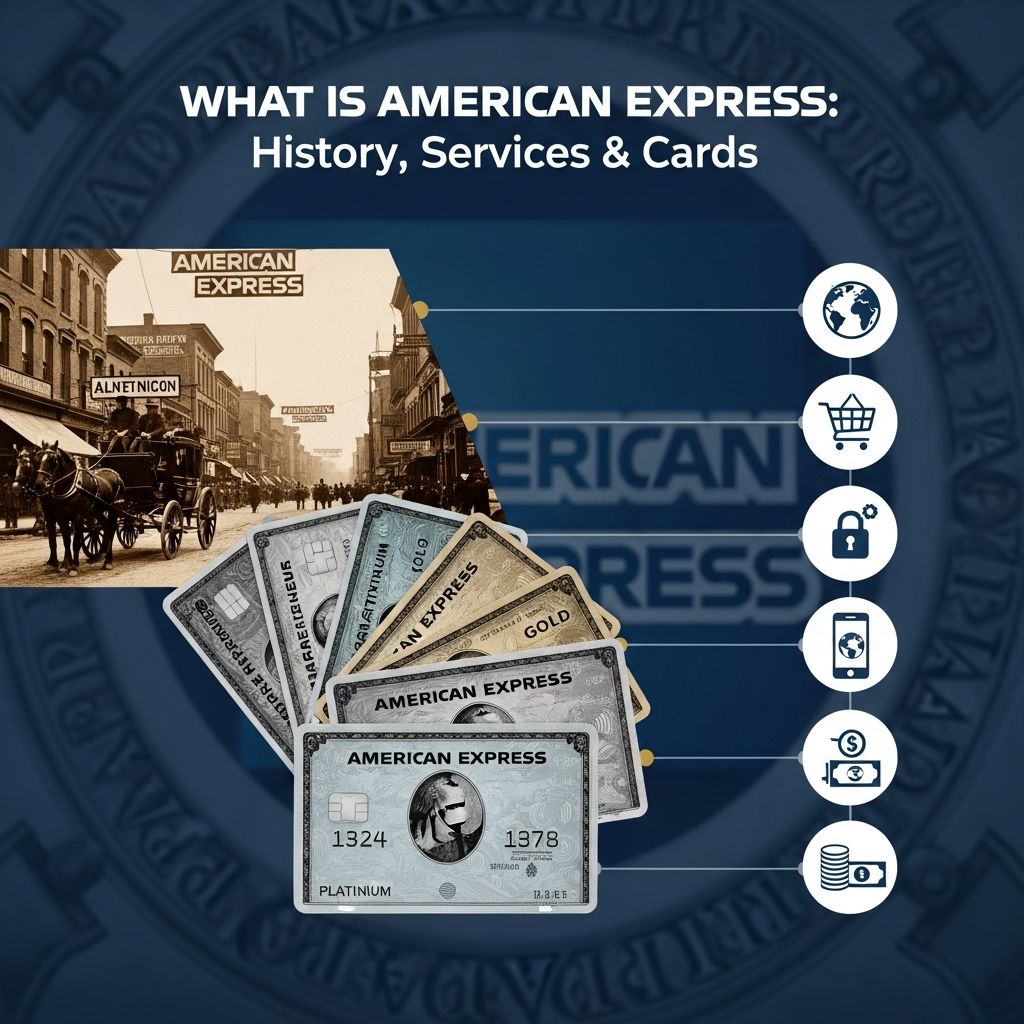
American Express, commonly known as Amex, is a globally recognized payments and travel company headquartered in New York City. Founded in 1850 as an express mail service, the company has evolved into one of the world’s leading financial services and payments processors, serving both consumers and businesses worldwide. Today, Amex operates through four main business segments: U.S. Card Services, International Card Services, Global Commercial Services, and Global Network & Merchant Services. The company is publicly traded and remains a dominant force in the payments industry, known for its premium credit and charge card offerings, travel services, and merchant processing solutions.
History of American Express
From Express Mail to Financial Services
American Express was founded on March 18, 1850, through the consolidation of three express mail companies in Buffalo, New York. The three founders—Henry Wells, William G. Fargo, and John Warren Butterfield—merged their respective companies: Wells & Company, Livingston, Fargo & Company, and Wells, Butterfield & Company. At the time, the United States Postal Service was slow, expensive, and unable to meet the demands of the rapidly growing nation. American Express filled this critical gap by employing express men who transported correspondence, parcels, freight, gold, currency, and other valuable goods from eastern cities to the western frontier using horseback and stagecoaches.
The company quickly established a reputation for excellence and trustworthiness within the financial services industry. By 1862, American Express had grown to operate 890 offices with more than 1,500 employees, managing a network of express lines spanning nearly 10,000 miles of railway and express routes across the country. The company’s early success was built on its ability to safely transport financial instruments such as stock certificates, currency, and other valuable documents for banks and financial institutions.
Expansion into Money Orders and Traveler’s Cheques
Recognizing the opportunity to expand beyond freight forwarding, American Express entered the financial services sector. In 1857, the company launched its first money order business to compete with the United States Post Office’s offerings. However, the breakthrough came in 1882 when an American Express employee named Marcellus Berry designed a safer, more secure money order that addressed a critical flaw in postal money orders: the ability to alter the face value without detection. The American Express money order was not only more secure but also more readily available than postal alternatives. The service was wildly successful, with more than 250,000 money orders issued in the first year alone.
Building on this success, American Express introduced the first traveler’s cheque in 1891, revolutionizing international travel. Within ten years, sales revenue from traveler’s cheques exceeded $6 million annually, establishing American Express as a leader in travel financial services. This success prompted international expansion, with the company opening its first European office in Paris in 1895, followed by branches in London and Berlin. By the early 1900s, American Express had established a presence on five continents, serving leisure travelers in Europe, business officials in Asia, and millions of immigrants in America using money orders to send funds back home.
Entry into the Travel Business and Credit Card Industry
American Express formally entered the travel business in 1915, expanding beyond financial instruments to offer comprehensive travel services including European tour tickets and baggage forwarding. This diversification proved strategic as the company anticipated future changes in the express delivery market.
The company’s major transformation occurred when American Express issued its first charge card on October 1, 1958, eight years after Diners Club introduced the first charge card in 1950. To position itself as a premium alternative, American Express offered its card with an annual fee of $6, which was $1 more than the Diners Club card, signaling a focus on exclusivity and premium service. This strategy was remarkably successful: within five years, more than a million people carried American Express charge cards, and over 85,000 merchants worldwide accepted it for payment. The charge card became synonymous with prestige and financial responsibility.
American Express took another significant step in 1987 by issuing its first credit card, the Optima, which allowed customers to carry forward a balance from month to month, unlike traditional charge cards. This innovation broadened the company’s appeal beyond its wealthy clientele and positioned American Express as a comprehensive payments provider.
American Express Business Segments
Today, American Express operates through four primary business divisions that serve different market segments and geographic regions:
| Business Segment | Focus Area | Target Customers |
|---|---|---|
| U.S. Card Services | Consumer and small business credit and charge cards in the United States | Individual consumers and small business owners |
| International Card Services | Credit and charge card products outside the United States | International consumers and businesses |
| Global Commercial Services | Corporate and business payment solutions | Large corporations and commercial enterprises |
| Global Network & Merchant Services | Payment processing and merchant acquisition | Merchants and payment networks worldwide |
American Express Card Products
Charge Cards vs. Credit Cards
American Express offers two primary types of cards, each serving different financial needs:
Charge Cards: These cards require the full balance to be paid each month and do not allow customers to carry forward any outstanding balance. Charge cards are designed for customers who pay their balances in full and prioritize rewards and prestige over revolving credit. They typically come with premium benefits, concierge services, and higher annual fees.
Credit Cards: Introduced with the Optima card in 1987, American Express credit cards allow customers to carry a balance from month to month and pay interest on outstanding balances. These cards provide more flexibility for customers who prefer to manage revolving credit and come in various reward categories.
Premium Card Positioning
American Express has built its brand on premium positioning and exclusivity. The company traditionally focused on wealthy and affluent customers, offering cards with significant annual fees offset by extensive benefits including travel credits, concierge services, purchase protection, extended warranties, and premium rewards programs. The annual fees range from moderate amounts for entry-level cards to several hundred dollars for flagship products like the Platinum and Centurion cards.
Expanding Financial Inclusion
While American Express built its reputation serving the wealthy and affluent, the company recognized an important market opportunity in the underserved population. According to research, the traditional banking system excludes nearly 70 million Americans from mainstream financial options. In 2010, American Express launched the Serve and Bluebird prepaid card products specifically designed to serve these consumers, offering convenient, low-cost options for managing and saving money without requiring traditional bank accounts. This strategic move marked a significant departure from the company’s traditional focus on upmarket clientele and demonstrated its commitment to expanding financial accessibility across different economic segments.
Brand Identity and Evolution
American Express has maintained a distinctive brand identity throughout its 175-year history. In its early days as an express mail service, the company used the image of a watchdog as its logo, symbolizing the values of trust, security, vigilance, and service—attributes essential to a successful mail service. When the company issued its first charge card in 1958, it adopted a new logo featuring a gladiator, representing strength and prestige. This imagery continues to be central to the American Express brand today, reflecting its core values of reliability, premium service, and financial strength.
American Express in the Modern Era
American Express has successfully navigated significant industry changes to remain competitive in the modern payments landscape. When the U.S. federal government nationalized the express industry in 1918, consolidating all domestic express operations into the American Railway Express Company, American Express pivoted almost entirely to its banking operations and travel services. This strategic flexibility has characterized the company throughout its history.
Today, American Express competes in an increasingly digital and competitive payments environment alongside Visa, Mastercard, and other payment networks. The company continues to innovate with digital payment solutions, mobile wallet integration, and personalized rewards programs tailored to customer spending patterns. Its focus on premium customer service, extensive merchant networks, and valuable reward programs maintains its competitive positioning in the global payments industry.
Frequently Asked Questions (FAQs)
Q: What is the difference between an American Express charge card and a credit card?
A: The primary difference is payment flexibility. American Express charge cards require the full balance to be paid each month with no option to carry a balance, while American Express credit cards allow you to pay your balance over time and carry a revolving balance with interest charges.
Q: When was American Express founded?
A: American Express was founded on March 18, 1850, as an express mail and freight forwarding company in Buffalo, New York, through the consolidation of three transportation companies.
Q: Who were the founders of American Express?
A: The three founders were Henry Wells, William G. Fargo, and John Warren Butterfield, who merged their respective express mail companies to create American Express.
Q: When did American Express introduce its first credit card?
A: American Express introduced its first charge card in 1958 and its first credit card, the Optima, in 1987, which allowed customers to carry forward a balance.
Q: What are the four main business segments of American Express?
A: The four main segments are U.S. Card Services, International Card Services, Global Commercial Services, and Global Network & Merchant Services.
Q: Is American Express only for wealthy customers?
A: While American Express built its reputation on premium products for affluent customers, the company now offers a diverse range of products, including the Serve and Bluebird prepaid cards designed for underserved populations seeking accessible financial services.
Q: What was American Express’s original business?
A: American Express was originally founded as an express mail and freight forwarding company that safely transported packages, valuables, gold, currency, and other goods across the United States.
References
- American Express Company — EBSCO Research Starters. Accessed November 2025. https://www.ebsco.com/research-starters/history/american-express-company
- American Express — Wikipedia. Accessed November 2025. https://en.wikipedia.org/wiki/American_Express
- American Express | National Postal Museum — Smithsonian Institution. Accessed November 2025. https://postalmuseum.si.edu/exhibition/america%E2%80%99s-mailing-industry-industry-segments-financial-services-industry/american-express
- American Express Company | History & Facts — Britannica Money. Accessed November 2025. https://www.britannica.com/money/American-Express-Company
- In 1850, three business rivals came together to form American Express — American Express Newsroom. March 18, 2025. https://www.americanexpress.com/en-us/newsroom/articles/colleagues-and-culture/in-1850–three-business-rivals-came-together-to-form-american-ex.html
Similar Articles








Read full bio of Sneha Tete