Money Market Account: How It Works, Rates, Pros & Cons
Discover how money market accounts blend savings and checking features with higher interest rates and easy access to your funds.

Money market accounts (MMAs) are deposit accounts offered by banks and credit unions that combine features of savings and checking accounts. They pay higher interest rates than traditional savings accounts while providing easier access to funds through tools like debit cards, checks, and ATMs.
Unlike true money market funds, which are investment products, MMAs are federally insured and low-risk. Banks pool depositor funds to invest in short-term, high-quality securities like Treasury notes and CDs, passing some interest back to account holders. Rates are variable, often tiered by balance, and compounded daily or monthly.
How Does a Money Market Account Work?
When you deposit money into an MMA, the financial institution uses it for low-risk investments or loans, generating interest shared with you at a variable APY. Higher balances typically earn better tiered rates. You can add funds anytime, but withdrawals are limited—often six per month under federal rules, though some banks impose stricter limits to avoid fees.
Interest is credited monthly or quarterly, helping your savings grow steadily. Minimum opening deposits range from $1,000 to $10,000 or more, with ongoing balance requirements to waive fees or maximize rates. MMAs suit those with larger sums seeking yield without locking funds like CDs.
Money Market Account Features
MMAs stand out with these core attributes:
- Higher interest rates: Often exceed traditional savings (e.g., 4-5% APY vs. 0.01-0.5%), though online high-yield savings may compete.
- Easy access: Many include debit/ATM cards, check-writing (limited), and electronic transfers—more liquid than CDs.
- Safety: FDIC-insured up to $250,000 per depositor (NCUA for credit unions), protecting principal.
- Tiered rates: Bigger balances yield higher APYs, incentivizing larger deposits.
- Limits: Transaction caps (e.g., 6/month) and minimums to avoid fees.
Money Market Account Pros and Cons
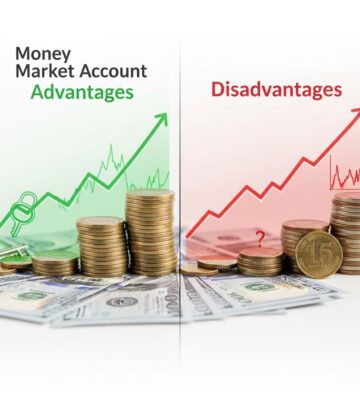
MMAs offer compelling benefits but come with trade-offs. Here’s a breakdown:
Pros
- Competitive yields: Higher APYs than standard savings accelerate growth.
- Insurance protection: FDIC/NCUA coverage ensures safety up to $250,000.
- Flexible access: Debit cards, checks, and ATMs for emergencies or bills.
- Liquidity: More accessible than CDs; ideal for short-term needs.
- Low risk: Principal preserved while earning interest, unlike stocks.
Cons
- Minimum balance fees: Falling below thresholds triggers monthly charges ($10-25).
- Transaction limits: Excess withdrawals may incur fees or account closure.
- Variable rates: APYs fluctuate with market conditions, potentially dropping.
- Higher minimums: Require $1,000+ to open/earn top rates, less accessible for small savers.
- Not for daily use: Less ideal than checking for frequent transactions.
Money Market Account vs. Savings Account vs. CD
Choosing the right account depends on your goals. Compare key differences:
| Feature | Money Market Account | High-Yield Savings | Certificate of Deposit (CD) |
|---|---|---|---|
| Interest Rate | Variable, higher than traditional savings (tiered) | Variable, competitive online rates | Fixed, often highest for term length |
| Access to Funds | Flexible: debit, checks, ATM (limits apply) | Limited: transfers, some ATM | Restricted: early withdrawal penalty |
| Minimum Balance | High ($1K+), fees if below | Low or none | Moderate, locked for term |
| Best For | Emergency funds, short-term goals | General savings, flexibility | Long-term goals, known timeline |
| Insurance | FDIC/NCUA up to $250K | FDIC/NCUA up to $250K | FDIC/NCUA up to $250K |
MMAs bridge savings growth and checking convenience but lag CDs in locked rates and high-yield savings in no-fee flexibility.
Who Should Get a Money Market Account?
MMAs fit specific profiles:
- Emergency fund holders: Accessible safety net earning interest; checks handy for big expenses like repairs.
- Short-term savers: Vacation, wedding, down payment—yield without penalties.
- Freelancers/self-employed: Park tax money separately, earning while accessible quarterly.
- Large cash holders: Tiered rates reward $10K+ balances; insured beyond basics at some banks.
Avoid if you need frequent access (choose checking) or have small balances (high-yield savings better).
Best Money Market Account Rates
As of early 2026, top MMAs offer 4.0-5.25% APY, far above national averages (~0.45%). Online banks/credit unions lead: e.g., some at 5.00%+ with $100 minimums, others tiered up to 5.25% for $100K+. Shop via comparison sites; rates change frequently—prioritize no-fee, high-minimum options matching your balance.
How to Open a Money Market Account
Opening takes minutes online or in-branch:
- Compare rates/fees: Use bank sites or aggregators for APY, minimums, limits.
- Check eligibility: U.S. resident, 18+, SSN; some require existing relationship.
- Gather docs: ID, SSN, funding source (transfer/ACH).
- Apply: Online form; fund minimum deposit.
- Set up access: Link external accounts, order debit/checks.
Online MMAs often beat brick-and-mortar rates with lower overhead.
Frequently Asked Questions (FAQs)
What is the difference between a money market account and a money market fund?
MMAs are insured bank deposits; money market funds are investments without FDIC protection, risking principal (though low).
Are money market accounts FDIC insured?
Yes, up to $250,000 per depositor per bank (NCUA for credit unions).
Can I use a money market account like a checking account?
Limited—debit/checks allowed, but 6 transactions/month cap; excess fees apply.
What happens if I exceed withdrawal limits?
Fees ($5-15 each) or account conversion to savings; repeated violations may close it.
Do money market accounts have overdraft protection?
Some link to checking; varies by bank.
Are MMA rates fixed or variable?
Variable, tied to market; can rise/fall anytime.
References
- Money Market Accounts: Definition, Benefits, and Features — Business Insider. 2025. https://www.businessinsider.com/personal-finance/banking/what-is-a-money-market-account
- What Is a Money Market Account & How Does It Work? — PNC Insights. 2025. https://www.pnc.com/insights/personal-finance/save/what-is-a-money-market-account.html
- What is a money market account? — Citizens Bank. 2025. https://www.citizensbank.com/learning/what-is-a-money-market-account.aspx
- Pros And Cons Of Money Market Accounts — Bankrate. 2025. https://www.bankrate.com/banking/mma/money-market-account-advantages-and-disadvantages/
- Money Market Account – Open Online — U.S. Bank. 2025. https://www.usbank.com/bank-accounts/savings-accounts/elite-money-market.html
Similar Articles








Read full bio of Sneha Tete