What Is A 5/1 Adjustable-Rate Mortgage (ARM)?
Understanding 5/1 ARMs: Lower initial rates, adjustable payments, and key considerations for homebuyers.
Understanding 5/1 Adjustable-Rate Mortgages
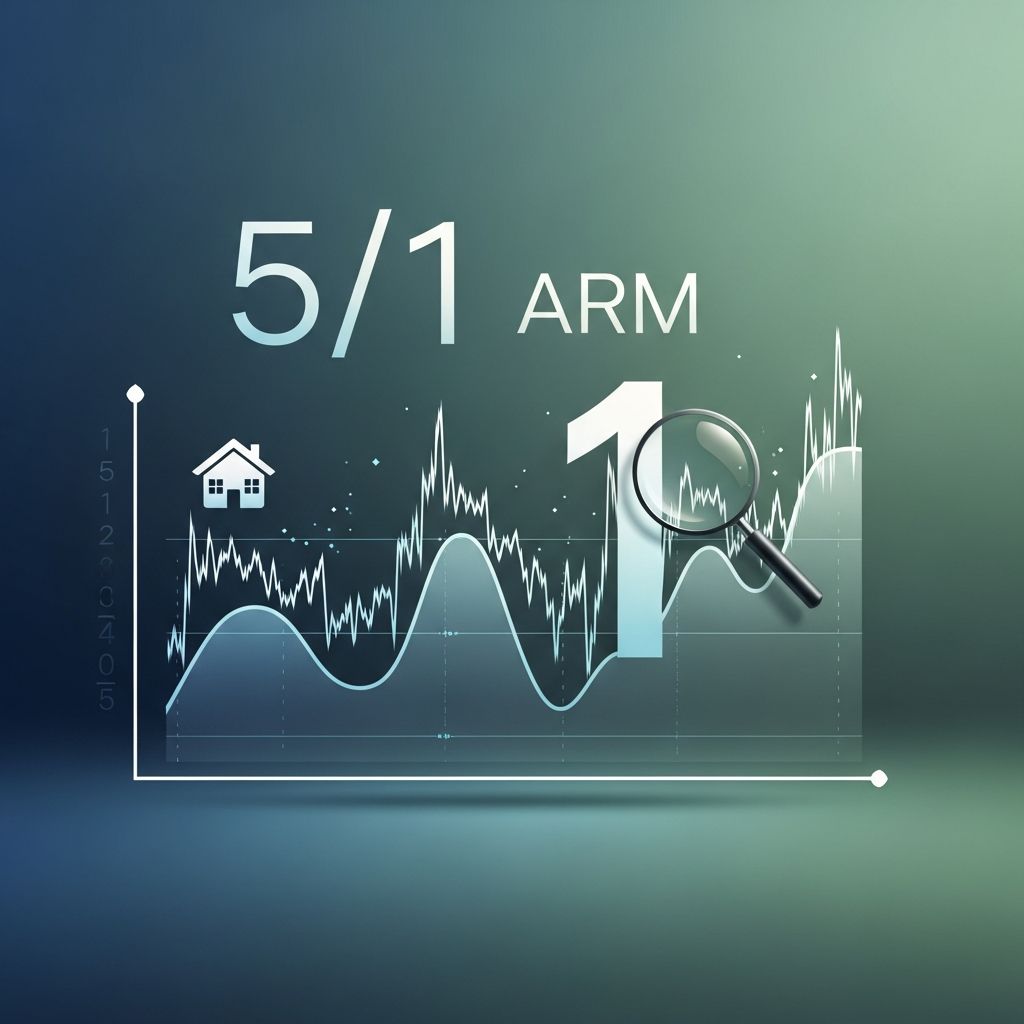
An adjustable-rate mortgage, commonly referred to as an ARM, is a home loan that features an initial low fixed-rate period followed by a variable interest rate for the remainder of the loan term. A 5/1 ARM is a specific type of adjustable-rate mortgage that combines the benefit of lower initial payments with the flexibility needed by borrowers who plan to move or refinance within a specific timeframe.
The “5/1” designation in this mortgage type has specific meaning. The “5” indicates that the loan maintains a fixed interest rate for the first five years of the loan term, while the “1” signifies that after the initial fixed-rate period expires, the interest rate will adjust annually, or once per year, for the remainder of the loan. This structure makes 5/1 ARMs particularly attractive to homebuyers seeking lower monthly payments during the early years of homeownership.
How the 5/1 ARM Works
Understanding the mechanics of a 5/1 ARM is essential for determining whether this loan product aligns with your financial situation and homeownership timeline. The loan operates in two distinct phases, each with different characteristics and payment structures.
The Fixed-Rate Period
During the initial five-year period, your 5/1 ARM functions identically to a traditional fixed-rate mortgage. Your interest rate remains constant, and your monthly mortgage payment stays the same throughout these five years. This predictability allows for straightforward budgeting and financial planning during the early years of your mortgage.
For example, if you closed on a 5/1 ARM loan in January 2025 at a 6.7 percent interest rate, that rate would remain unchanged until January 2030. This means your monthly payment would remain stable for the entire five-year introductory period, providing certainty and peace of mind.
The Adjustment Period
Once the initial five-year fixed period concludes, your mortgage enters the adjustment period. At this point, your interest rate becomes variable and will adjust annually, meaning your rate can change once each year for the remaining 25 years of your 30-year loan term. Your monthly payment amount will fluctuate based on the new interest rate applied to your loan each year.
These adjustments are not arbitrary. Instead, lenders calculate your new rate based on a specific index plus a margin established when you obtained the loan. The two most common indices used for ARMs are the 11th District Cost of Funds Index (COFI) and the Secured Overnight Financing Rate (SOFR). You can find the specific index your lender uses on your loan estimate paperwork.
Real-World Example of a 5/1 ARM
To better understand how a 5/1 ARM functions in practice, consider the following scenario:
You borrow $400,000 to purchase a home and finance this purchase with a 5/1 ARM at an initial interest rate of 6.7 percent. During the first five years, your monthly loan payment would be approximately $2,581. This payment remains constant throughout the fixed-rate period, making it easy to budget for your mortgage obligation.
After five years elapse, suppose your rate adjusts upward by 0.25 percent, bringing it to 6.95 percent. Your new monthly payment for that year would increase to approximately $2,641. One year later, your rate will adjust again, potentially increasing or decreasing based on market conditions and your loan’s index. This cycle continues annually for the remaining 25 years of your loan term until you pay off the mortgage or refinance.
Rate Caps and Rate Adjustment Mechanics
One crucial aspect of 5/1 ARMs that protects borrowers is the implementation of rate caps. These caps establish a ceiling for how high your interest rate can increase once the introductory fixed-rate period ends. Rate caps limit the maximum amount your rate can adjust in any single year and also establish a lifetime maximum rate for the entire loan.
Understanding your specific rate caps is essential for calculating potential payment scenarios and determining your maximum financial obligation. Your lender is required to disclose these caps on your loan estimate, so review this document carefully before committing to a 5/1 ARM.
5/1 ARM Loan Requirements
Qualifying for a 5/1 ARM involves meeting specific lending criteria that vary depending on the loan type you’re pursuing. Whether you’re seeking a conventional loan, FHA mortgage, or VA loan, certain baseline requirements apply across all ARM products.
Standard Qualification Criteria
For conventional 5/1 ARM loans, you’ll typically need to meet the following requirements:
- A minimum credit score of 620
- A debt-to-income (DTI) ratio of no more than 45 percent
- A minimum down payment of 5 percent
These requirements form the foundation for ARM qualification, though individual lenders may have additional or more stringent criteria. It’s important to note that ARMs can be more difficult to qualify for than fixed-rate loans for the same amount. This is because mortgage lenders assess your ability to make higher monthly payments if interest rates rise during the adjustment period. Lenders want assurance that you can afford potential payment increases before approving your ARM application.
Credit Score Importance
Your credit score plays a significant role in determining both your eligibility for a 5/1 ARM and the interest rate you’ll receive. Borrowers with excellent credit scores are typically offered the best mortgage rates by lenders. If you’re considering a 5/1 ARM and your credit score is below 620, take time to improve your credit before applying, as this can open doors to better loan terms and lower rates.
Down Payment Considerations
While a 5 percent down payment meets the minimum requirement for conventional 5/1 ARM loans, making a higher down payment can provide additional benefits. A larger down payment decreases your loan-to-value (LTV) ratio, which in turn can help you secure a lower mortgage rate. This reduction in your initial rate can translate to significant savings over the five-year fixed period and potentially into the adjustment period.
Understanding Mortgage Points
Some borrowers consider paying for mortgage points to further reduce their 5/1 ARM rate. While this might seem like a smart financial move, it often isn’t the best strategy for ARM borrowers. Mortgage points typically take five to six years before the cost paid upfront is recouped through lower monthly payments. Since a 5/1 ARM’s fixed-rate period lasts only five years, paying points to reduce your rate may not make financial sense if you plan to move or refinance within that timeframe.
However, if you’re confident you’ll keep the loan for a longer period—such as with a 10-year ARM or fixed-rate mortgage—paying points can be a worthwhile investment to reduce your long-term borrowing costs.
5/1 ARM vs. Fixed-Rate Mortgage
When comparing 5/1 ARMs to 30-year fixed-rate mortgages, several key differences emerge that can significantly impact your borrowing experience and long-term costs.
Interest Rate Comparison
The introductory fixed rate on a 5/1 ARM is often considerably lower than the rate offered on a 30-year fixed-rate loan. Currently, the spread between these products averages around 0.50 percent, with 30-year fixed rates averaging approximately 6.875 percent while 5/1 ARMs come in at 6.375 percent. This lower rate translates to lower monthly payments during the initial five-year period.
Payment Predictability
One of the primary advantages of fixed-rate mortgages is payment certainty. With a 30-year fixed-rate loan, you know exactly how much you’ll pay over the life of the loan, making budgeting straightforward and predictable. Conversely, after the initial five-year period of a 5/1 ARM expires, your monthly payment becomes unpredictable as it adjusts based on market conditions.
Long-Term Cost Considerations
While a 5/1 ARM offers lower initial payments, it carries the risk of higher payments during the adjustment period. If interest rates rise significantly during the adjustment phase, your monthly payment could increase substantially. A fixed-rate mortgage eliminates this uncertainty, though you pay for this security through higher initial interest rates and monthly payments.
Pros and Cons of a 5/1 ARM
Advantages
- Lower initial monthly payments: The discounted rate during the first five years results in lower monthly mortgage payments compared to fixed-rate alternatives
- Potential for rate decreases: While rates can increase, they can also decrease during the adjustment period, potentially lowering your payments
- Earlier homeownership: More affordable initial payments might make homeownership accessible sooner for budget-conscious buyers
- Flexibility for short-term owners: Ideal for those planning to move or refinance within five years
Disadvantages
- Potential for higher rates: During the adjustment period, interest rates can rise significantly, increasing your monthly payments
- Complexity: ARMs are more complex than fixed-rate mortgages, requiring deeper understanding of index, margin, and rate caps
- Payment uncertainty: Budgeting becomes more difficult when your mortgage payment changes annually
- Potential higher overall cost: If rates increase substantially during the adjustment period, you may pay more over the loan’s lifetime than with a fixed-rate mortgage
- Stricter qualification requirements: ARMs often have more stringent qualification criteria than fixed-rate loans
When a 5/1 ARM Makes Sense
A 5/1 ARM can be an excellent choice for specific borrower profiles and financial situations. Consider this loan type if any of the following apply to you:
You plan to move within five years: If you’re certain you’ll relocate before the adjustment period begins, a 5/1 ARM allows you to benefit from the lower rate without exposure to rate increases. You’ll pay off the loan or transfer your mortgage when you sell the property.
You intend to refinance before rate adjustment: If you plan to refinance to a different loan product or a lower rate within five years, a 5/1 ARM can save you substantial money during the initial period.
You can manage payment uncertainty: If you’re comfortable with the potential for higher payments after five years and have the financial capacity to handle increases, a 5/1 ARM might align with your risk tolerance.
You have strong credit and income stability: Lenders scrutinize your ability to handle potential payment increases, so having excellent credit and stable income strengthens your application and rates.
When to Avoid a 5/1 ARM
Conversely, a 5/1 ARM may not be suitable if:
- You plan to stay in your home for more than five to seven years
- You cannot afford potential payment increases after the initial period
- You prefer payment predictability and budgeting certainty
- Current interest rates are already high and unlikely to decrease
- You’re a first-time homebuyer unfamiliar with ARM mechanics
Current 5/1 ARM Rates
As of November 28, 2025, the national average 5/1 ARM APR stands at 6.08%. This compares favorably to 30-year fixed-rate mortgages, which average 6.31% APR. The spread between these products remains relatively narrow, approximately 0.23 percentage points in terms of APR, though it varies by lender and market conditions.
These rates represent the current market environment, which has seen elevated mortgage rates compared to historical averages. Despite higher rates, 5/1 ARMs continue to offer savings compared to fixed-rate alternatives for borrowers willing to accept adjustment risk.
Frequently Asked Questions About 5/1 ARMs
Q: What happens to my payment after the five-year fixed period ends?
A: After five years, your interest rate adjusts annually based on the index your lender uses plus their margin. Your monthly payment will change each year based on the new rate, potentially increasing or decreasing depending on market conditions and rate caps.
Q: Can my interest rate increase without limit after the fixed period?
A: No. Rate caps limit how much your rate can increase annually and establish a lifetime maximum rate. Your lender is required to disclose these caps in your loan estimate.
Q: Is a 5/1 ARM harder to qualify for than a fixed-rate mortgage?
A: Yes, typically. Lenders assess your ability to afford potential payment increases during the adjustment period, making qualification criteria stricter for ARMs than for fixed-rate loans for the same amount.
Q: Should I pay mortgage points to lower my 5/1 ARM rate?
A: Usually no. Points typically take five to six years to recoup through lower payments. Since your 5/1 ARM’s fixed period lasts only five years, paying points may not provide sufficient time to recover the upfront cost if you plan to move or refinance within that timeframe.
Q: What index is used to adjust my 5/1 ARM rate?
A: Most ARMs use either the 11th District Cost of Funds Index (COFI) or the Secured Overnight Financing Rate (SOFR). You’ll find your specific index on your loan estimate paperwork.
Q: Is a 5/1 ARM a good choice for a first-time homebuyer?
A: It depends on your circumstances. If you’re planning to stay in the home for more than five years or prefer payment predictability, a fixed-rate mortgage might be better. However, if you plan to move or refinance within five years and can handle potential payment increases, a 5/1 ARM could work well.
References
- What Is A 5/1 Adjustable-Rate Mortgage (ARM)? — Bankrate. 2025. https://www.bankrate.com/mortgages/what-is-a-5-1-arm/
- Current ARM Mortgage Rates — Bankrate. 2025-11-28. https://www.bankrate.com/mortgages/arm-loan-rates/
- Adjustable-Rate Mortgage (ARM) Requirements In 2025 — Bankrate. 2025. https://www.bankrate.com/mortgages/arm-loan-requirements/
- Fixed-Rate Mortgage Vs. ARM: What’s the Difference? — Bankrate. 2025. https://www.bankrate.com/mortgages/arm-vs-fixed-rate/
- What Is An Adjustable-Rate Mortgage (ARM)? — Bankrate. 2025. https://www.bankrate.com/mortgages/basics-of-adjustable-rate-mortgages/
- Pros And Cons Of An Adjustable-Rate Mortgage (ARM) — Bankrate. 2025. https://www.bankrate.com/mortgages/pros-and-cons-arm/
- Compare 5/1 ARM Rates Today — Bankrate. 2025. https://www.bankrate.com/mortgages/5-1-arm-rates/
Similar Articles








Read full bio of medha deb