What Does Negative Correlation Coefficient Mean?
Understanding negative correlation coefficients and their role in portfolio diversification and risk management.

Understanding Negative Correlation Coefficient
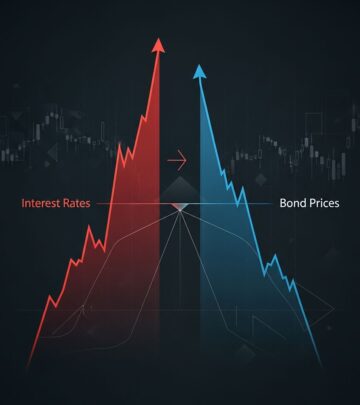
A negative correlation coefficient is a statistical measure that quantifies the relationship between two variables where one increases while the other decreases. This fundamental concept plays a crucial role in finance, statistics, and investment management. When analyzing the movement of two assets or variables, investors and analysts use correlation coefficients to understand how these movements relate to each other, particularly when constructing diversified investment portfolios.
The correlation coefficient is denoted by the letter “r” and ranges from -1 to 1. This numerical scale helps investors understand the strength and direction of relationships between different investments. A coefficient of -1 represents a perfect negative correlation, indicating that when one variable moves in one direction, the other moves in the exact opposite direction with perfect consistency. Understanding this metric is essential for anyone involved in investment decisions or statistical analysis.
What Is a Negative Correlation?
A negative correlation describes a relationship between two variables where one variable increases as the other decreases. This inverse relationship is observable in many real-world scenarios, both within finance and in everyday life. For example, there exists a negative correlation between hot coffee consumption and warmer weather—as temperatures rise, people tend to drink less hot coffee, and conversely, as temperatures drop, hot coffee consumption typically increases.
In the investment world, negative correlations are particularly valuable because they allow investors to identify assets that tend to move in opposite directions under similar economic conditions. Recognizing these inverse relationships enables portfolio managers to construct more resilient investment portfolios that can withstand various market conditions. When two assets have a negative correlation, gains in one asset may be offset by losses in another, providing a natural hedge against market volatility.
The Correlation Coefficient Scale
Understanding the correlation coefficient scale is fundamental to interpreting negative correlations accurately. The scale ranges from -1 to 0, with each point indicating different strengths of negative relationships:
| Coefficient Value | Relationship Strength | Interpretation |
|---|---|---|
| -1.0 | Perfect Negative | Variables move in exact opposite directions with perfect consistency |
| -0.7 to -0.99 | Very Strong | Strong inverse relationship with minimal deviation |
| -0.4 to -0.69 | Moderate | Clear inverse relationship but with some variability |
| -0.1 to -0.39 | Weak | Inverse relationship exists but is not strong or consistent |
| -0.1 or higher | Very Weak/None | Minimal to no inverse relationship |
A coefficient of -1 indicates a perfect negative correlation, meaning that if one asset rises by a certain percentage, the other will decrease by the same percentage. A score of -0.1 would indicate a weak negative relationship between variables. Most real-world financial relationships fall somewhere in between these extremes, with correlation coefficients varying based on the specific assets or variables being analyzed.
The Pearson Correlation Coefficient
The Pearson Correlation Coefficient (PCC) is a statistical tool used to measure the strength and direction of the linear relationship between two variables. Named after British mathematician Karl Pearson, this coefficient is crucial in statistical analysis and is particularly valuable in investment analysis and linear regression studies. The PCC, represented by the letter “r,” can take values from -1 to 1, with negative values indicating inverse relationships.
In financial analysis, the Pearson Correlation Coefficient helps investors and analysts determine how closely two assets move together. For instance, when examining the relationship between stock prices and bond prices, the PCC would quantify their statistical relationship. A value close to -1 signifies a strong negative correlation, where an increase in stock prices corresponds with a decrease in bond prices. Understanding the PCC enables researchers and analysts to interpret data more effectively and make more informed investment decisions.
Calculating R-Squared: Understanding Variance Relationships
Beyond the correlation coefficient itself, analysts can calculate the R-squared value to determine the degree to which the variance of two variables is related to one another. R-squared is calculated by squaring the R-value of a relationship. For example, if an R-value equals -0.6, then the R-squared value would equal 0.36 or 36% when expressed as a percentage.
This R-squared value has significant practical implications. It indicates that the variance in one variable could be explained by the second variable 36% of the time. In other words, approximately 36% of the price movements in one asset can be attributed to movements in the correlated asset. This information helps investors understand how much of an asset’s performance is influenced by movements in another asset, which is particularly valuable for portfolio construction and risk assessment.
Negative Correlation in Portfolio Diversification
One of the most valuable applications of negative correlation in finance is portfolio diversification. By investing in assets that tend to perform oppositely under the same economic conditions, such as stocks and bonds, investors can remain profitable under a variety of market conditions. This strategic approach to portfolio construction reduces overall portfolio risk while potentially maintaining or improving returns.
When two assets have a strong negative correlation, when one experiences gains, the other may suffer losses, and vice versa. Investors can leverage this relationship to balance the performance of their portfolio effectively. For instance, when a particular asset class is expected to underperform, investors can overweight their portfolio with the asset class that typically moves in the opposite direction. This dynamic rebalancing strategy helps maintain consistent portfolio performance across different economic cycles.
The principle of negative correlation is so important that it forms the foundation of modern portfolio theory. By combining assets with negative correlations, portfolio managers can construct portfolios that exhibit lower volatility than the individual assets they contain. This phenomenon, known as the diversification benefit, allows investors to achieve better risk-adjusted returns than they could by investing in a single asset class.
Risk Management and Hedging Strategies
Negative correlation serves as an effective tool for managing investment risks. Understanding how various assets perform relative to each other allows investors to anticipate potential losses and act accordingly. This knowledge is particularly important during market downturns when many assets tend to move together, reducing the benefits of diversification.
For example, if an investor has a significant position in a particular company’s stock, they may hedge this risk by taking a short position in a related industry or sector that has a negative correlation with the company. If the stock’s value decreases, the loss may be offset by the gain from the short position. Hence, understanding and utilizing negative correlations can protect portfolios from adverse market movements.
Hedging using negative correlations is a sophisticated strategy that requires careful analysis and understanding of the relationships between different assets. Investors and portfolio managers often use various hedging instruments, including options, futures, and inverse exchange-traded funds (ETFs), to establish these protective positions. The effectiveness of such strategies depends on maintaining stable negative correlation relationships during different market conditions.
Important Distinction: Correlation vs. Causation
A critical concept that investors and analysts must understand is that correlation does not imply causation. A strong negative correlation doesn’t necessarily mean one variable’s movement is causing the other to move in the opposite direction. The relationship may be coincidental, influenced by a third variable, or simply a statistical artifact.
For example, if there were a negative correlation between ice cream sales and snowfall, this wouldn’t mean that higher ice cream sales cause less snow to fall. Instead, both variables are influenced by a third factor: temperature. Understanding this distinction prevents investors from making incorrect assumptions about why assets move together or apart, which could lead to flawed investment decisions.
When constructing portfolios, investors should ensure they understand the fundamental reasons why two assets are negatively correlated. This deeper understanding helps identify correlations that are likely to persist and distinguish them from temporary or spurious relationships that may break down during stressed market conditions.
Limitations of Negative Correlation
While negative correlations are valuable for portfolio construction and risk management, investors should be aware of their limitations. Correlations are not static; they change over time and can break down during periods of market stress. During a bear market, widespread selling can lead to falling prices across the board, despite typical negative correlations between different asset classes. This phenomenon, sometimes called “correlation convergence,” occurs when fear and panic selling override normal market relationships.
Additionally, historical correlation data may not predict future relationships. Market structures, economic conditions, and investor behavior evolve over time, potentially changing how different assets move relative to each other. Investors should therefore avoid relying solely on historical correlations when making investment decisions and should regularly monitor and update their correlation analysis.
Another limitation is that correlations measure linear relationships. Some assets may have more complex non-linear relationships that are not fully captured by correlation coefficients. Modern portfolio managers often employ additional statistical techniques and stress testing to account for these limitations.
Frequently Asked Questions
Q: What does a correlation coefficient of -0.5 mean?
A: A correlation coefficient of -0.5 indicates a moderate negative relationship between two variables. This means that when one variable increases, the other tends to decrease, but the relationship is not as strong or consistent as a coefficient closer to -1. In practical terms, roughly 25% of the variance in one variable can be explained by the other (R-squared = 0.25).
Q: How can I calculate correlation coefficient in my investment analysis?
A: Most financial software and spreadsheet programs, including Excel and specialized investment analysis platforms, have built-in functions to calculate correlation coefficients. In Excel, you can use the CORREL function. Many brokerages and portfolio analysis tools also provide correlation matrices that show the correlations between multiple assets automatically.
Q: Can correlation coefficients change over time?
A: Yes, correlation coefficients can and do change over time. Market conditions, economic factors, and investor behavior all evolve, which can alter the relationships between different assets. This is why it’s important to regularly update correlation analysis and not rely solely on historical data when making investment decisions.
Q: Is a perfect negative correlation (-1) common in real markets?
A: Perfect negative correlations (-1) are extremely rare in real financial markets. While some asset pairs, such as certain inverse ETFs and their underlying indices, are specifically designed to have perfect negative correlations, naturally occurring correlations are typically somewhere between -1 and 0. Most investor-relevant correlations fall in the -0.3 to -0.8 range.
Q: How should negative correlation influence my investment decisions?
A: Understanding negative correlations can help you build a more diversified portfolio that reduces overall risk. By combining assets with negative correlations, you can potentially achieve more stable returns across different market conditions. However, correlation should be just one factor in your investment analysis—consider fundamental factors, risk tolerance, and investment goals as well.
References
- Pearson Correlation Coefficient — EBSCO Research Starters. 2025. https://www.ebsco.com/research-starters/science/pearson-correlation-coefficient-pcc
- Negative Correlation: Uses, Example, Interpretation, and Limitations — Finance Strategists. 2025. https://www.financestrategists.com/wealth-management/fundamental-vs-technical-analysis/negative-correlation/
- Statistics: Definition, Types, and Importance — Investopedia. 30 July 2024. https://www.investopedia.com/terms/s/statistics.asp
- What Is the Pearson Coefficient? Definition, Benefits, and History — Investopedia. 28 August 2024. https://www.investopedia.com/terms/p/pearsoncoefficient.asp
Similar Articles








Read full bio of medha deb