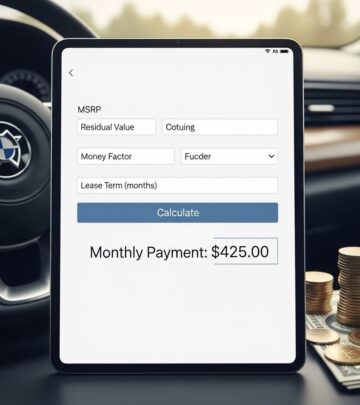
Lease Payments: A Comprehensive Guide For 2025 Accounting
Understanding lease payments: types, calculations, and accounting rules for lessees and lessors.

What Are Lease Payments?
Lease payments are the cash flows that a lessee (the party using the asset) makes to a lessor (the party owning the asset) in exchange for the right to use property, equipment, or vehicles over a specified period. Understanding lease payments is essential for businesses and individuals entering into lease agreements, as these payments directly affect financial statements, budgeting, and decision-making processes. Under modern accounting standards like ASC 842, lease payments play a critical role in determining how leases are classified, measured, and reported on balance sheets.
The concept of lease payments extends beyond simple monthly rent. It encompasses a variety of payment types and obligations that lessees must consider when evaluating the true cost of leasing an asset. Determining what qualifies as a lease payment and what doesn’t can significantly impact financial reporting and the calculation of lease liabilities.
Components of Lease Payments
Lease payments are composed of several distinct components that must be carefully identified and properly classified. Each component serves a different purpose in the lease agreement and requires different accounting treatment.
Fixed Payments
Fixed payments are the most straightforward component of lease payments. These are payments that remain constant throughout the lease term, as specified in the lease contract. Fixed payments are easy to identify and determine because they are explicitly stated in the lease agreement. They typically represent the base rent or equipment payment that the lessee owes to the lessor each period. Fixed payments are always included in the measurement of lease liabilities under ASC 842 standards.
In-substance fixed payments represent a special category of fixed payments that may appear variable in form but are, in reality, unavoidable. These include payments that lack genuine economic variability or situations where the lessee must choose between payment options but is obligated to make at least one set of payments. For example, if a lease offers two payment options—$250 monthly or $0.25 per mile with a $100 minimum—the in-substance fixed payment would be the lower amount of $100, since the lessee must make at least this minimum payment regardless of usage.
Variable Payments Based on Index or Rate
Variable lease payments that depend on an index or rate are included in lease payments. These payments fluctuate based on external benchmarks such as the Consumer Price Index (CPI), LIBOR, or market interest rates. At the commencement date, variable payments dependent on an index or rate are measured using the index or rate value on that specific date. This approach provides clarity and consistency in the initial measurement of lease liabilities, even though the actual payments may change over time.
These index-based variable payments are treated differently than other variable payments because they are tied to objective, external measures that are beyond the lessee’s control. This distinction is important for accounting purposes and affects how lease obligations are initially recorded and subsequently adjusted.
Renewal and Termination Options
Lease payments must include amounts related to renewal or termination options if the lessee is reasonably certain to exercise these options. This requires judgment and analysis of the specific circumstances surrounding each lease. If the lessee has demonstrated through past behavior, contractual terms, or economic incentives that they are likely to renew a lease or exercise a termination option, the associated payments must be included in the initial lease liability calculation.
Determining whether a lessee is “reasonably certain” to exercise an option involves evaluating factors such as the cost to exercise the option, the value of the asset at that time, alternative options available, and the importance of the asset to the lessee’s operations. This assessment must be made at the lease commencement date and updated if circumstances change.
Residual Value Guarantees and Purchase Options
Residual value guarantees represent the lessee’s obligation to compensate the lessor if the asset’s value at the end of the lease falls below a guaranteed amount. If these guarantees are reasonably certain to be paid, they must be included in lease payments. Similarly, purchase options that the lessee is reasonably certain to exercise should be included in the lease payment calculation, as they represent future cash outflows committed by the lessee.
Termination Fees and Other Obligations
Some lease agreements include penalties or fees for early termination. If the lessee is reasonably certain to incur these termination fees, they should be included in the lease payment calculation. Additionally, certain reimbursements to the lessor, such as real estate taxes in office leases or common area maintenance costs, may be included as lease payments if they are not variable based on actual usage or performance.
What Lease Payments Exclude
Understanding what is not included in lease payments is equally important as knowing what is included. Several categories of payments are specifically excluded from the definition of lease payments under ASC 842 standards.
Variable Payments Based on Usage or Performance
Variable lease payments that depend on the usage or performance of the underlying asset are excluded from lease payments. These payments vary based on actual usage rather than external indexes or rates. Examples include payments calculated as a percentage of sales, payments based on the number of hours an asset is used, or charges tied to actual mileage in vehicle leases beyond a fixed component. These variable payments are recognized as expenses in the periods in which they occur, rather than being included in the initial lease liability.
The key distinction is that usage-based or performance-based variable payments create genuine economic variability that is within the control or directly attributable to the lessee’s operational decisions. This differs from index-based variable payments, which are tied to external economic factors.
Non-Lease Components
Lease agreements often include services or components that are not related to the right to use the underlying asset. These non-lease components must be identified and excluded from lease payments. Examples include maintenance services, insurance, or support services that are separate from the lease of the asset itself. However, under certain accounting policy elections, lessees may choose to combine lease and non-lease components for measurement purposes.
Lease Incentives
Lease incentives are payments made by the lessor to or on behalf of the lessee, or losses assumed by the lessor related to the lessee’s preexisting leases. These incentives reduce the total lease payments used in calculating the lease liability and right-of-use (ROU) asset. Lease incentives received after the lease commencement date are accounted for differently than those received at or before commencement, and proper documentation is essential for correct accounting treatment.
Determining Lease Payments: Accounting Standards
The determination of lease payments is governed by specific accounting standards that provide guidance for consistent classification and measurement. These standards are crucial for ensuring that lease accounting is handled appropriately across different organizations and industries.
ASC 842 Standards
The Financial Accounting Standards Board (FASB) established ASC 842 as the primary standard for lease accounting in the United States. Under ASC 842, almost all leases are recorded on the balance sheet at the commencement date. The lease liability is measured at the present value of lease payments, which must be carefully determined based on the components discussed above. This standard applies to both lessees and lessors and requires comprehensive disclosure of lease obligations.
IFRS 16 Standards
International Financial Reporting Standards (IFRS) established IFRS 16 as the global equivalent to ASC 842. While these standards are broadly similar, there are some differences in how certain payments are treated, particularly regarding variable payments. Both standards require lessees to recognize right-of-use assets and lease liabilities for substantially all leases, fundamentally changing how lease obligations appear in financial statements.
Measurement at Lease Commencement
The lease liability is measured at the commencement date as the present value of lease payments that are not yet paid, discounted using the rate implicit in the lease or the lessee’s incremental borrowing rate. This measurement forms the basis for subsequent accounting and directly impacts the balance sheet. The right-of-use asset is typically measured as the lease liability adjusted for any prepaid or accrued lease payments and lease incentives received.
Lease Payment Examples and Scenarios
To better understand how lease payments work in practice, consider several common scenarios:
Vehicle Lease
In a two-year automobile lease, a lessee might make fixed monthly payments of $350. Additionally, the lease might include a residual value guarantee of $12,000 at the end of the lease term. The lessee would also be required to reimburse the lessor for registration fees and insurance surcharges based on a fixed annual amount. All of these components—the fixed monthly payment, the residual value guarantee, and the fixed insurance reimbursements—would be included in the lease payment calculation. However, any variable mileage charges beyond a certain threshold would be excluded and expensed as incurred.
Commercial Real Estate Lease
An office building lease might include base rent of $50,000 annually, plus variable rent based on the Consumer Price Index (CPI). At the lease commencement, the CPI-based component would be measured using the CPI value on that date and included in lease payments. Additionally, if the lease terms indicate that the lessee is reasonably certain to renew for a five-year extension, the base rent for that renewal period would also be included in the initial lease liability. However, utilities and maintenance costs that vary based on actual usage would be excluded.
Equipment Lease
An equipment lease might include fixed quarterly payments of $10,000 plus a purchase option of $50,000 at the end of the lease term. If the lessee determines it is reasonably certain to exercise the purchase option based on the equipment’s importance to operations and the favorable purchase price, the $50,000 would be included in lease payments. Variable payments based on the equipment’s actual usage hours would be excluded.
Recording Lease Payments and Financial Reporting
Once lease payments are determined, they must be properly recorded in financial statements. Under ASC 842, this process differs from previous accounting treatments and significantly affects how leases appear on balance sheets.
Initial Recording
At the lease commencement date, the lessee records a lease liability equal to the present value of lease payments and a corresponding right-of-use asset. Subsequent to commencement, lessees recognize interest expense on the lease liability and depreciation expense on the right-of-use asset, resulting in higher total lease expenses in early lease years compared to later years.
Straight-Line Rent Expense
While the mechanics of ASC 842 produce front-loaded expense patterns, some organizations may analyze lease payments using a straight-line rent expense method for internal purposes. This method requires aggregating all lease payments over the full contract term and dividing by the number of periods to determine a consistent periodic rent expense. This approach can be useful for budgeting and operational analysis, though it differs from the accounting treatment required for financial statements.
Lessor Perspective
From the lessor’s perspective, lease payments determine the lease revenue and the net investment in the lease. Lessors classify leases as operating, direct financing, or sales-type leases based partly on whether the present value of lease payments substantially exceeds the asset’s value. Different lease classifications result in different revenue recognition patterns and income statement treatments.
Common Challenges in Determining Lease Payments
Several challenges commonly arise when determining what qualifies as a lease payment:
Distinguishing Fixed from In-Substance Fixed Payments
Determining whether a payment is truly variable or in-substance fixed requires careful analysis. Payments that may appear variable in form but are unavoidable in substance must be classified as fixed. This determination significantly affects the lease liability calculation and can be subject to different interpretations.
Assessing Reasonable Certainty
Determining whether a lessee is “reasonably certain” to exercise renewal or purchase options requires professional judgment. Different assessments can lead to significantly different lease liabilities and may result in audit questions or disputes with auditors.
Identifying Non-Lease Components
Separating lease components from non-lease components can be challenging, particularly in complex arrangements. Misclassification can result in incorrect accounting and financial statement misstatements.
Tracking Variable Index-Based Payments
For variable payments tied to indexes or rates, entities must establish systems to track changes in the underlying index or rate and adjust lease payments and expense accordingly. This is particularly complex for leases with long terms or for entities with numerous leases.
Best Practices for Managing Lease Payments
Organizations should implement several best practices to ensure accurate lease accounting:
- Maintain comprehensive lease abstracts that clearly document all payment obligations and contingencies
- Establish clear policies for determining reasonable certainty regarding renewal and purchase options
- Implement lease accounting software that can track variable payments and adjust for index changes
- Regularly review lease agreements to identify any amendments or modifications affecting payment obligations
- Coordinate with legal and procurement teams to ensure all lease terms are properly communicated to accounting personnel
- Monitor changes in external indexes or rates that affect variable lease payments
- Document assumptions and judgments made in determining lease payments for audit trail purposes
Frequently Asked Questions About Lease Payments
Q: Are lease payments always fixed amounts?
A: No. Lease payments can include fixed payments, variable payments based on indexes or rates, and contingent payments related to renewal or purchase options. Only certain types of variable payments are included in lease payment calculations.
Q: How do I know if a payment is part of the lease or a non-lease component?
A: Lease components relate directly to the right to use the underlying asset. Non-lease components include services like maintenance, insurance, or support services. Review the lease agreement to identify what services are bundled, and consider whether they are essential to using the asset or are separable services.
Q: What is the impact of lease incentives on lease payments?
A: Lease incentives reduce the total lease payments used to calculate the lease liability. These incentives must be properly identified and documented, with different accounting treatment depending on whether they are received before or after the lease commencement date.
Q: How often should variable payments based on indexes be adjusted?
A: Variable payments based on indexes or rates are typically adjusted annually or at intervals specified in the lease agreement. After the initial measurement at the commencement date using the index value on that date, subsequent changes in the index trigger adjustments to the lease payments, which are recognized as variable lease expense.
Q: Can I exclude purchase options from lease payments if I’m uncertain about exercising them?
A: Yes, if you are not reasonably certain to exercise a purchase option, it should be excluded from the initial lease payment calculation. However, if circumstances change and you become reasonably certain, the lease accounting must be remeasured to include the option amount.
Q: How does the discount rate affect lease payment calculations?
A: Lease payments are discounted to present value using either the rate implicit in the lease or the lessee’s incremental borrowing rate. A higher discount rate results in a lower present value of future lease payments and thus a lower lease liability, while a lower discount rate has the opposite effect.
Q: What documentation should I maintain for lease payment determinations?
A: Maintain the original lease agreement, any amendments, a lease abstract summarizing key terms and payment obligations, documentation of judgments made regarding reasonable certainty, and calculations supporting the present value determination. This documentation is critical for audits and disputes.
References
- How to Determine Lease Payments — Thomson Reuters. 2025. https://tax.thomsonreuters.com/blog/lease-payments/
- ASC 842-10: Fixed Payments — Deloitte. 2025. https://dart.deloitte.com/USDART/home/codification/broad-transactions/asc842-10/roadmap-leasing/chapter-6-lease-payments/6-2-fixed-payments
- Lease Accounting Explained: New Standards, Lessee vs. Lessor — FinQuery. 2025. https://finquery.com/blog/lease-accounting-explained/
- What Qualifies as a Lease Payment — CrunchAFI. 2025. https://www.crunchafi.com/knowledge-base/article/what-qualifies-as-a-lease-payment-in-step-2-of-adding-a-lease
- Lease Accounting Policy — Harvard University. 2025. https://policies.fad.harvard.edu/accounting-leases
Similar Articles








Read full bio of medha deb