Welfare: Definition, Types, Programs & Impact
Complete guide to welfare systems, government programs, and social safety nets.
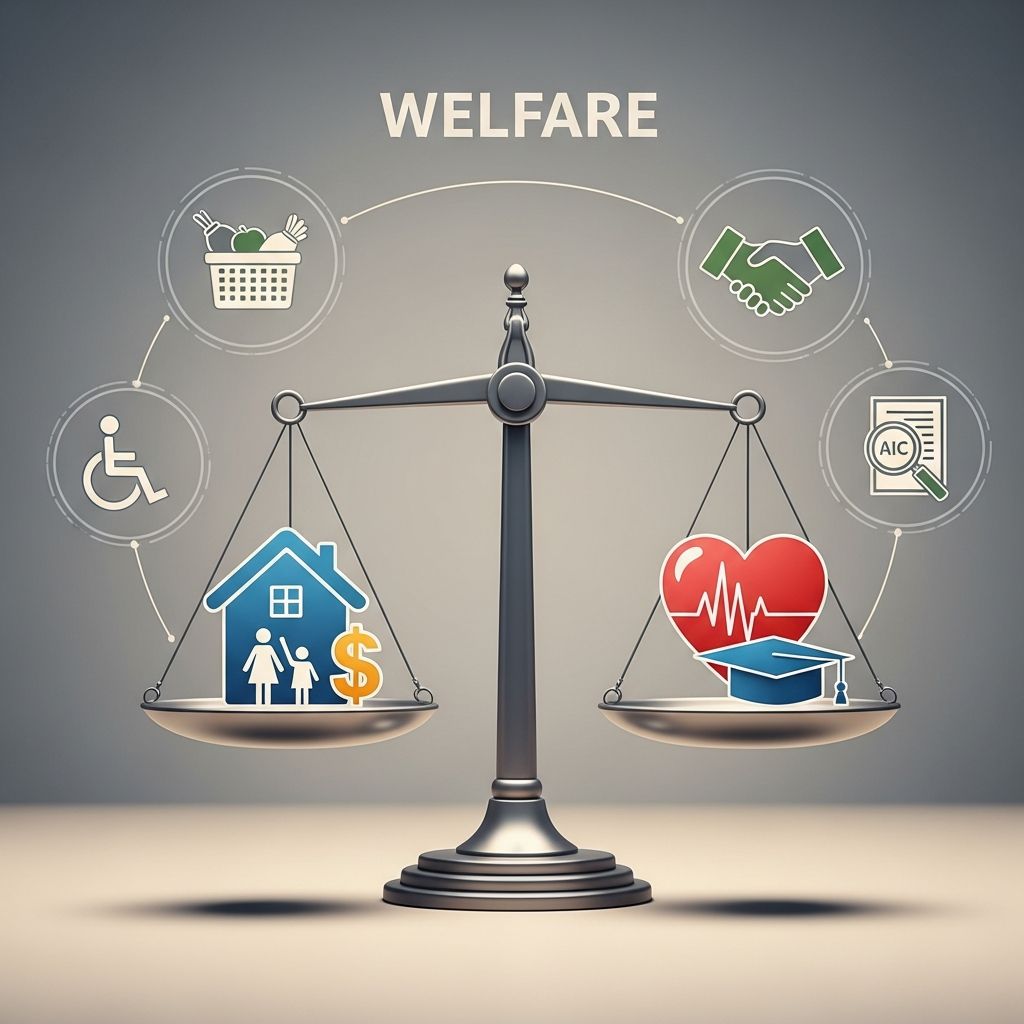
What Is Welfare?
Welfare refers to government programs and policies designed to support the well-being of individuals and families, particularly those facing economic hardship, disability, or other challenging circumstances. The term encompasses a broad range of initiatives aimed at ensuring that society’s most vulnerable members can meet their basic needs and maintain a reasonable standard of living.
The concept of welfare extends beyond simple financial assistance. It represents a commitment by society to provide access to essential services including health care, nutrition, housing, and financial support. These programs recognize that certain populations face systematic barriers to self-sufficiency and require targeted intervention to achieve economic stability.
In contemporary usage, welfare typically refers to government-administered safety net programs that provide assistance to those who meet specific eligibility criteria. However, the term also has a broader economic meaning referring to overall societal well-being and the general welfare of a population.
Core Components of Welfare
Welfare systems address multiple dimensions of human need:
- Economic Security: Financial assistance to cover basic living expenses
- Health Care: Medical coverage and preventive health services
- Nutrition Support: Food assistance programs for low-income families
- Housing Assistance: Programs helping individuals afford stable housing
- Child Welfare: Services protecting children and supporting families
- Employment Support: Job training and unemployment benefits
Historical Development of Welfare Policy
The modern welfare state emerged during periods of significant social and economic upheaval. Germany pioneered government-sponsored social welfare in the 1880s, establishing laws designed to protect industrial workers and those in need. This groundbreaking approach demonstrated that governments could take direct responsibility for citizen welfare.
The concept gained momentum in the early 20th century as industrialized nations recognized the need for systematic support systems. In the United States, the Great Depression fundamentally shifted public attitudes toward government intervention. President Franklin D. Roosevelt’s administration introduced the “New Deal,” establishing the modern American welfare state and creating enduring programs that continue today.
One of Roosevelt’s most significant contributions was Social Security, established in 1935. This program aimed to provide security for elderly and disabled individuals, ensuring they remained free from want. Thirty years later, President Lyndon Johnson’s administration expanded the welfare system, building on Roosevelt’s legacy by introducing programs like Medicare and Medicaid to address health care gaps.
Types of Social Welfare Policy
Social welfare policies fall into two primary categories, each serving distinct purposes and populations:
Distributive Social Welfare Policy
Distributive social welfare policy, also known as entitlement programs, aims to provide universal benefits regardless of income level. These programs operate on the principle that benefits are distributed based on the amount recipients have contributed to the system. Distributive programs function as social insurance, rewarding prior participation and contribution.
Key characteristics of distributive programs include:
- Benefits tied to individual contributions or insurance payments
- Universal eligibility based on meeting specific criteria
- Emphasis on earned benefits rather than need-based assistance
- Programs funded through payroll taxes and dedicated revenue sources
Redistributive Social Welfare Policy
Redistributive social welfare policy, commonly referred to as welfare programs, targets assistance to individuals and families meeting specific income qualifications. These programs operate on the principle that those with greater resources contribute to supporting those with fewer resources, promoting economic equality and reducing poverty.
Characteristics of redistributive programs include:
- Income-based eligibility requirements
- Means testing to verify financial need
- Assistance prioritized for the most vulnerable populations
- Flexible benefits adjusted based on family circumstances
Major U.S. Welfare Programs
Social Security
Social Security stands as one of America’s most successful and enduring social welfare programs. Established during the Great Depression, Social Security provides monthly benefits to retired individuals, disabled workers, and survivors of deceased workers. The program operates on a contributory basis, with workers and employers paying into the system throughout employment.
As of 2020, more than 62 million Americans received Social Security benefits, demonstrating the program’s enormous scope and importance. Social Security replaced traditional reliance on family support systems and charity, establishing a guarantee that workers would receive retirement income based on their contribution history.
Medicare
Medicare, established in 1965 as part of President Johnson’s Great Society initiatives, provides health insurance coverage to individuals aged 65 and older, regardless of income level. The program represents a major achievement in distributive welfare policy, ensuring that elderly Americans have access to essential health care services.
Medicaid
Medicaid operates as a joint federal-state program providing health coverage to low-income individuals and families. Unlike Medicare, Medicaid is redistributive in nature, targeting assistance to those meeting income and resource limitations. The program covers vulnerable populations including children, pregnant women, elderly individuals, and disabled persons.
Temporary Assistance for Needy Families (TANF)
TANF replaced the previous Aid to Families with Dependent Children (AFDC) program following the Personal Responsibility and Work Opportunity Reconciliation Act of 1996. This program provides cash assistance to low-income families with children, emphasizing work requirements and time limits on benefits.
Unemployment Insurance
Unemployment benefits replace lost wages for workers who become unemployed through no fault of their own. Funded through employer payroll taxes, unemployment insurance operates as an entitlement program providing temporary income support during job transitions.
Supplemental Nutrition Assistance Program (SNAP)
Formerly known as food stamps, SNAP provides electronic benefits enabling low-income households to purchase food. The program ensures food security for millions of American families, particularly those with children and elderly members.
Housing Assistance
Federal housing programs help low-income individuals and families afford stable housing. These initiatives recognize that adequate shelter is fundamental to well-being and economic stability.
Welfare in the Twenty-First Century
Contemporary American welfare systems have evolved significantly from their origins. Current social welfare systems in use as of 2023 include health care, food assistance, unemployment compensation, housing assistance, and child care assistance. These programs are funded through federal taxes, with recipients receiving benefits through electronic benefit transfer (EBT) cards or monthly payments.
The level of assistance individuals or families receive depends on multiple factors including family size, state of residence, income level, disability status, and other circumstances. This individualized approach recognizes that welfare needs vary significantly across populations and circumstances.
Shifts in Welfare Philosophy
A significant philosophical shift has occurred in American welfare policy over recent decades. According to political analysis, the most distinguishable effect of welfare reform has been a transition from universality and solidarity principles toward selectivity and individual responsibility. This shift reflects changing attitudes about government’s role and emphasis on encouraging workforce participation among benefit recipients.
Economic Welfare vs. Government Welfare Programs
It is important to distinguish between welfare in an economic sense and welfare as government programs. Economists often use “welfare” to refer to overall well-being and contentment. Economic welfare broadly refers to the level of prosperity and standard of living of individuals or groups. In economic analysis, welfare specifically refers to utility gained through achievement of material goods and services.
Economic welfare is measured using various indicators including gross domestic product (GDP), literacy rates, access to health care, and environmental quality assessments. According to economic analysis, welfare is dependent on factors including employment, income distribution, labor conditions, leisure time, production, and environmental functions.
This broader conception of welfare acknowledges that well-being encompasses more than government assistance programs. It reflects the interdependent relationship between economic systems, individual choices, and social conditions.
Key Welfare Terms and Concepts
| Term | Definition |
|---|---|
| Welfare Dependency | A condition where a welfare recipient relies on monthly cash payments as their sole source of income |
| Welfare State | A system where government assumes responsibility for health, education, employment, and social security of the people |
| Entitlement Programs | Benefits provided to individuals meeting specific criteria, regardless of income level |
| Means Testing | Assessment of financial need to determine eligibility for assistance programs |
| Cash Transfer | Direct payment of money to individuals or families by government programs |
The Role of Social Workers in Welfare Systems
Social workers serve as essential intermediaries between vulnerable individuals and welfare programs. These professionals provide direct services supporting individual and community well-being, offer referrals to appropriate programs, and advocate for clients navigating complex welfare systems. Social work professionals understand both the systemic barriers individuals face and the available resources to address them, making them vital to effective welfare policy implementation.
Challenges and Future Directions
Contemporary welfare systems face ongoing challenges including program accessibility, benefit adequacy, work incentives, and cost sustainability. Policymakers continue debating the appropriate balance between supporting vulnerable populations and encouraging self-sufficiency. Questions about program eligibility, benefit levels, and the transition from assistance to employment remain central to welfare policy discussions.
Future welfare policy will likely continue evolving as demographics shift, economic conditions change, and societal priorities adjust. The integration of technology in benefit administration, expansion or contraction of eligible populations, and renewed focus on addressing root causes of poverty represent potential directions for welfare policy development.
Frequently Asked Questions
Q: What is the difference between welfare and social security?
A: Social Security is a contributory program where benefits are based on prior earnings and contributions. Welfare programs are typically need-based, providing assistance to those meeting income qualifications. Social Security functions as insurance, while welfare operates as redistribution.
Q: Who qualifies for welfare benefits?
A: Eligibility varies by program but typically includes low-income individuals and families, unemployed workers, elderly persons, disabled individuals, and families with dependent children. Each program has specific income limits and requirements.
Q: How are welfare programs funded?
A: Welfare programs are funded through federal and state taxes. Some programs like Social Security and unemployment insurance use dedicated payroll taxes, while others like TANF and food assistance draw from general revenue.
Q: What is welfare dependency?
A: Welfare dependency describes situations where individuals rely on government assistance as their sole source of income. Modern welfare policy attempts to reduce dependency through work requirements and time limits on benefits.
Q: How has welfare policy changed since the 1990s?
A: The Personal Responsibility and Work Opportunity Reconciliation Act of 1996 restructured welfare, emphasizing work requirements, time limits, and state flexibility. This reflected a philosophical shift toward individual responsibility alongside government support.
Q: What programs are included in the modern welfare system?
A: Current welfare systems include Social Security, Medicare, Medicaid, SNAP, TANF, unemployment insurance, housing assistance, and child care support among other programs.
References
- Understanding Social Welfare Policy — Virginia Commonwealth University School of Social Work. 2024. https://onlinesocialwork.vcu.edu/blog/social-welfare-policy/
- Welfare definition of economics — Econlib. 2024. https://www.econlib.org/library/Topics/College/wellbeingandwelfare.html
- Welfare — EBSCO Research Starters. 2023. https://www.ebsco.com/research-starters/social-sciences-and-humanities/welfare
- Wellbeing and Welfare — Library of Economics and Liberty. 2024. https://www.econlib.org/library/Topics/College/wellbeingandwelfare.html
Similar Articles








Read full bio of Sneha Tete