Weighted Average Maturity: Definition, Calculation & Use
Master WAM: Learn how weighted average maturity measures bond portfolio risk and interest rate sensitivity.
Weighted Average Maturity: Definition and Overview
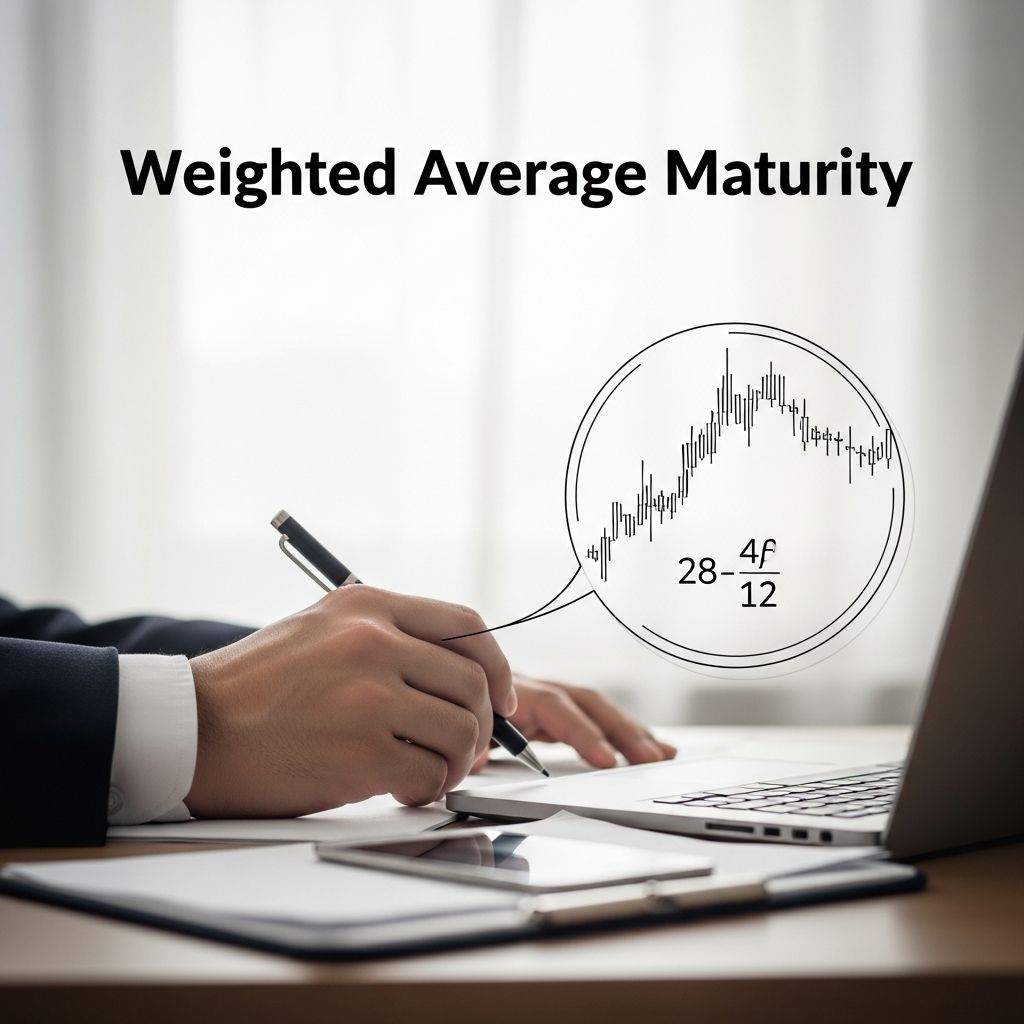
Weighted average maturity (WAM) is a critical financial metric used to measure the average time until the maturity of bonds and debt securities in a portfolio. Rather than simply averaging the maturity dates of all securities, WAM takes into account the market value or dollar amount invested in each security, ensuring that larger positions have a proportionally greater influence on the calculation.
In essence, WAM provides investors and portfolio managers with a single, meaningful number that represents the typical time horizon for their fixed-income investments. This metric is particularly important for understanding how sensitive a bond portfolio is to changes in interest rates. Securities with longer maturities tend to experience greater price fluctuations when interest rates move, making WAM a crucial risk assessment tool.
For mortgage-backed securities and other pools of debt instruments, weighted average maturity has become the standard measure for evaluating portfolio composition and risk exposure. By understanding the WAM of their holdings, investors can make more informed decisions about when to buy, sell, or rebalance their portfolios to align with their investment objectives and risk tolerance.
What Does Weighted Average Maturity Measure?
Weighted average maturity fundamentally measures a bond fund’s sensitivity to changes in interest rates and market conditions. It calculates the average maturity period for each security in a debt portfolio, with the weighting proportional to each security’s market value or the dollar amount invested in it.
The key insight behind WAM is that not all bonds in a portfolio have equal importance. A $1 million bond investment maturing in 10 years should carry more weight in the calculation than a $100,000 investment maturing in 5 years. By weighting each security according to its market value, WAM provides a realistic picture of the portfolio’s actual interest rate sensitivity.
Portfolios with higher weighted average maturities are generally considered riskier because they have greater sensitivity to interest rate fluctuations. When interest rates rise, bond prices fall—and this effect is more pronounced for longer-maturity securities. Conversely, when interest rates decline, longer-maturity bonds benefit from larger price appreciation.
Understanding the WAM of a portfolio helps investors assess whether their fixed-income holdings align with their investment timeline and risk tolerance. It also enables portfolio managers to communicate portfolio characteristics to clients and stakeholders in a standardized, easily understood format.
How Weighted Average Maturity Works
The mechanics of WAM involve a straightforward but important process that accounts for both the size and maturity of each holding in a portfolio. Understanding how WAM works requires examining the relationship between portfolio composition, interest rate sensitivity, and investment time horizons.
When a portfolio contains multiple bonds or debt securities with different maturity dates, simply averaging those dates without considering investment amounts would produce a misleading result. For example, if a portfolio held one $9 million bond maturing in 2 years and one $1 million bond maturing in 20 years, a simple average would suggest a 11-year maturity. However, the portfolio is actually heavily weighted toward the shorter-term security, so the true average is much closer to 2 years.
This is where weighting becomes essential. By multiplying each security’s maturity by its proportion of the total portfolio value, WAM accurately reflects how the portfolio will actually behave in response to market changes. The process ensures that portfolio managers can identify concentration risks and understand the true duration characteristics of their holdings.
WAM also helps investors compare different bond funds or fixed-income portfolios on an apples-to-apples basis. Two funds might hold bonds with different individual maturities, but their WAM figures allow investors to quickly assess which portfolio has longer or shorter average maturity characteristics and, by extension, higher or lower interest rate risk.
Calculating Weighted Average Maturity: Step-by-Step
Computing the weighted average maturity of a portfolio involves several straightforward steps that can be performed manually or using financial software and calculators.
Step 1: Determine the Weight of Each Security
Begin by calculating each security’s weight in the portfolio. The weight is determined by dividing the security’s market value by the total market value of the entire portfolio. For example, if a bond is worth $50,000 and the total portfolio value is $500,000, the weight would be 10% or 0.10.
Step 2: Identify the Maturity of Each Security
Next, determine the maturity of each security in years. Maturity represents the number of years until the security returns its principal to the investor. This is typically expressed as a whole number or decimal.
Step 3: Calculate Weighted Maturity for Each Security
Multiply each security’s weight by its maturity to obtain the weighted maturity for that individual security. For instance, if a security has a weight of 0.25 (25% of the portfolio) and matures in 4 years, the weighted maturity is 0.25 × 4 = 1.0 years.
Step 4: Sum All Weighted Maturities
Finally, add together all the individual weighted maturities to arrive at the portfolio’s overall weighted average maturity. This final number represents the average time until the portfolio’s securities mature, adjusted for the size of each position.
Example Calculation
Consider a portfolio with three bonds:
| Bond | Market Value | Weight | Maturity (Years) | Weighted Maturity |
|---|---|---|---|---|
| Bond X | $6,000 | 42.9% | 2 | 0.86 |
| Bond Y | $6,000 | 42.9% | 6 | 2.57 |
| Bond Z | $8,000 | 57.1% | 4 | 2.28 |
| Total Portfolio / Weighted Average Maturity | 6 years | |||
In this example, the weighted average maturity of 6 years indicates that, on average, investors would need to wait 6 years to receive their investments back if they held the entire portfolio to maturity.
What Weighted Average Maturity Signifies
Weighted average maturity serves as a significant indicator of several important portfolio characteristics. First and foremost, WAM reveals a bond fund’s sensitivity to changes in interest rates. Portfolios with higher WAM values are more sensitive to rate movements, meaning their values will fluctuate more dramatically when the Federal Reserve or other central banks adjust interest rates.
A higher WAM also indicates that the portfolio is taking on more interest rate risk. When rates rise unexpectedly, portfolios with longer average maturities will experience steeper price declines. This is a fundamental principle of bond investing: longer-duration securities carry greater risk but typically offer higher yields to compensate investors for that risk.
WAM also helps investors understand the timing of cash flows they can expect from their bond holdings. A portfolio with a WAM of 3 years will return cash flows more quickly on average than a portfolio with a WAM of 10 years. For investors who need to access their funds within a specific timeframe, understanding WAM helps ensure their portfolio aligns with their liquidity needs.
Additionally, WAM provides insight into portfolio composition and concentration. A portfolio with a very high WAM might be heavily concentrated in long-term bonds, potentially indicating either deliberate positioning for capital appreciation if rates are expected to fall, or excessive risk if the portfolio isn’t supposed to be that volatile.
Importance of Weighted Average Maturity for Investors
For bond investors, understanding weighted average maturity is essential for several reasons. It enables informed decision-making about portfolio allocation and helps investors assess whether their fixed-income holdings appropriately match their investment objectives, time horizons, and risk tolerance.
Portfolio managers use WAM to communicate fund characteristics to investors and to ensure compliance with investment mandates. For example, a fund marketed as a short-duration bond fund should maintain a relatively low WAM, while a long-term bond fund would naturally have a higher WAM.
WAM also facilitates comparison shopping among different bond funds and fixed-income investments. By comparing WAM figures, investors can quickly identify which funds have similar interest rate risk characteristics, even if their specific holdings differ.
Furthermore, WAM helps investors understand and potentially mitigate timing risks. By knowing how long, on average, until their bonds mature, investors can better plan for capital needs and ensure they’re not forced to sell securities prematurely at unfavorable prices.
Weighted Average Maturity vs. Duration: Understanding the Difference
While weighted average maturity and duration are related concepts often used in fixed-income analysis, they measure different things. WAM simply calculates the time-weighted average until maturity, while duration measures the weighted average time to receive the bond’s cash flows, accounting for all coupon payments, not just the final principal payment.
Duration provides a more precise measure of interest rate sensitivity because it reflects when investors actually receive their money back through both coupons and principal. For this reason, many sophisticated investors and portfolio managers prefer duration to WAM, though both metrics serve valuable purposes.
However, WAM remains valuable for its simplicity and for mortgage-backed securities and amortizing loans where traditional duration calculations become more complex.
Frequently Asked Questions
What is a good weighted average maturity for a bond portfolio?
There is no universal “good” WAM—it depends entirely on an investor’s objectives and time horizon. Conservative investors seeking stable income might prefer portfolios with lower WAM (3-5 years), while investors willing to accept more volatility for higher potential returns might accept WAM of 7-10 years or higher. The key is matching WAM to individual investment goals.
How does weighted average maturity relate to interest rate risk?
WAM and interest rate risk are directly related. Higher WAM means the portfolio contains more long-term securities, which are more sensitive to interest rate changes. When rates rise, portfolios with higher WAM typically experience greater price declines, and vice versa.
Can weighted average maturity change over time?
Yes, WAM changes as bonds mature and as market values fluctuate. As securities approach maturity, WAM naturally decreases. Additionally, if bond prices rise or fall significantly due to market conditions, the relative weights of holdings change, which can alter the portfolio’s WAM.
Is weighted average maturity important for mortgage-backed securities?
Yes, WAM is particularly important for mortgage-backed securities and other amortizing securities. For these investments, WAM is often more widely used and easier to calculate than duration, making it a standard metric for assessing these types of portfolios.
How should investors use WAM when building a bond portfolio?
Investors should use WAM to ensure their bond holdings align with their investment timeline and risk tolerance. Those needing funds in the short term should maintain lower WAM, while those with longer investment horizons can accept higher WAM for potentially greater returns.
What tools can help calculate weighted average maturity?
Financial advisors, investment firms, and online calculators can compute WAM. Most bond fund prospectuses and fund fact sheets also report WAM, allowing investors to easily identify this metric for their holdings.
How does WAM affect bond fund performance?
WAM doesn’t directly determine performance, but it influences how portfolios respond to market conditions. When interest rates fall, funds with higher WAM typically outperform because their long-term bonds appreciate more. Conversely, when rates rise, higher-WAM funds may underperform.
References
- Weighted Average Maturity in Bond Portfolio Management — POEMS Financial. https://www.poems.com.sg/glossary/technicals/weighted-average-maturity/
- Understanding Weighted Average Maturity: A Legal Perspective — US Legal Forms. https://legal-resources.uslegalforms.com/w/weighted-average-maturity
Similar Articles








Read full bio of medha deb