Weighted Average: Definition, Formula, and Practical Applications
Master weighted averages: Learn how to calculate and apply this essential financial metric.

What Is a Weighted Average?
A weighted average is a calculation that takes into account the relative importance or frequency of different values in a dataset. Unlike a simple average, which treats all values equally, a weighted average assigns specific weights or significance levels to each value based on its importance or occurrence. This method provides a more accurate representation of data when certain values should have greater influence on the final result.
The weighted average is widely used in finance, accounting, investing, and inventory management. It reflects the true impact of each component by incorporating the proportion or significance of each value into the calculation. This approach is particularly useful when dealing with datasets where values have different levels of importance or when analyzing situations where some data points should carry more weight than others.
Understanding the Concept of Weighted Average
The fundamental principle behind a weighted average is that not all values in a dataset are created equal. In many real-world situations, certain values are more significant or occur more frequently than others. A weighted average accounts for these differences by multiplying each value by its assigned weight before calculating the overall average.
Consider a scenario where a student’s final grade is calculated from multiple components: exams (weighted 50%), assignments (weighted 30%), and participation (weighted 20%). A simple average would treat each component equally, but a weighted average recognizes that exams are twice as important as participation and gives them proportionally greater influence on the final grade.
This concept extends across various industries and applications, from portfolio management in finance to cost accounting in inventory systems. Understanding and properly applying weighted averages is essential for accurate financial analysis and informed decision-making.
The Weighted Average Formula
The mathematical formula for calculating a weighted average is straightforward yet powerful. The basic formula is:
Weighted Average = (Value₁ × Weight₁ + Value₂ × Weight₂ + … + Valueₙ × Weightₙ) ÷ (Weight₁ + Weight₂ + … + Weightₙ)
Where:
- Value represents each individual data point in the dataset
- Weight represents the relative importance or frequency assigned to each value
- n represents the total number of values in the dataset
The numerator consists of each value multiplied by its corresponding weight, with all products summed together. The denominator is the sum of all weights. This formula ensures that values with higher weights contribute more significantly to the final average.
How to Calculate a Weighted Average: Step-by-Step
Calculating a weighted average involves a systematic approach. Follow these steps to ensure accuracy:
- Identify All Values: List all the individual values that will be included in your calculation
- Assign Weights: Determine the appropriate weight or importance for each value based on your specific situation
- Multiply Each Value by Its Weight: Take each value and multiply it by its corresponding weight
- Sum the Products: Add all the results from step 3 together to get the numerator
- Sum the Weights: Add all the individual weights together to get the denominator
- Divide: Divide the total from step 4 by the total from step 5 to obtain the weighted average
Practical Example of Weighted Average Calculation
Let’s examine a practical example to illustrate how weighted averages work in real-world scenarios.
Investment Portfolio Example: Suppose an investor holds a portfolio consisting of three stocks with the following details:
| Stock | Value ($) | Portfolio Weight (%) |
|---|---|---|
| Stock A | $5,000 | 50% |
| Stock B | $3,000 | 30% |
| Stock C | $2,000 | 20% |
If the respective returns are Stock A at 8%, Stock B at 6%, and Stock C at 10%, the weighted average portfolio return would be calculated as:
(8% × 0.50) + (6% × 0.30) + (10% × 0.20) = 4% + 1.8% + 2% = 7.8%
This 7.8% weighted average return represents the actual portfolio performance, accounting for the different sizes of each position.
Applications of Weighted Average in Finance
Weighted averages play a crucial role in numerous financial applications and are fundamental to many analytical processes.
Weighted Average Cost of Capital (WACC)
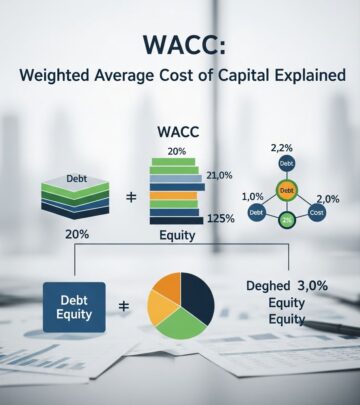
One of the most important applications is calculating the Weighted Average Cost of Capital (WACC). This metric represents the average rate a company must pay to finance its assets, considering the proportion of debt and equity in its capital structure. WACC is essential for evaluating investment opportunities and assessing corporate value.
Portfolio Analysis
Investors use weighted averages to determine portfolio returns, risk metrics, and performance attribution. By weighting each holding according to its proportion of the total portfolio, analysts can accurately assess overall portfolio performance and risk exposure.
Inventory Valuation
The weighted average cost method is widely used in inventory accounting. Companies calculate the weighted average cost of inventory items to determine the cost of goods sold (COGS) and ending inventory values. This method smooths out price fluctuations and provides a balanced valuation approach.
Index Calculations
Financial indices such as stock market indices use weighted average calculations. For example, market-cap weighted indices give larger companies proportionally greater influence on the index value, while equal-weighted indices treat all constituents equally.
Advantages of Using Weighted Averages
Weighted averages offer several distinct advantages over simple averages:
- Accuracy: Provides more accurate representation of data when values have different levels of importance
- Reflects Reality: Better mirrors real-world situations where some factors are genuinely more significant than others
- Better Decision-Making: Enables more informed financial decisions by accurately representing the relative impact of different components
- Flexibility: Allows for customization of weights based on specific circumstances and priorities
- Professional Standard: Widely accepted in financial analysis, accounting, and investment management
Weighted Average vs. Simple Average
The primary distinction between a weighted average and a simple average lies in how each value contributes to the final result.
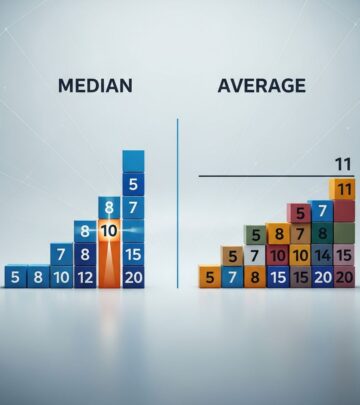
A simple average treats all values equally, dividing the sum of all values by the count of values. This approach works well when all data points have equal significance. However, it can distort results when certain values should have greater influence.
A weighted average assigns different importance levels to different values based on their relative significance. This approach provides a more nuanced and accurate calculation when dealing with heterogeneous data.
For example, if calculating average student performance where assignments are worth 30% and exams are worth 70%, a simple average would incorrectly treat each assessment with equal importance, while a weighted average appropriately emphasizes the exam scores.
Common Uses of Weighted Averages in Business
Beyond finance, weighted averages have numerous business applications:
- Performance Evaluation: Calculating employee performance scores based on weighted criteria
- Quality Control: Assessing product quality where different defects have different severity levels
- Project Management: Evaluating project success based on weighted objectives and deliverables
- Customer Satisfaction: Determining overall satisfaction scores based on weighted service components
- Academic Grading: Calculating final grades based on weighted assessment components
Limitations and Considerations
While weighted averages are powerful tools, they do have limitations to consider:
- Weight Selection: The accuracy of the result depends heavily on appropriate weight assignment, which can be subjective
- Data Quality: Inaccurate or unreliable input data will produce misleading weighted averages
- Complexity: More complex calculations can be prone to errors if not carefully executed
- Context Dependency: Weighted averages must be interpreted within their specific context and may not tell the complete story
Frequently Asked Questions
Q: What is the main difference between weighted and simple averages?
A: A simple average treats all values equally, while a weighted average assigns different importance levels to different values based on their relative significance. Weighted averages provide more accurate results when certain data points should have greater influence on the final outcome.
Q: How do I determine appropriate weights for my calculation?
A: Weight determination depends on your specific situation and priorities. Consider the relative importance of each value, its frequency of occurrence, or its strategic significance. In financial contexts, weights are often based on market values, portfolio proportions, or contractual agreements.
Q: Can weights be percentages or must they be whole numbers?
A: Weights can be any numerical values. They are typically expressed as percentages (where they sum to 100%), proportions (summing to 1), or raw numbers. The formula automatically normalizes them through division by the sum of all weights.
Q: Where are weighted averages most commonly used in finance?
A: Weighted averages are extensively used in calculating portfolio returns, weighted average cost of capital (WACC), inventory valuation using the average cost method, financial index calculations, and cost accounting.
Q: Is a weighted average always better than a simple average?
A: Not necessarily. A weighted average is more appropriate when values have different levels of importance. If all values genuinely deserve equal weight, a simple average is more suitable and less complicated to calculate.
Q: How is the weighted average cost method used in inventory accounting?
A: Companies calculate the average cost of all inventory items available for sale, weighted by the quantity of each item. This average cost is then applied to inventory sold and remaining inventory to determine COGS and ending inventory values accurately.
References
- Weighted Average Cost of Capital (WACC) — Corporate Finance Institute. 2024. https://corporatefinanceinstitute.com/resources/valuation/wacc/
- Inventory Valuation Methods: Weighted Average Method — Financial Accounting Standards Advisory Board (FASAB). 2023. https://fasb.org/
- Portfolio Performance Attribution and Weighted Returns — CFA Institute. 2024. https://www.cfainstitute.org/
- Mathematical Methods in Financial Analysis — U.S. Securities and Exchange Commission. 2024. https://www.sec.gov/
- Weighted Average Calculations in Investment Analysis — MSCI Index Research. 2023. https://www.msci.com/
Similar Articles








Read full bio of medha deb