WACC: Weighted Average Cost of Capital Explained
Master WACC calculations and understand how companies determine their true cost of capital.
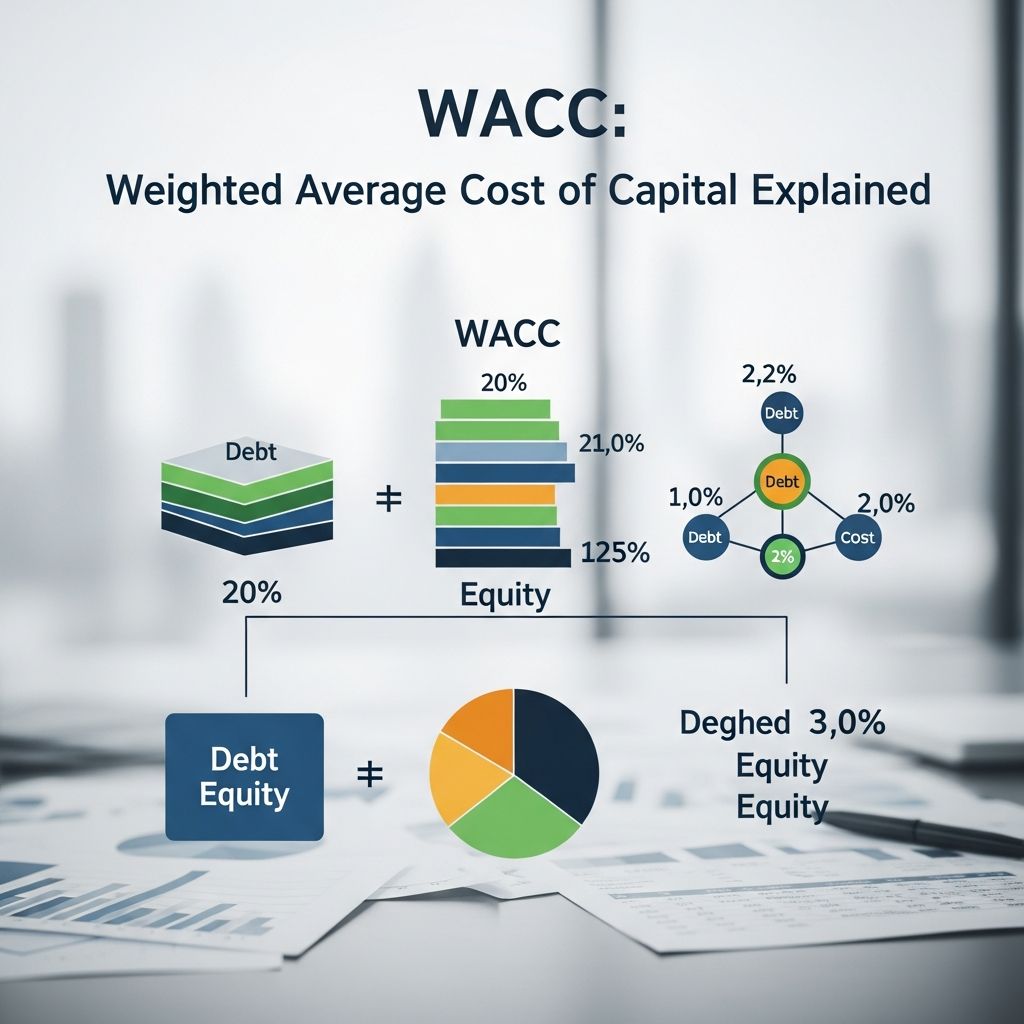
What is Weighted Average Cost of Capital (WACC)?
The Weighted Average Cost of Capital (WACC) represents the average rate a company must pay to finance its assets, blending the costs of equity, debt, and preferred stock according to their proportions in the capital structure. It reflects the minimum return a company must earn on its investments to satisfy all its stakeholders, including equity shareholders, debt holders, and preferred stockholders. Understanding WACC is essential for finance professionals involved in investment banking, equity research, corporate development, and financial modeling.
WACC serves as a critical benchmark for evaluating whether a company’s investments and projects create value. When a company undertakes a new project or acquisition, the expected returns must exceed the WACC to justify the investment. This makes WACC not just a theoretical concept but a practical tool that directly influences corporate decision-making.
The WACC Formula and Components
The standard WACC formula is calculated as follows:
WACC = (E/V × Re) + ((D/V × Rd) × (1 – T))
Where each variable represents:
- E = Market value of the firm’s equity (market capitalization)
- D = Market value of the firm’s debt
- V = Total value of capital (equity plus debt)
- E/V = Percentage of capital that is equity
- D/V = Percentage of capital that is debt
- Re = Cost of equity (required rate of return)
- Rd = Cost of debt (yield to maturity on existing debt)
- T = Corporate tax rate
For companies with preferred stock, an extended version of the formula includes the cost of preferred stock as an additional component. Each financing source has a different cost structure, and WACC weights them proportionally to reflect the company’s actual capital structure.
Understanding the Key Components
Cost of Equity (Re)
The cost of equity represents the return investors require for holding a company’s stock. It is typically calculated using the Capital Asset Pricing Model (CAPM), which establishes a relationship between risk and expected return. The CAPM formula incorporates the risk-free rate, the equity risk premium, and the company’s beta coefficient to determine the required rate of return.
Beta measures a stock’s volatility relative to the overall market. The levered beta includes both business risk and the additional risk from the company’s debt financing. However, to assess pure business risk, analysts often use unlevered beta (also called asset beta), which removes the effects of financial leverage. This unlevered beta is then re-levered based on the specific company’s capital structure being valued.
Cost of Debt (Rd)
The cost of debt is the yield to maturity on the company’s existing debt obligations. This is relatively straightforward to calculate because it represents the actual interest rate the company pays on its borrowings. Unlike equity holders who receive variable returns, debt holders receive fixed payments, making the cost of debt more predictable. The tax deductibility of interest payments creates a tax shield benefit, which is why the WACC formula includes the (1 – T) adjustment factor.
Tax Rate (T)
The tax adjustment in the WACC formula reflects an important corporate finance reality: interest payments on debt are tax-deductible. This tax shield reduces the effective cost of debt financing. When a company borrows money, it can deduct interest expenses from taxable income, effectively reducing the net cost of that debt. The tax rate used should reflect the company’s marginal tax rate, as this represents the tax rate applicable to incremental income.
Cost of Preferred Stock
For companies with preferred stock outstanding, the cost of preferred stock is calculated as the dividend yield on the preferred shares. This represents the annual dividend paid divided by the market price of the preferred stock. Preferred stock sits between debt and common equity in terms of risk and return, so its cost reflects this intermediate position.
Why WACC Matters in Corporate Finance
WACC serves multiple critical functions in corporate finance and investment analysis. Its primary purpose is to determine the cost of each component of the company’s capital structure based on the proportion of equity, debt, and preferred stock. This weighted approach ensures that the overall cost of capital reflects the company’s actual financing mix.
More importantly, WACC functions as the discount rate in discounted cash flow (DCF) valuations. When valuing a business or project using the unlevered free cash flow (UFCF) approach, analysts discount future cash flows by the WACC to determine the present value and thus the enterprise value of the business. This makes WACC fundamental to business valuation across investment banking, private equity, and corporate development.
Applications of WACC
Business Valuation
In DCF valuation models, WACC represents the minimum rate at which future cash flows should be discounted. By applying WACC to projected free cash flows, analysts can determine enterprise value. Subtracting net debt from enterprise value yields equity value, which can then be divided by fully diluted shares outstanding to calculate equity value per share. This valuation approach is standard practice in investment banking and equity research.
Hurdle Rate for Investment Decisions
Companies use WACC as a hurdle rate when evaluating new projects and investments. If a potential investment has an Internal Rate of Return (IRR) lower than the company’s WACC, management should reject the project as it would destroy shareholder value. Conversely, projects with IRRs exceeding WACC are worth pursuing as they create value.
Mergers and Acquisitions Analysis
WACC plays a central role in evaluating merger and acquisition opportunities. By comparing the expected returns from an acquisition against the WACC, companies can determine whether the deal makes financial sense. If the acquisition cannot generate returns exceeding the cost of capital, the company might be better served by buying back shares or paying dividends to shareholders.
Project Evaluation and Capital Budgeting
Financial managers use WACC as the discount rate when evaluating internal capital projects and investments. This ensures consistency in how the company assesses opportunities and allocates resources. Projects are typically ranked by their net present value when discounted at WACC, with higher NPV projects receiving priority for funding.
Calculating WACC: Step-by-Step Process
Step 1: Determine Capital Structure Weights
Begin by identifying the market values of equity (E), debt (D), and any preferred stock. Calculate the proportions by dividing each component by the total capital value (V). These weights must sum to 100% and represent the company’s actual financing mix.
Step 2: Calculate Cost of Equity
Use the CAPM formula to determine the cost of equity. Identify the risk-free rate (typically the yield on government securities), estimate the equity risk premium (the excess return investors expect for holding stocks versus risk-free securities), and determine the company’s levered beta. Multiply the equity risk premium by beta and add the risk-free rate to obtain the cost of equity.
Step 3: Determine Cost of Debt
Find the yield to maturity on the company’s outstanding debt securities. If the company has multiple debt instruments, calculate a weighted average. This represents the cost of debt before considering the tax benefit.
Step 4: Apply Tax Adjustment
Multiply the cost of debt by (1 – T), where T is the marginal tax rate. This adjustment reflects the tax deductibility of interest payments, reducing the effective cost of debt financing.
Step 5: Calculate Weighted Components
Multiply each component’s cost by its weight in the capital structure. For equity: E/V × Re. For debt: D/V × Rd × (1 – T). For preferred stock (if applicable): P/V × Rp, where P is the market value of preferred stock and Rp is its cost.
Step 6: Sum the Components
Add all weighted components together to obtain the WACC. This final figure represents the company’s overall cost of capital.
Common Challenges in WACC Calculation
Calculating WACC accurately presents several challenges. Estimating the cost of equity through CAPM requires forecasting the equity risk premium, which involves judgment and historical analysis. Beta estimates can vary depending on the time period and methodology used. For unlevered companies or those with limited trading activity, obtaining reliable beta estimates becomes difficult.
Determining appropriate market values can also be problematic. Book values of debt may differ significantly from market values, particularly in environments with changing interest rates. For private companies, determining equity value requires estimation techniques rather than relying on market prices. Additionally, selecting the appropriate tax rate requires careful analysis, as companies may face different marginal rates depending on their jurisdiction and profitability.
WACC Across Different Industries and Company Sizes
WACC varies significantly across industries and company sizes. Capital-intensive industries like utilities and telecommunications typically have higher debt proportions and lower WACCs due to stable cash flows and lower financial risk. Technology and biotech companies often have higher WACCs because they rely more heavily on equity financing and carry greater business risk.
Larger, established companies generally have lower WACCs than smaller, growing firms. This reflects their greater financial stability, easier access to capital markets, and lower perceived risk. Startups and early-stage companies typically face much higher costs of capital due to limited operating history and higher default risk.
WACC and Company Valuation Strategy
WACC is not static; it changes as the company’s capital structure, business risk profile, and market conditions evolve. A company seeking to minimize its WACC must balance its capital structure efficiently. Taking on too much debt increases financial risk and the cost of both debt and equity, ultimately raising WACC. Conversely, maintaining too much equity may result in an unnecessarily high overall cost of capital.
Understanding WACC helps companies make strategic financing decisions. By analyzing how different capital structures impact WACC, management can optimize the mix of debt and equity financing. This optimization directly affects the company’s ability to undertake value-creating projects and compete effectively.
Frequently Asked Questions
Q: Why is WACC important for business valuation?
A: WACC serves as the discount rate in DCF valuation models. By discounting projected free cash flows at WACC, analysts determine the present value and enterprise value of a business. This makes WACC fundamental to determining what a company is worth.
Q: How does tax affect the cost of debt in WACC?
A: Interest payments on debt are tax-deductible, creating a tax shield benefit. The WACC formula includes the factor (1 – T) to account for this tax advantage, effectively reducing the cost of debt for companies that can benefit from tax deductions.
Q: Can WACC be negative?
A: In theory, WACC could approach zero or become negative in extreme circumstances with negative interest rates, but this is highly unusual. In normal market conditions, WACC is always positive because investors demand positive returns on their capital.
Q: How often should a company recalculate WACC?
A: Companies should recalculate WACC when significant changes occur in capital structure, market conditions, or risk profile. For valuation purposes, WACC is typically recalculated annually or when preparing major financial analyses such as acquisition evaluations.
Q: What is the difference between levered and unlevered WACC?
A: Levered WACC includes the effects of financial leverage (debt), while unlevered WACC represents the cost of capital without debt. Unlevered WACC is useful for comparing companies with different capital structures or for valuing unlevered cash flows.
Q: How do I estimate beta for a private company?
A: For private companies, analysts typically use unlevered betas from comparable public companies, then re-lever them based on the private company’s target capital structure. Alternatively, they may use industry average betas or adjust comparable company betas for differences in size and business risk.
References
- WACC Formula, Definition and Uses – Guide to Cost of Capital — Corporate Finance Institute. 2024. https://corporatefinanceinstitute.com/resources/valuation/what-is-wacc-formula/
- Capital Asset Pricing Model (CAPM) — U.S. Securities and Exchange Commission (SEC). https://www.sec.gov/
- Discounted Cash Flow Analysis and Valuation — CFA Institute. 2024. https://www.cfainstitute.org/
- Corporate Capital Structure and Financing Decisions — Financial Management Association International. https://www.fma.org/
Similar Articles








Read full bio of Sneha Tete