Wedge Pattern: Definition, Types & Trading Guide
Master wedge patterns in technical analysis: Learn to identify rising and falling wedges for profitable trading decisions.

What Is a Wedge Pattern?
A wedge pattern is a fundamental technical analysis tool used by traders to identify potential market reversals and breakout opportunities. The pattern is characterized by a contracting range in prices, where two converging trendlines form a distinctive cone or triangle-like shape on price charts. This formation typically develops over a period of 3 to 4 weeks and represents a period of market consolidation before a significant price movement occurs.
Wedge patterns are considered significant formations that frequently appear at the top or bottom of market trends. They represent a narrowing of trading activity within clearly defined boundary lines that gradually converge toward each other. The pattern signals that the market is entering a period of indecision, where buyers and sellers are reaching equilibrium, and a substantial price movement is likely imminent. Understanding wedge patterns can provide traders with high-probability setups for entry and exit decisions.
How Wedge Patterns Form
Wedge patterns develop through a specific price action sequence involving two sloping trendlines that gradually converge. The formation requires careful observation of price movements over multiple trading periods, typically ranging from 10 to 50 trading days. Each trendline must be touched at least three times to confirm the validity of the pattern, establishing reliable support and resistance levels.
The key characteristics of wedge formation include decreasing volume as prices narrow within the converging lines, indicating market consolidation and reduced trading activity. This volume decline is crucial for confirming that a genuine wedge pattern is forming, as it demonstrates diminishing interest from both buyers and sellers. Eventually, prices break through one of the trendlines, triggering increased volume and a rapid directional movement that completes the pattern.
Types of Wedge Patterns
Rising Wedge Pattern
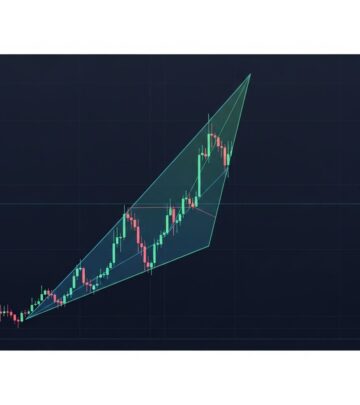
A rising wedge is a bearish technical pattern that forms when the market makes higher highs and higher lows with an increasingly narrow price range. In this pattern, both trendlines slope upward from left to right, but the lower line rises at a steeper angle than the upper line. This creates the distinctive wedge shape where the upper boundary rises more gradually than the lower boundary.
When a rising wedge appears in an uptrend, it functions as a reversal pattern, signaling that the uptrend is losing momentum and strength. The market continues to reach higher prices, but with weakening demand at each new price level. Volume gradually declines with each new price advance, indicating that fewer buyers are willing to purchase at progressively higher prices. This reduced buying pressure creates the bearish implication of the pattern.
Trading Implications: Rising wedges typically develop when an asset’s upward momentum is slowing down, and a reversal to the downside is forthcoming. Once prices break below the lower boundary line, they are likely to experience a significant downward movement. Early detection of this pattern allows traders to anticipate price declines and position themselves accordingly.
Falling Wedge Pattern
A falling wedge is a bullish technical pattern that develops when the market makes lower lows and lower highs with an increasingly narrow price range. In this formation, both trendlines slope downward from left to right, but the upper line descends at a steeper angle than the lower line. This creates a wedge shape where the lower boundary falls more gradually than the upper boundary.
When a falling wedge appears in a downtrend, it functions as a reversal pattern, indicating that the downtrend is losing momentum. The market continues to reach lower prices, but downward momentum is diminishing with each new wave. As the pattern develops, volume keeps declining, and trading activity slows due to narrowing prices. This reduced selling pressure signals that the downtrend is losing strength and a bullish reversal is developing.
Trading Implications: Falling wedges suggest that an asset is losing downward momentum, and buyers are entering to push prices higher. Once prices break above the upper boundary line, they typically experience a significant upward movement. The pattern offers traders an excellent opportunity to enter long positions in anticipation of an uptrend resumption.
Key Components and Validation Criteria
| Component | Characteristic | Significance |
|---|---|---|
| Upper Trendline | Connects 2–3 significant highs | Marks the resistance level and upper boundary |
| Lower Trendline | Connects 2–3 significant lows | Defines the support level and lower boundary |
| Convergence Point | Lines narrow into a cone shape | Signals momentum shift and consolidation |
| Volume Profile | Decreases during formation | Indicates market consolidation and indecision |
| Timeframe | Forms over 3–6 months | Longer formations add credibility to the pattern |
For a wedge pattern to be considered valid and tradable, it must satisfy several validation criteria. The most important requirement is that each trendline must be touched at least three times, though more touches strengthen the pattern’s reliability. The converging nature of the trendlines creates a cone-like shape that becomes progressively narrower, symbolizing the market’s building tension and anticipation.
Volume analysis plays a critical role in confirming wedge patterns. Decreasing volume during the formation phase indicates market indecision and consolidation, setting the stage for a breakout. When the breakout occurs, volume should spike significantly, confirming the validity of the pattern and the strength of the directional movement.
Trading Strategies for Wedge Patterns
Rising Wedge Trading Strategy
Entry Signal: Traders establish a short position when the price breaks below the lower trendline, confirming the bearish reversal.
Stop-Loss Placement: A stop-loss order should be positioned above the upper trendline to minimize losses if the breakout fails to materialize as expected.
Profit Target: The target price is calculated by measuring the height of the wedge at its widest point and projecting this distance downward from the breakout point. This method provides a quantifiable profit objective.
Success Rate: Rising wedges demonstrate an 81% success rate in bull markets, making them reliable reversal indicators.
Falling Wedge Trading Strategy
Entry Signal: Traders establish a long position when the price breaks above the upper trendline, confirming the bullish reversal.
Stop-Loss Placement: A stop-loss order should be positioned below the lower trendline to protect against unexpected downside movements.
Profit Target: Similar to rising wedges, the target price is calculated by measuring the wedge height and projecting it upward from the breakout point.
Success Rate: Falling wedges achieve a 74% success rate in bull markets, demonstrating their effectiveness as bullish reversal patterns.
Confirmation Techniques
Successful wedge pattern trading requires multiple confirmation signals beyond the basic pattern structure. Traders should validate patterns using technical indicators such as the Relative Strength Index (RSI) or Moving Average Convergence Divergence (MACD) to confirm momentum shifts. Volume analysis is essential, with breakouts confirmed by significant volume increases on the directional move.
Additional confirmation comes from price action closing definitively through the support or resistance level. For rising wedges, a close below the lower trendline confirms the bearish breakout. For falling wedges, a close above the upper trendline confirms the bullish breakout. These clear price action confirmations significantly increase the probability of successful trades.
Risk Management Strategies
One of the primary advantages of trading wedge patterns is the ease of implementing effective risk management strategies. The defined boundaries created by the trendlines make it straightforward to establish stop-loss orders that protect capital. By placing stops just outside the pattern boundaries, traders can precisely define their maximum acceptable loss on each trade.
The wedge’s geometric structure also facilitates profit target calculation. Traders can measure the maximum width of the wedge and use this distance to project potential price movement after the breakout. This approach provides a mathematical basis for determining reward-to-risk ratios, ensuring that potential profits justify the risk taken on each trade.
Position sizing becomes more manageable with wedge patterns because traders have clear price levels where their thesis is invalidated. This clarity allows for proper position sizing calculations, where traders risk a consistent percentage of their account on each setup while maintaining appropriate risk-reward ratios.
Volume Analysis and Pattern Confirmation
Volume plays a crucial role in validating wedge patterns and predicting breakout direction. During the pattern formation phase, volume typically declines as the price range narrows, indicating that market participants are uncertain about the next major move. This reduction in trading activity represents consolidation and gathering strength before the breakout.
At the breakout point, volume should spike significantly in the direction of the breakout. An increase in volume accompanying a break above the upper trendline on a falling wedge confirms bullish sentiment. Similarly, a volume spike accompanying a break below the lower trendline on a rising wedge confirms bearish sentiment. Breakouts occurring with low volume should be viewed with skepticism, as they may represent false signals rather than genuine pattern completions.
Wedge Patterns in Different Market Conditions
Wedge patterns function differently depending on the broader market context. Rising wedges appearing in strong uptrends indicate trend exhaustion and reversal potential. The same rising wedge pattern appearing in a downtrend functions as a bearish continuation pattern, suggesting that downward momentum is temporarily pausing before resuming.
Falling wedges in downtrends represent reversal patterns with clear bullish implications. However, falling wedges occurring within strong uptrends may function as consolidation patterns, with prices subsequently resuming their upward trajectory rather than reversing.
Understanding the broader trend context is essential for correctly interpreting wedge patterns and avoiding false signals. Traders should analyze multiple timeframes and consider the prevailing market direction when trading these formations.
Frequently Asked Questions
What is the minimum number of touches required for a valid wedge pattern?
Each trendline must be touched at least three times for a wedge pattern to be considered valid and tradable. More touch points strengthen the pattern’s reliability and increase the probability of a successful breakout.
How long does it typically take for a wedge pattern to form?
Wedge patterns typically take 3 to 4 weeks to complete, though some patterns may form over 3 to 6 months depending on the timeframe being analyzed. Longer formations generally provide more credibility to the pattern.
Is volume important in confirming wedge patterns?
Yes, volume is crucial for confirming wedge patterns. Decreasing volume during pattern formation indicates consolidation, while volume should spike significantly at the breakout to confirm the validity of the pattern and the strength of the directional move.
How do I calculate profit targets for wedge pattern trades?
Profit targets are calculated by measuring the height of the wedge at its widest point and projecting this distance in the direction of the breakout. For rising wedges, project downward from the breakout point; for falling wedges, project upward.
Can wedge patterns fail, and how should traders prepare?
Yes, wedge patterns can produce false breakouts that reverse quickly. Traders should always use stop-loss orders placed just outside the pattern boundaries to protect against these scenarios and manage risk effectively.
What are the success rates for different wedge patterns?
Rising wedges demonstrate an 81% success rate in bull markets, while falling wedges achieve a 74% success rate in bull markets, making both patterns relatively reliable for trading purposes.
References
- Wedge Pattern — Wikipedia. Accessed 2025. https://en.wikipedia.org/wiki/Wedge_pattern
- Wedge Patterns: Rising & Falling Signals — LuxAlgo. 2024. https://www.luxalgo.com/blog/wedge-patterns-rising-and-falling-signals/
- What Is A Wedge And What Are The Rising And Falling Wedge Patterns? — TrendSpider. 2024. https://trendspider.com/learning-center/what-is-a-wedge-and-what-are-the-rising-and-falling-wedge-patterns/
Similar Articles








Read full bio of medha deb