Webull vs Robinhood: Which Broker Wins in 2025?
Compare Webull and Robinhood on fees, tools, assets, and features to find your ideal broker.
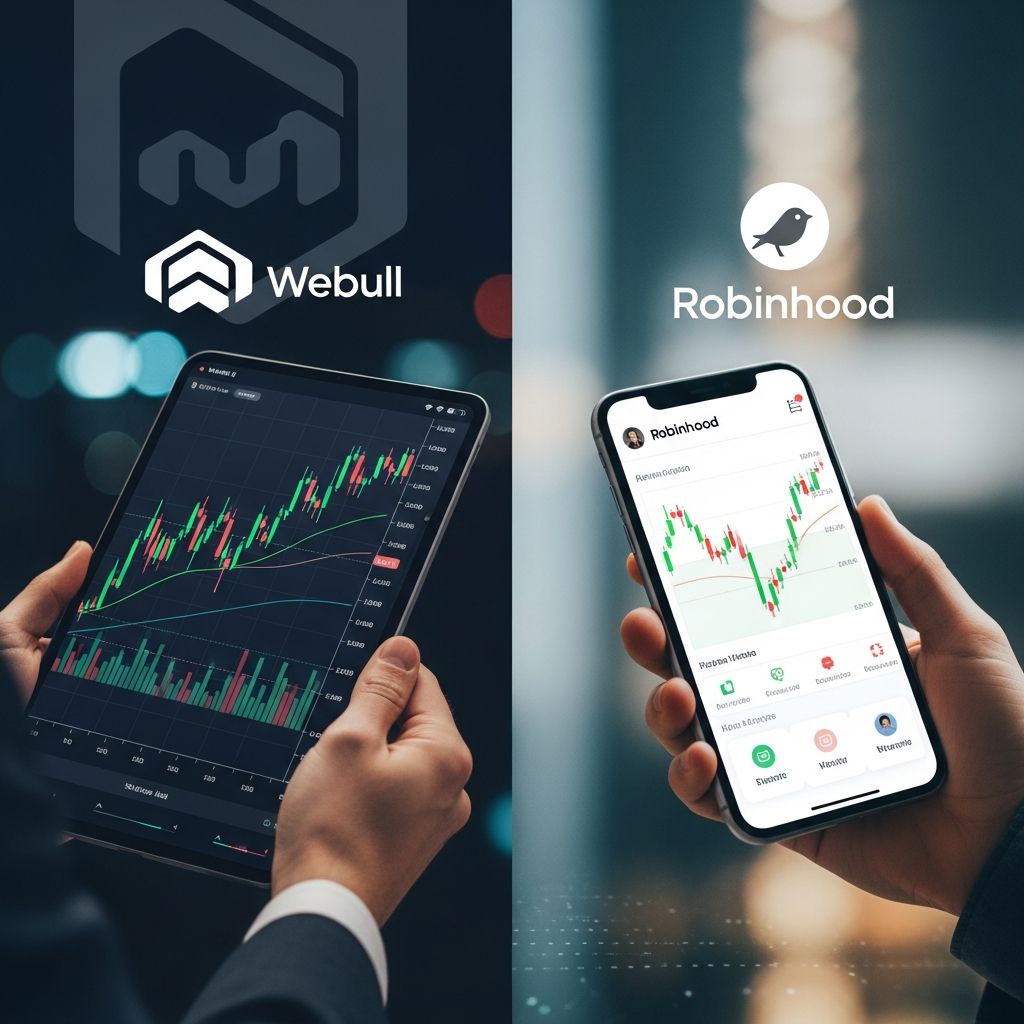
Webull vs Robinhood: A Comprehensive Broker Comparison for 2025
Choosing the right online brokerage platform can significantly impact your investing journey. Two popular options that frequently come up in investor conversations are Webull and Robinhood. Both platforms offer commission-free trading and beginner-friendly interfaces, but they differ in important ways. This guide provides an in-depth comparison to help you determine which broker aligns best with your investment goals and trading style.
Overall Winner: Which Platform Comes Out Ahead?
In a head-to-head evaluation, Webull emerges as the stronger overall choice with an 81.0% rating compared to Robinhood’s 77.3%. Webull is particularly excellent for beginning and intermediate traders, offering an outstanding user experience paired with superior charting capabilities. However, Robinhood holds its own for absolute beginners seeking maximum simplicity and those interested in advisor services. The best choice ultimately depends on your specific needs, experience level, and trading priorities.
Trading Platforms and Tools: Advanced Features Matter
The trading platform is where these two brokers show their most significant differences. Webull edges out Robinhood with a 4-star rating and ranks 7th out of 14 brokers at StockBrokers.com, compared to Robinhood’s 3.5 stars and 9th-place ranking. This advantage stems from Webull’s downloadable Windows and Mac desktop applications, paper trading functionality, and enhanced charting features including historical trade markers, corporate event indicators, auto pattern detection, and custom studies.
For mobile trading, both platforms deliver well-rated stock trading apps, each earning 4.5 stars, though Webull holds the edge in the overall comparison. The biggest differences appear in charting capabilities and watchlist functionality. Webull supports landscape charts and allows you to compare multiple symbols on the same chart simultaneously. Robinhood offers more technical studies and enables watchlist column customization. Notably, Webull clearly supports mobile after-hours trading, while Robinhood’s capabilities in this area remain unclear.
Trading Hours and Market Access
Webull provides extended trading hours that give active traders greater flexibility. The platform offers pre-market sessions from 4:00 AM to 9:30 AM ET and after-hours trading from 4:00 PM to 8:00 PM ET. This expanded access allows traders to react to news and earnings announcements outside regular market hours, a feature that can be particularly valuable during volatile market conditions.
Robinhood’s trading hours are not explicitly detailed as extensively, focusing primarily on regular market hours for most traders. This difference makes Webull the clear winner for active traders who need flexibility beyond the standard 9:30 AM to 4:00 PM ET trading window.
Available Assets and Investment Options
When it comes to tradable assets, Webull offers a significantly wider mix. Feature-by-feature analysis shows that both platforms support stocks, options, futures, margin trading, fractional shares, and OTC stocks. However, critical differences emerge in cryptocurrency and forex offerings.
For cryptocurrency trading, Webull lists 50 coins versus Robinhood’s 22. While Robinhood offers more coins overall, Webull’s selection includes all the major cryptocurrencies that most investors want to trade. The most significant difference involves forex trading: Webull offers it, while Robinhood does not. This makes Webull substantially more versatile for traders interested in currency markets.
Neither broker supports mutual funds, limiting diversification options for some investors. This gap means investors needing mutual fund exposure might need to consider alternative platforms like Fidelity or Charles Schwab.
Account Types and Retirement Options
Webull provides multiple account types including individual brokerage accounts alongside traditional, Roth, and rollover IRAs. This comprehensive retirement account offering gives investors flexibility in structuring their long-term wealth building strategies with tax-advantaged accounts.
Robinhood offers brokerage accounts, margin accounts, and its premium Gold subscription tier. While Robinhood supports margin trading with clearly tiered interest rates, it doesn’t explicitly offer the same retirement account variety as Webull. For investors focused on retirement planning, Webull’s IRA options provide additional value.
Fee Structure and Costs Comparison
Both platforms charge zero commissions on stocks, ETFs, options, and cryptocurrency trades, with only regulatory fees applying. However, important cost differences emerge in specific areas.
Margin Interest Rates
If you plan to borrow on margin, Robinhood is considerably cheaper across listed tiers. Robinhood charges 5.75% for balances below $25,000 and $25,000–$49,999, with a reduced 5.55% rate for $50,000–$99,999. Webull charges 8.74% across these same balance ranges, making Robinhood the clear winner for margin borrowers.
Account Transfer Fees
Webull charges $75 for both partial and full ACAT transfers, while Robinhood charges $100. This $25 difference makes Webull more attractive for investors planning to move their accounts to another platform.
Premium Subscriptions
Robinhood offers its Gold subscription at $5 per month, providing premium features including research reports, higher cash interest rates, and margin investing access. Webull keeps its structure simple with no premium tiers, meaning all features are available without additional monthly fees.
Cryptocurrency Trading and Pricing Transparency
Both platforms support cryptocurrency trading, but transparency differs significantly. Webull publicly discloses its spread markup at 100 basis points, or 1 percent of the trade value. Robinhood, however, does not reveal how much traders pay via the spread, only disclosing that it receives $0.85 in rebates for every $100 in crypto traded. This opacity makes it difficult for Robinhood users to understand their true trading costs. For cost-conscious crypto traders, Webull’s transparency provides a clear advantage.
Research and Market Analysis Tools
Webull edges out Robinhood for market research capabilities, earning 2.5 out of 5 stars and ranking 9th of 14 brokers, compared to Robinhood’s 2 stars and 10th-place ranking. Both platforms deliver basic research on stocks and ETFs but skip in-depth PDF reports, mutual fund research, and bond research.
Webull’s added advantage comes from its social-media sentiment signal, which provides insight into investor sentiment trends. Robinhood’s main research-related feature is a simple portfolio allocation view by asset class. For active traders and intermediate investors who want deeper market insights, Webull’s research tools offer better value.
Day Trading Features and Advanced Capabilities
For day traders, Webull provides streaming time and sales data (the tape) and trading hotkeys for quick order entry, both essential for fast market moves. Robinhood lacks both time and sales data and keyboard hotkeys, which can slow execution during volatile periods.
Both platforms provide ladder trading and Level 2 quotes, giving traders depth of market data and the ability to place orders from a price ladder. However, Webull’s additional day trading features make it the superior choice for this trading style.
Banking Features and Payment Options
Neither Webull nor Robinhood offer checking accounts, savings accounts, mortgage loans, or Certificates of Deposit (CDs). For investors seeking traditional banking functionality, both platforms fall short.
The key distinction appears in payment card offerings. Robinhood provides both debit and credit card options, while Webull provides neither. This means Robinhood users can more easily access their cash balances through card payments, adding a layer of convenience for everyday transactions.
User Experience and Learning Curve
Robinhood is better if you’re brand-new to investing, offering a straightforward mobile-first interface that simplifies the learning process. The app prioritizes ease of use, making it ideal for investors taking their first steps into the market.
Webull has a steeper learning curve but rewards users who take time to master its tools. The platform’s advanced features and charting capabilities can initially overwhelm beginners but provide significant value to traders willing to invest time in learning. Intermediate and active traders typically appreciate this depth and functionality.
Pros and Cons Summary
Webull Advantages
- Superior charting and technical analysis tools with advanced indicators
- Extended pre-market and after-hours trading hours
- Wider range of tradable assets including forex and more cryptocurrencies
- Lower account transfer fees ($75 vs $100)
- Transparent cryptocurrency pricing with disclosed spread markups
- Multiple retirement account options (Traditional, Roth, Rollover IRAs)
- No premium subscription fees required
- Better research capabilities with sentiment analysis
Webull Disadvantages
- No financial advisors or managed portfolio options
- Steeper learning curve for beginners
- No mutual fund support
- Higher margin interest rates compared to Robinhood
- No payment card options
Robinhood Advantages
- Extremely beginner-friendly with intuitive mobile-first interface
- Zero commission on all supported asset classes
- Debit and credit card options for account access
- Lower margin interest rates for borrowing
- Optional $5/month Gold subscription with premium features
- Simple, uncluttered platform design
Robinhood Disadvantages
- Limited asset selection compared to Webull
- No mutual funds, bonds, or futures trading
- Weaker research and analysis tools
- Less transparent cryptocurrency pricing
- No extended trading hours clearly documented
- Higher account transfer fees ($100 vs $75)
- Limited retirement account options
Comparison Table: Key Features Head-to-Head
| Feature | Webull | Robinhood |
|---|---|---|
| Commission on Stocks/ETFs | $0 | $0 |
| Commission on Options | $0 | $0 |
| Cryptocurrencies Available | 50+ | 22 |
| Forex Trading | Yes | No |
| Mutual Funds | No | No |
| Margin Interest Rate | 8.74% | 5.75%-5.55% |
| Account Transfer Fee | $75 | $100 |
| Extended Trading Hours | Yes (4am-8pm ET) | Not Clearly Offered |
| IRA Accounts | Traditional, Roth, Rollover | Limited Options |
| Premium Subscription | None | $5/month Gold |
| Payment Cards | None | Debit & Credit |
| Paper Trading | Yes | No |
| Desktop Apps | Windows & Mac | Mobile Focus |
Frequently Asked Questions
Q: Which broker is better for beginners?
A: Robinhood is better for absolute beginners due to its simple, mobile-first interface and straightforward design. However, if you’re willing to spend time learning, Webull offers better long-term value with superior tools and more asset options.
Q: Does Webull have better trading tools than Robinhood?
A: Yes, Webull offers advanced charts, technical indicators, extended trading hours, and more control options. Robinhood focuses on simplicity with fewer research tools, making it suitable for passive investors rather than active traders.
Q: Can you trade crypto on both platforms?
A: Yes, both support cryptocurrency trading. Webull offers 50+ coins with transparent pricing, while Robinhood offers 22 coins but with less pricing transparency regarding spreads.
Q: Which platform has lower fees?
A: Both charge zero commissions on stocks, ETFs, and options. However, Robinhood has lower margin interest rates (5.55%-5.75% vs Webull’s 8.74%), while Webull has lower account transfer fees ($75 vs $100).
Q: Does Webull offer retirement accounts?
A: Yes, Webull offers Traditional, Roth, and Rollover IRAs, providing more retirement planning flexibility than Robinhood.
Q: Can you trade forex on Robinhood?
A: No, Robinhood does not offer forex trading. Only Webull provides this capability among these two brokers.
Q: Is there a minimum account balance required?
A: Neither Webull nor Robinhood requires a minimum account balance, making both accessible to new investors starting with any amount.
Q: Which broker provides extended trading hours?
A: Webull clearly offers pre-market (4:00 AM-9:30 AM ET) and after-hours (4:00 PM-8:00 PM ET) trading. Robinhood’s extended hours availability is not clearly documented.
Final Recommendation: Choosing Your Ideal Broker
Choose Webull if you: Are an active or intermediate trader, want advanced charting and technical analysis tools, plan to trade forex, prefer extended trading hours, value retirement account flexibility, or want cryptocurrency trading with transparent pricing.
Choose Robinhood if you: Are a complete beginner seeking simplicity, prefer a mobile-first experience, plan to borrow on margin frequently, want payment card access to your account, or prefer an app with minimal learning curve.
The reality is that both platforms serve legitimate purposes depending on your investing style and needs. Webull excels for traders seeking sophisticated tools and broader asset access, while Robinhood shines for simplicity-focused beginners. Your ideal choice should align with your experience level, trading frequency, and long-term financial goals.
References
- Webull vs Robinhood 2025 – StockBrokers.com — StockBrokers.com. 2025. https://www.stockbrokers.com/compare/robinhood-vs-webull
- Webull vs Robinhood (2025) — Unbiased.com. 2025. https://www.unbiased.com/discover/financial-advice/webull-vs-robinhood
- Webull vs. Robinhood 2025 | Comparing Fees, Tools & Features — Options Trading. 2025. https://www.optionstrading.org/blog/webull-vs-robinhood/
- Robinhood Vs Webull: Which Is Better For You? — Bankrate. 2025. https://www.bankrate.com/investing/robinhood-vs-webull/
- Robinhood vs Webull: Which App is Better in 2025? — Projects File. 2025. https://projectsfile.com/robinhood-vs-webull-which-app-is-better-in-2025/
Similar Articles








Read full bio of medha deb