Weather Disasters and Auto Insurance: Rising Premium Reality
Learn how climate-driven extreme weather is reshaping auto insurance costs nationwide
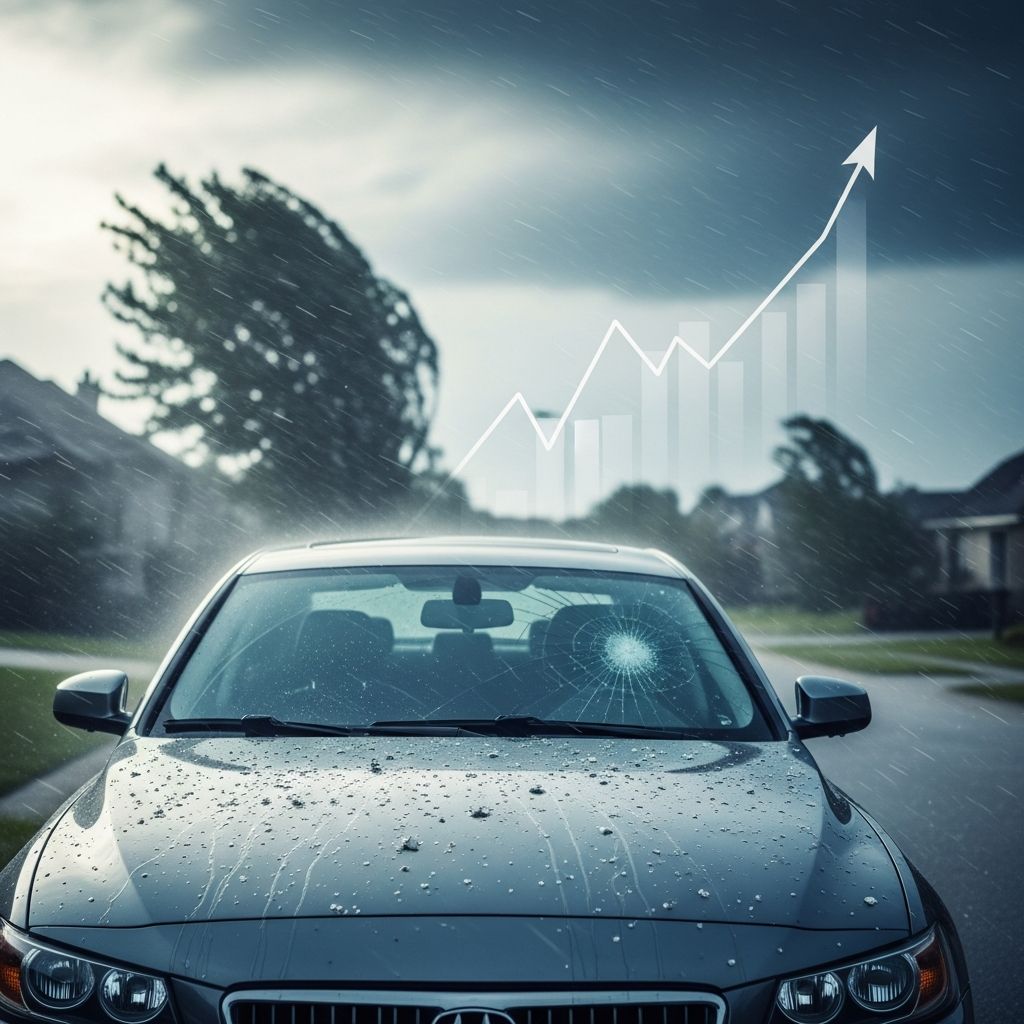
The relationship between severe weather and auto insurance premiums has become increasingly pronounced as climate-driven disasters strike with greater frequency and intensity across the United States. Insurance companies are fundamentally reassessing their risk models in response to accelerating weather patterns, resulting in substantial rate increases that extend far beyond those directly impacted by storms and natural disasters.
The Financial Impact of Intensifying Storm Activity
The financial toll of extreme weather events on the insurance industry has reached unprecedented levels. In 2023 alone, extreme weather cost the U.S. more than $92 billion, with insurance companies bearing a significant portion of this burden. Following recent hurricanes such as Helene and Milton, Floridians filed more than 90,000 auto insurance claims, illustrating the concentrated damage that major weather systems can inflict on specific regions.
What distinguishes the current climate landscape from historical patterns is the sheer regularity with which billion-dollar disaster events now occur. Insurance companies traditionally structured their business models around predictable disaster frequencies that assumed a modest baseline of catastrophic events annually. This foundational assumption no longer holds validity. Extreme weather occurrences that were once considered rare outliers have become routine, forcing insurers to completely recalibrate their pricing structures and risk assessments.
Beyond Major Hurricanes: Secondary Weather Perils
While hurricanes and major storms command headlines, the most significant driver of rising insurance costs stems from secondary weather phenomena. According to research from the University of Michigan’s sustainable enterprise department, heavy rainfall events, flash flooding, hailstorms, and even drought conditions collectively generate more insurance claims and payouts than isolated megastorms.
These secondary perils present a particular challenge for insurers because they affect broader geographic areas and occur more frequently than hurricane systems. A region might experience multiple hailstorms during a single season or face repeated flooding events, whereas major hurricanes follow more sporadic temporal patterns. This sustained, distributed impact means insurance companies must maintain reserves for constant payouts rather than absorbing occasional catastrophic losses.
Regional Vulnerability Patterns
Geographic location fundamentally determines exposure to specific weather-related risks:
- Midwest regions face elevated hail damage, which accounts for approximately 12% of comprehensive car insurance claims nationwide
- Coastal states experience intensified hurricane frequency and severity, with Florida now ranking as the third-highest auto insurance rate state in the country
- Western states contend with wildfire threats that damage vehicles and increase comprehensive coverage claims
- Southern and central plains deal with severe thunderstorms, tornadoes, and flash flooding that damage both vehicles and supporting infrastructure
The Mathematics of Rising Premiums
Insurance rate calculations depend on statistical probability models. When the frequency or severity of damaging events increases, insurers must proportionally increase premium charges to maintain actuarial solvency. An August report indicated that average U.S. auto insurance policies could experience a 22 percent spike by the close of the year. However, this national average masks significant regional variations.
Certain states face dramatically steeper increases. California, Missouri, and Minnesota could experience rate increases as high as 50 percent, driven substantially by damage from severe storms and wildfires. These projections reflect not merely historical losses but forecasted future claims based on climate trend analysis.
The rate-setting process incorporates multiple variables beyond just weather-related events. Inflation, accident frequency, claim severity, and policyholder behavior all factor into premium calculations. Nonetheless, climate-driven property damage has become an increasingly dominant component of the calculation.
Market Restructuring and Coverage Challenges
Insurance companies are responding to elevated risk environments through multiple operational adjustments beyond simply raising rates:
- Underwriting tightening: Companies are implementing more stringent requirements for policy approval, meaning some applicants face outright denial rather than higher premiums
- Geographic retreat: Insurers are limiting new policy issuance in high-risk areas, leaving residents with fewer coverage options
- Policy non-renewal: In 2023, major carriers like Allstate threatened to stop renewing auto policies in several states until governments approved higher rate structures
- Coverage reduction: Some companies are reducing the scope of covered events or excluding certain perils to manage exposure
The policy non-renewal strategy demonstrates how climate risk now drives regulatory conflicts between insurance companies and state governments. Carriers argue that current approved rates fail to reflect actual risk levels, while regulators attempt to balance consumer affordability with insurer viability.
The Bundling Effect and Cascading Cost Increases
Many consumers purchase both home and auto insurance from the same provider to receive bundled discounts. This interconnected pricing structure creates unexpected cost escalation dynamics. When home insurance premiums spike due to climate risks—which has occurred at even more dramatic rates than auto insurance increases—the bundled discount structure means auto insurance costs often rise concurrently even if auto-specific claims haven’t increased proportionally.
Between 2021 and 2024, homeowners insurance rates rose 27% nationally, with high-risk areas experiencing substantially steeper increases. In some cases, homeowners have seen premiums double or triple within a few years. These home insurance escalations create upward pressure on bundled auto insurance premiums, meaning consumers face compounding cost increases across their entire insurance portfolio.
Vehicles as Climate Disaster Vulnerability Points
Automobiles occupy a paradoxical position in climate disaster scenarios. Vehicles serve as essential escape mechanisms during weather emergencies, enabling families to evacuate threatened areas. Simultaneously, vehicles themselves constitute valuable property vulnerable to weather damage. Parked cars face damage from hail, flooding, wind, debris, and fire just as severely as stationary property like homes.
During major hurricane events, the concentration of vehicle damage creates secondary market disruptions. Following hurricanes Helene and Milton, rental car agencies experienced unprecedented demand from customers waiting for repairs on their own damaged vehicles. This market imbalance created pricing pressures and service delays that extended far beyond the affected regions as rental companies throughout the country reallocated vehicles to disaster zones.
The Insurance Coverage Gap
Despite the massive financial toll of natural disasters, insurance coverage remains incomplete. Worldwide, only a portion of natural catastrophe losses receives insurance compensation. In a recent year, insurers and reinsurers paid $95 billion of $250 billion in total economic losses from natural disasters—representing only 38% coverage. The remaining $155 billion in losses falls on uninsured property owners, businesses, and ultimately public disaster assistance programs.
This coverage gap reflects both deliberate underinsurance by property owners and the reality that certain types of damage fall outside standard insurance policies. Flood damage, for example, typically requires separate flood insurance rather than being covered under standard homeowners or comprehensive auto policies. Many vehicle owners fail to purchase comprehensive coverage, leaving themselves vulnerable to weather-related losses.
Structural Challenges in the Insurance Business Model
The fundamental tension facing the insurance industry stems from a mismatch between historical business model assumptions and current environmental reality. Insurance depends on statistical predictability—the ability to calculate average event frequency and price policies accordingly. When disaster frequency increases faster than pricing can adjust, insurers face erosion of profitability and potential insolvency.
Climate change introduces a directional trend in environmental risk that diverges sharply from the assumption of statistical stationarity. Rather than weather patterns fluctuating around a stable historical mean, climate-driven changes produce consistently increasing disaster frequency and severity. This means insurers cannot rely on actuarial tables based on historical data—they must incorporate forecasted future conditions into current pricing.
Regional Implications for Housing and Affordability
Rising insurance costs create cascading effects on housing markets and economic opportunity. States experiencing elevated natural disaster risk face both high insurance rates and depressed housing values, compounding affordability challenges. Mortgage lenders require hazard insurance as a condition of financing, meaning prospective homebuyers in high-risk areas face insurance costs as a direct barrier to homeownership.
In some regions, private insurance market contraction has forced residents to rely on state-run insurers of last resort, which typically charge higher premiums and offer more limited coverage. This creates a tiered insurance market where residents in the most vulnerable locations face the highest costs and fewest options.
Compensation for Policy Holders
| Factor | Impact on Premiums | Regional Variation |
|---|---|---|
| Hurricane/Tornado Risk | High increase | Coastal and southern states |
| Hail Damage Frequency | Moderate increase | Midwest and Great Plains |
| Flood Risk | Moderate to high | Areas with poor drainage or near water bodies |
| Wildfire Exposure | High increase | Western states, particularly California |
| Heavy Rainfall Events | Moderate increase | Nationwide, increasingly common |
Consumer Response Strategies
Property owners confronting rising insurance costs have limited options but several potential strategies:
- Coverage assessment: Review policies to ensure comprehensive and collision coverage appropriately matches vehicle value and personal risk tolerance
- Deductible adjustment: Increasing deductibles reduces premiums but increases out-of-pocket costs when claims occur
- Bundle optimization: Comparing bundled rates across multiple insurers can identify better overall pricing despite individual line increases
- Risk mitigation: Installing vehicle protection systems, parking in covered structures, and implementing preventative maintenance may qualify for discounts
- Relocation consideration: In extreme cases, geographic relocation to lower-risk areas can produce dramatic insurance savings, though moving costs and lifestyle disruption require careful analysis
Looking Forward: Climate Risk as Permanent Insurance Factor
The trajectory of climate-driven weather intensification suggests that auto insurance rate increases represent a permanent structural shift rather than a temporary spike. As global temperatures continue rising and atmospheric carbon concentrations increase, meteorological patterns will likely continue shifting toward more frequent severe weather events.
Insurance companies will continue adjusting their risk models, pricing structures, and coverage offerings in response to observable climate trends. Consumers should anticipate that auto insurance costs will remain elevated relative to historical patterns and may continue increasing as climate impacts intensify. The insurance sector’s adjustment represents one visible manifestation of how climate change imposes direct financial costs on ordinary households and businesses.
References
- Climate-Fueled Extreme Weather Is Hiking up Car Insurance Rates — Inside Climate News. 2024-10-29. https://insideclimatenews.org/news/29102024/todays-climate-extreme-weather-car-insurance/
- Climate Change and Auto Insurance: Preparing for Increased Risks — Insure with Masters. https://insurewithmasters.com/climate-change-and-auto-insurance-preparing-for-increased-risks/
- How Extreme Weather Impacts Car Insurance Rates — VandenBout Law. https://www.vandenboutlaw.com/how-do-extreme-weather-events-impact-car-insurance-rates/
- Climate Change and Insurance — Citizens Climate Lobby. https://citizensclimatelobby.org/blog/policy/climate-change-and-insurance/
- How Weather Impacts Insurance Rates and What You Can Do About It — Kapnick Insurance. https://kapnick.com/blog/weather-impacts-insurance-rates/
- Is climate change affecting your car insurance rates? — PreventionWeb. https://www.preventionweb.net/news/climate-change-affecting-your-car-insurance-rates
Similar Articles








Read full bio of medha deb