Wall Street Journal Prime Rate: Definition & Impact
Understand the Wall Street Journal prime rate and how it affects your loans and credit cards.
Understanding the Wall Street Journal Prime Rate
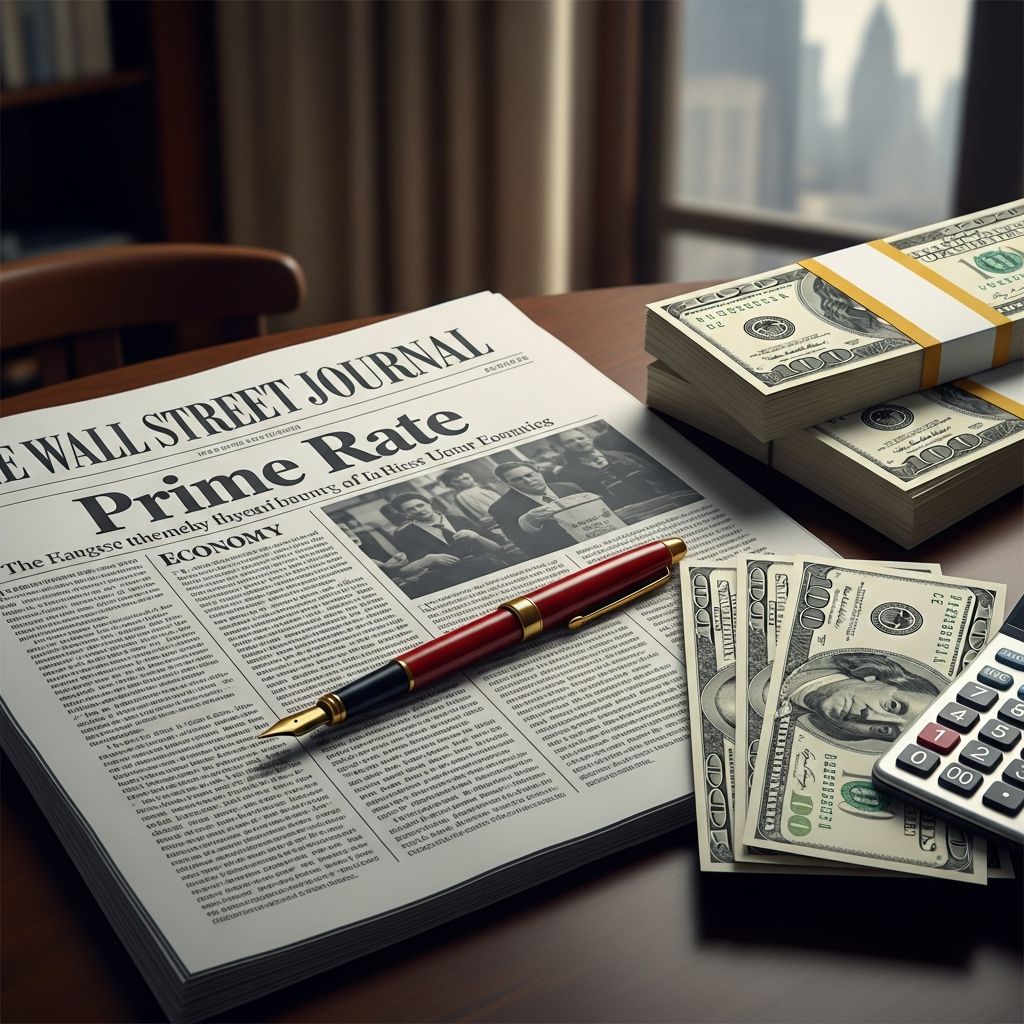
The Wall Street Journal prime rate, commonly referred to as the WSJ prime rate or U.S. Prime Rate, stands as one of the most important benchmarks in the financial system. It represents the interest rate at which banks and financial institutions lend money to their most creditworthy customers—typically large corporations and established businesses with excellent credit histories. This rate serves as a critical foundation for determining interest rates on consumer financial products, making it essential for anyone with loans, credit cards, or other variable-rate borrowing arrangements to understand how it works and what influences its movements.
What Is the Wall Street Journal Prime Rate?
The Wall Street Journal prime rate is the consensus rate that reflects the base interest rate posted by at least 70% of the nation’s 10 largest U.S. banks for short-term loans to their most creditworthy customers. The Wall Street Journal conducts regular surveys of major financial institutions to gather this data and publishes the official prime rate based on their findings. This published rate serves as the benchmark that financial institutions across the country reference when setting their own interest rates for various products and services.
While the prime rate itself is primarily offered to large corporations and businesses with the strongest credit profiles, its significance extends far beyond these elite borrowers. The prime rate functions as a baseline or index that lenders use to calculate interest rates for average consumers across multiple financial products. When a bank sets your credit card APR or determines the interest rate on your auto loan, they typically start with the prime rate and then add a margin based on your personal creditworthiness, the type of loan, current market conditions, and the level of risk the lender perceives.
How Is the Prime Rate Determined?
Understanding the determination of the prime rate requires knowledge of the broader monetary policy system and the interconnected nature of interest rates in the U.S. economy. The prime rate follows a specific hierarchy of rate-setting, beginning with decisions made by the Federal Reserve Board.
The Federal Funds Rate Connection
The foundation of the prime rate begins with the federal funds rate, which is the interest rate that commercial banks charge each other for overnight lending. This rate is established by the Federal Open Market Committee (FOMC), which consists of Federal Reserve officials. The FOMC meets a minimum of eight times per year to review economic conditions and determine whether to adjust the federal funds target rate. When the Federal Reserve Board makes changes to monetary policy, these decisions directly influence the federal funds rate.
The federal funds rate serves as a critical policy tool for the Federal Reserve to manage the overall economy. When the Fed is concerned about inflation, it typically raises the federal funds rate to make borrowing more expensive, which reduces spending and slows economic growth. Conversely, during economic slowdowns or recessions, the Fed lowers the federal funds rate to encourage borrowing and spending, thereby stimulating economic activity.
The Three Percentage Point Spread
Most commercial banks establish their prime rate at approximately 3 percentage points higher than the federal funds target rate. This spread of roughly 3% represents the additional margin that banks apply to compensate for the difference in risk and to generate profit on their lending operations. For example, if the Federal Reserve sets the upper limit of the federal funds target rate at 4.50%, banks would typically establish their prime rate at around 7.50%.
While this 3% spread is standard across most major banks, individual financial institutions may adjust their rates slightly depending on prevailing market conditions, competitive pressures, and their own cost of funds. However, when the Fed changes its target rate, banks generally follow suit within a few days, as they adjust their prime rates in response to the new federal funds rate environment.
The Survey and Publication Process
The Wall Street Journal maintains its role as the primary publisher of the official prime rate through an ongoing survey of major U.S. banks. The Journal surveys the 30 largest banks in the nation and monitors when they change their prime rates. When three-quarters of these surveyed banks (23 banks) adjust their rates, the Journal updates its published prime rate effective on the day the Journal publishes the new figure. This methodology ensures that the WSJ prime rate reflects genuine market movements rather than isolated decisions by individual banks.
How Banks Use the Prime Rate
Financial institutions use the prime rate as a reference point or index when determining interest rates for various consumer and business lending products. The prime rate serves as the starting point, and lenders then add a margin or spread based on several factors specific to the borrower and the loan itself.
Credit Card APR Determination
The prime rate plays a particularly important role in setting credit card interest rates. Most credit card issuers use the prime rate as a baseline when establishing the annual percentage rate (APR) that cardholders pay on purchases and other transactions. However, your actual credit card APR will typically be higher than the published prime rate because lenders add a margin based on your credit score, payment history, creditworthiness, and the specific terms of the card.
If your credit card has a variable APR tied to the prime rate, changes in the prime rate can directly affect your interest charges. When the prime rate increases, your variable credit card APR will likely increase within a billing cycle or two. Similarly, if the prime rate decreases, your APR should decrease as well, potentially lowering the interest you pay on carried balances.
Other Loan Products
Beyond credit cards, the prime rate influences interest rates on numerous other financial products, including:
- Auto loans and vehicle financing
- Personal loans
- Home equity lines of credit (HELOCs)
- Adjustable-rate mortgages (ARMs)
- Small business loans
- Home equity loans
For each of these products, lenders use the prime rate as a foundation and add their own margin based on the borrower’s creditworthiness, the loan amount, the loan term, and current market conditions. This approach allows lenders to maintain consistency in their pricing while adjusting for individual risk profiles.
Impact of Prime Rate Changes on Consumers
Movements in the prime rate have cascading effects throughout the economy and directly impact consumers in multiple ways. Understanding these effects can help you anticipate changes in your own borrowing costs and make informed financial decisions.
Rising Prime Rates
When the Federal Reserve raises the federal funds rate in response to inflation concerns or economic overheating, the prime rate typically rises as well within a short timeframe. For consumers with variable-rate debt, this means their monthly payments and interest charges increase. Credit card holders see higher APRs, auto loan borrowers may face higher interest on refinanced loans or new purchases, and homeowners with adjustable-rate mortgages or home equity lines of credit experience increased monthly obligations.
Rising prime rates also discourage new borrowing, as the cost of loans becomes more expensive. This can slow consumer spending and business investment, which are important drivers of economic growth.
Falling Prime Rates
When the Federal Reserve lowers the federal funds rate to stimulate the economy during slowdowns, the prime rate decreases accordingly. Consumers with variable-rate loans benefit from lower interest charges and reduced monthly payments. Lower prime rates encourage borrowing and spending, which can help boost economic activity during periods of weakness.
Credit Score Impact on Individual Rates
While the prime rate moves in lockstep for all major banks, the actual rate you receive on a loan or credit card depends significantly on your credit score and financial profile. Borrowers with excellent credit may receive rates closer to the prime rate plus a smaller margin, while those with fair or poor credit may face rates substantially higher than the prime rate.
Historical Context of Prime Rate Movements
The prime rate has experienced significant variations throughout recent decades, reflecting different economic conditions and Federal Reserve policy responses. During the dot-com boom of the late 1990s, the prime rate reached 8.50% by the end of 1999 as the Fed maintained higher rates during a period of strong economic growth. Following the dot-com bust and the resulting recession in the early 2000s, the Fed aggressively lowered rates, and the prime rate fell to 4.00% by June 2003 as the central bank attempted to stimulate the struggling economy.
These historical fluctuations demonstrate how the prime rate responds to broader economic conditions and Federal Reserve policy decisions. Understanding this relationship helps explain why your loan rates and credit card APRs may change even without any change in your personal financial situation.
Key Differences: Prime Rate vs. Federal Funds Rate
While the prime rate and federal funds rate are closely related, they serve different purposes in the financial system. The federal funds rate is the rate banks charge each other for overnight lending to meet reserve requirements set by the Federal Reserve. This rate is a monetary policy tool used by the Federal Reserve to influence the overall economy.
The prime rate, by contrast, is the rate banks charge to their most creditworthy customers for actual lending. The prime rate is approximately 3% higher than the federal funds rate and is used as a benchmark for consumer and business lending rates. When news reports mention the Federal Reserve discussing interest rate changes, they typically refer to adjustments in the federal funds rate, which subsequently influence the prime rate and consumer loan rates.
Important Considerations About the Prime Rate
While the prime rate serves as a standard benchmark for many lenders, it’s important to understand that it is not a mandatory minimum that all lenders must follow. Even though the Fed changes the federal funds rate and major banks adjust the prime rate, individual financial institutions are not legally required to change their own rates or the margins they add to the prime rate. Some banks may maintain their current rates longer than others, and some may adjust their margins based on competitive conditions or their own cost of funds.
Additionally, just because your loan has a variable rate tied to the prime rate doesn’t mean your rate will change immediately when the prime rate changes. Different financial institutions implement rate changes at different times, and some lenders may update rates only once per billing cycle or quarter. Always review the terms of your specific loan agreement to understand exactly how and when rate changes will be implemented.
Frequently Asked Questions
Q: What is the current Wall Street Journal prime rate?
A: The current prime rate changes based on Federal Reserve decisions and major bank surveys. For the most up-to-date prime rate, check the Wall Street Journal’s official publications or major financial websites that track this benchmark in real-time.
Q: How often does the prime rate change?
A: The prime rate changes when the Federal Open Market Committee adjusts the federal funds rate or when 75% of the surveyed major banks change their rates. The FOMC meets at least eight times per year, though rate changes don’t occur at every meeting.
Q: Will my credit card APR increase if the prime rate goes up?
A: If you have a variable-rate credit card tied to the prime rate, your APR will likely increase when the prime rate rises. Fixed-rate credit cards are not affected by prime rate changes, but variable-rate cards will see APR adjustments within one or two billing cycles.
Q: Can I get a loan at the prime rate?
A: Most individual consumers cannot directly access the prime rate itself. The prime rate is the starting point that lenders use, but they add a margin based on your credit score and financial profile to determine your actual rate.
Q: What happens to my adjustable-rate mortgage if the prime rate increases?
A: Adjustable-rate mortgages typically have rate adjustment periods (such as annually or every five years). When your ARM resets and the prime rate has increased, your monthly mortgage payment will increase accordingly.
Q: How does the prime rate affect the economy?
A: Higher prime rates make borrowing more expensive for businesses and consumers, which can slow spending and economic growth. Lower prime rates encourage borrowing and spending, which stimulates economic activity during slow periods.
References
- Wall Street Journal Prime Rate — Bankrate. 2025. https://www.bankrate.com/rates/interest-rates/wall-street-prime-rate/
- What is the Prime Rate and How Does it Impact You — Citizens Bank. 2025. https://www.citizensbank.com/learning/what-is-the-prime-rate.aspx
- What is the Prime Interest Rate and How Does it Work? — Capital One. 2025. https://www.capitalone.com/learn-grow/money-management/prime-interest-rate/
- What Is the Prime Rate? — Experian. 2025. https://www.experian.com/blogs/ask-experian/what-is-prime-rate/
- What’s Wall Street Journal Prime Rate and Why Does it Matter to Me? — Fulton Bank. 2025. https://www.fultonbank.com/Education-Center/Managing-Credit-and-Debt/Prime-rate-and-why-it-matters
- A Primer on the Prime Rate — ESL Federal Credit Union. 2025. https://www.esl.org/resources-tools/educational-resources/understanding-the-prime-rate
- U.S. Prime Rate — Federal Reserve Board. 2025. https://www.federalreserve.gov/
Similar Articles








Read full bio of Sneha Tete