Wage Replacement Ratio: Planning Your Retirement Income
Master your retirement finances by understanding wage replacement ratios and income needs.
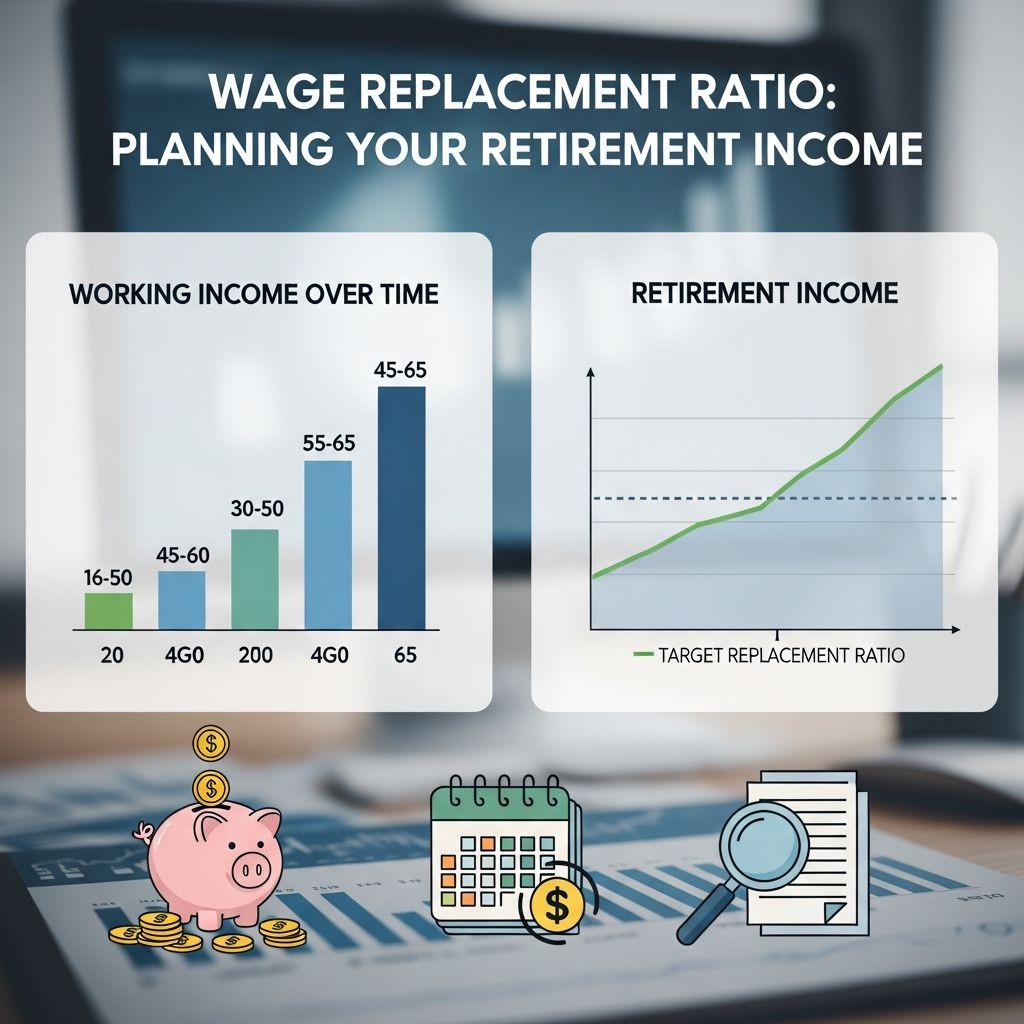
What Is a Wage Replacement Ratio?
A wage replacement ratio, often called an income replacement ratio, is a financial metric that represents the percentage of your pre-retirement income that you’ll need to maintain your standard of living after you stop working. This fundamental concept helps retirees and financial planners determine how much money you should have saved or available when you retire. Understanding this ratio is critical for anyone planning their retirement, as it bridges the gap between your working years and your retirement years.
The wage replacement ratio typically measures the annual retirement income you’ll receive from various sources—including Social Security, pensions, investment returns, and personal savings—compared to your final annual salary before retirement. Rather than assuming you’ll need 100% of your pre-retirement income, financial experts have determined that most people can maintain their desired lifestyle with a lower percentage, primarily because many work-related expenses disappear after retirement.
Understanding the Concept Behind Replacement Ratios
The concept of wage replacement ratios stems from the recognition that your spending patterns change significantly once you retire. When you’re working, a substantial portion of your income goes toward expenses directly related to employment, such as commuting, professional clothing, retirement account contributions, and taxes associated with employment income. These expenses naturally diminish or disappear entirely in retirement.
For example, if you’re contributing 8% of your salary to a 401(k) plan and spending an additional 5% on work-related transportation and clothing, you’re already accounting for 13% of your income that you won’t need to replace in retirement. Additionally, taxes typically decrease significantly in retirement, further reducing your income replacement needs.
Industry-Standard Replacement Rate Guidelines
Financial professionals and retirement planning experts have established widely recognized benchmarks for adequate retirement income replacement. These standards provide a starting point for your retirement planning calculations.
Common replacement rate targets:
Most financial advisors suggest that you should aim to replace between 70% and 85% of your pre-retirement income. The most frequently cited benchmark is 75% to 80%, which represents what many people need to maintain their pre-retirement standard of living. The federal government’s official retirement calculator uses 70% as a default replacement rate, though it allows adjustments ranging from 20% to 120% based on individual circumstances.
However, recent real-world data demonstrates that the appropriate replacement rate varies significantly based on your income level. Lower-income individuals may need a higher replacement rate—potentially exceeding 100%—to maintain their lifestyle, while higher-income earners might require a lower percentage due to reduced spending needs and greater flexibility in lifestyle adjustments.
How to Calculate Your Personal Wage Replacement Ratio
Calculating your wage replacement ratio is straightforward and can serve as an excellent starting point for comprehensive retirement planning. Here’s a practical approach:
Basic calculation method:
Begin by determining your annual pre-retirement income, then multiply it by your target replacement rate. For instance, if you’re earning $80,000 annually and you select a 75% replacement rate, your target retirement income goal would be $60,000 per year. This calculation provides a clear numerical target for your retirement savings strategy.
Example calculation:
Consider a married couple with a combined pre-retirement income of $100,000 annually. Using a 74% replacement rate as a starting point, they would aim for approximately $74,000 in annual retirement income. If they expect $39,000 from Social Security benefits, they would need roughly $35,000 from other sources such as pensions, investment portfolios, or part-time work.
You can also adjust the standard replacement rate based on your personal savings habits. If you’re saving 12% of your income instead of the commonly assumed 8%, you can subtract 4 percentage points from the standard 75% replacement rate, resulting in a personally adjusted target of approximately 71%.
Factors That Influence Your Replacement Ratio
Several important variables affect how much of your pre-retirement income you’ll actually need to replace in retirement. Understanding these factors helps you create a more accurate and personalized retirement plan.
Retirement lifestyle and location:
Your desired retirement lifestyle significantly impacts your replacement ratio needs. If you’re planning an active retirement with frequent travel and entertainment, you may need a higher replacement rate than someone planning a quieter retirement focused on hobbies and family time. Similarly, your geographic location affects retirement expenses, with costs varying dramatically between urban and rural areas, as well as between different states and countries.
Health and longevity expectations:
Your anticipated lifespan and health status influence how long your retirement income must last. Individuals in excellent health expecting a long retirement need to ensure their income replacement plan sustains them for potentially 30+ years, while others might plan for a shorter retirement period.
Outstanding debts:
Whether you carry mortgage debt, outstanding loans, or other financial obligations into retirement affects your replacement ratio needs. Many financial experts recommend entering retirement debt-free, which can significantly lower your required replacement rate. Conversely, carrying substantial debt into retirement increases the income percentage you’ll need to maintain.
Investment returns and inflation:
The actual returns on your retirement investments and the rate of inflation directly impact how long your retirement savings will last. Higher investment returns extend your retirement funds, while inflation erodes purchasing power, potentially requiring a higher replacement rate than initially calculated.
Sources of Retirement Income
Your wage replacement ratio typically combines income from multiple sources. Understanding how each source contributes to your total retirement income helps you plan more effectively.
Primary retirement income sources include:
Social Security benefits form the foundation for most American retirees, replacing a significant but typically insufficient portion of pre-retirement income. Employer-sponsored pensions, increasingly rare in modern employment, provide guaranteed lifetime income for eligible retirees. Personal savings and investment accounts—including 401(k)s, IRAs, brokerage accounts, and real estate—represent the portion you’ve accumulated through your own efforts. Part-time work or consulting in retirement can supplement other income sources. Rental income from property investments may also contribute to your retirement income stream.
Real-World Income Replacement Data
Recent empirical research reveals that income replacement needs vary substantially across income levels, challenging traditional one-size-fits-all assumptions. Actual data from retirement households demonstrates that individuals earning $30,000 annually may need 104% income replacement to maintain their lifestyle, while those earning $300,000 might require only 55%. This variation reflects differences in spending patterns, tax obligations, and lifestyle flexibility across income levels.
The traditional industry guidance of 70% to 80% replacement represents an average rather than a universal prescription. Lower-income households typically spend most or all of their income on essential expenses, making it difficult to reduce spending in retirement. Higher-income households, by contrast, often have discretionary spending that can be reduced, allowing them to maintain their lifestyle with a lower percentage of pre-retirement income.
Adjusting Your Replacement Ratio for Personal Circumstances
While standard guidelines provide a helpful framework, your personal situation may warrant adjustments to the typical replacement rate. Consider increasing your target replacement rate if you plan an active retirement with significant travel, anticipate exceptional health and longevity, have ongoing debt obligations, live in a high-cost area, or expect major expenses such as helping family members or relocating. Conversely, you might reduce your target rate if you plan a modest retirement, expect significant lifestyle changes, will have a paid-off home, or anticipate lower healthcare costs due to employer coverage or other benefits.
Why Replacement Ratios Matter for Retirement Planning
The wage replacement ratio provides several critical benefits for your retirement planning process. It offers a clear, measurable goal you can work toward, transforming abstract retirement planning into concrete numerical targets. This specificity helps you determine how much you need to save, evaluate whether you’re on track, and make necessary adjustments to your savings and investment strategy. Additionally, the replacement ratio framework encourages you to think critically about your post-retirement lifestyle, expenses, and priorities before retirement arrives.
By establishing a target replacement rate early in your career, you can work backward to determine required savings rates and investment returns. This proactive approach significantly increases the likelihood of achieving a comfortable, financially secure retirement.
Common Mistakes in Replacement Ratio Planning
Many individuals make predictable errors when working with replacement ratios. Using an inappropriate standard rate without considering personal circumstances leads to either insufficient savings or unnecessary over-saving. Failing to account for inflation when calculating retirement needs can result in inadequate purchasing power in later retirement years. Neglecting to review and adjust your replacement ratio as life circumstances change—career changes, major expenses, health developments—can derail your retirement plan. Additionally, many people underestimate retirement expenses or overestimate Social Security benefits, leading to disappointing retirement realities.
Frequently Asked Questions
Q: What’s the difference between a wage replacement ratio and a savings rate?
A: Your savings rate is the percentage of current income you’re setting aside for retirement. Your wage replacement ratio is the percentage of pre-retirement income you’ll need in retirement. These are related but distinct concepts—a higher savings rate during working years can reduce the replacement ratio you need to achieve.
Q: Should I use gross or net income when calculating my replacement ratio?
A: Most financial professionals recommend using gross income when calculating replacement rates, as it provides a more accurate picture of your earning capacity. However, some prefer net income calculations as they more directly reflect what you actually spend. Choose whichever approach aligns with your financial planning methodology, but remain consistent throughout your planning process.
Q: How often should I review my replacement ratio calculation?
A: Review your replacement ratio annually or whenever significant life changes occur, such as marriage, divorce, major salary increases, health changes, or changes in retirement goals. Regular review ensures your plan remains aligned with your current circumstances and expectations.
Q: Can the replacement ratio account for part-time work in retirement?
A: Yes, if you plan to work part-time in retirement, you can reduce your replacement ratio accordingly. For example, if you expect to earn $15,000 annually from part-time work, you can subtract that amount from your retirement income needs before calculating your replacement percentage.
Q: What if my replacement ratio calculation suggests I need more than 100%?
A: A replacement ratio exceeding 100% indicates you may face financial challenges in retirement based on your current savings trajectory. In this situation, consider increasing your savings rate, delaying retirement, planning a more modest retirement lifestyle, or seeking professional financial planning advice.
References
- Actuarial Analysis of Retirement Income Replacement Ratios — University of Nebraska-Lincoln, Journal of Actuarial Practice. 2000. https://digitalcommons.unl.edu/joap/1076/
- Retirement Income Strategies: Income Replacement for Retirement — Berkshire Money Management. https://berkshiremm.com/retirement-income-strategies-income-replacement-for-retirement/
- Desired Replacement Rate — U.S. Office of Personnel Management. https://www.opm.gov/retirement-center/calculators/federal-ball-park-estimator/ReplacementRate.html
- Understanding and Applying the Replacement Ratio for Retirement — Securian Financial Group. https://www.securian.com/insights-tools/articles/retirement-income-replacement-ratio.html
- How to Determine the Amount of Income You Will Need at Retirement — T. Rowe Price. https://www.troweprice.com/personal-investing/resources/insights/how-to-determine-amount-of-income-you-will-need-at-retirement.html
- An Innovative Approach to Calculating Income Replacement Rates — J.P. Morgan Asset Management. https://am.jpmorgan.com/us/en/asset-management/adv/insights/retirement-insights/real-life-data-calculating-income-replacement-rates/
- Alternate Measures of Replacement Rates for Social Security — Social Security Administration. https://www.ssa.gov/policy/docs/ssb/v68n2/v68n2p1.html
Similar Articles








Read full bio of medha deb