VWAP: Volume-Weighted Average Price Guide
Master VWAP trading: Learn how institutional investors use volume-weighted average price for optimal execution.
What Is Volume-Weighted Average Price (VWAP)?
Volume-Weighted Average Price (VWAP) is a fundamental trading metric that represents the ratio of the value of a security or financial asset traded to the total volume of transactions during a trading session. It serves as a benchmark measure that reflects the average price at which a security traded throughout a specific period, typically adjusted for the volume of transactions that occurred at each price level.
VWAP differs from simple arithmetic averages because it weighs prices according to their trading volume. This means that price movements accompanied by higher volume carry significantly more weight in the calculation than price changes that occur amid low volume. The indicator is most commonly computed on a daily basis, though it can be measured between any two points in time during a trading session.
For institutional traders, VWAP serves as a critical tool to determine the average prices of large orders while minimizing market impact. Retail traders, conversely, utilize VWAP to monitor intraday price movements and identify potential entry and exit points. By monitoring VWAP, traders gain insight into a stock’s liquidity and the price that buyers and sellers agree is fair at a specific moment in time.
The VWAP Formula and Calculation
VWAP is calculated using a specific mathematical formula that accumulates both price and volume data throughout the trading day. Understanding this formula is essential for traders who want to implement VWAP-based strategies effectively.
The formula for VWAP is:
VWAP = Σ(Price × Volume) / Σ(Volume)
In this formula:
- Price refers to the price of each individual trade that occurs during the defined period
- Volume represents the quantity of shares or contracts traded at each price level
- Σ (Sigma) indicates the sum of all values in the calculation
- The calculation excludes cross trades and basket cross trades to ensure accuracy
The calculation process involves taking the cumulative total of the price of each trade, multiplying it by the volume of that trade, and then dividing the result by the total volume traded during the day. This cumulative approach means that VWAP reflects the running average price throughout the trading session, updating with each new trade.
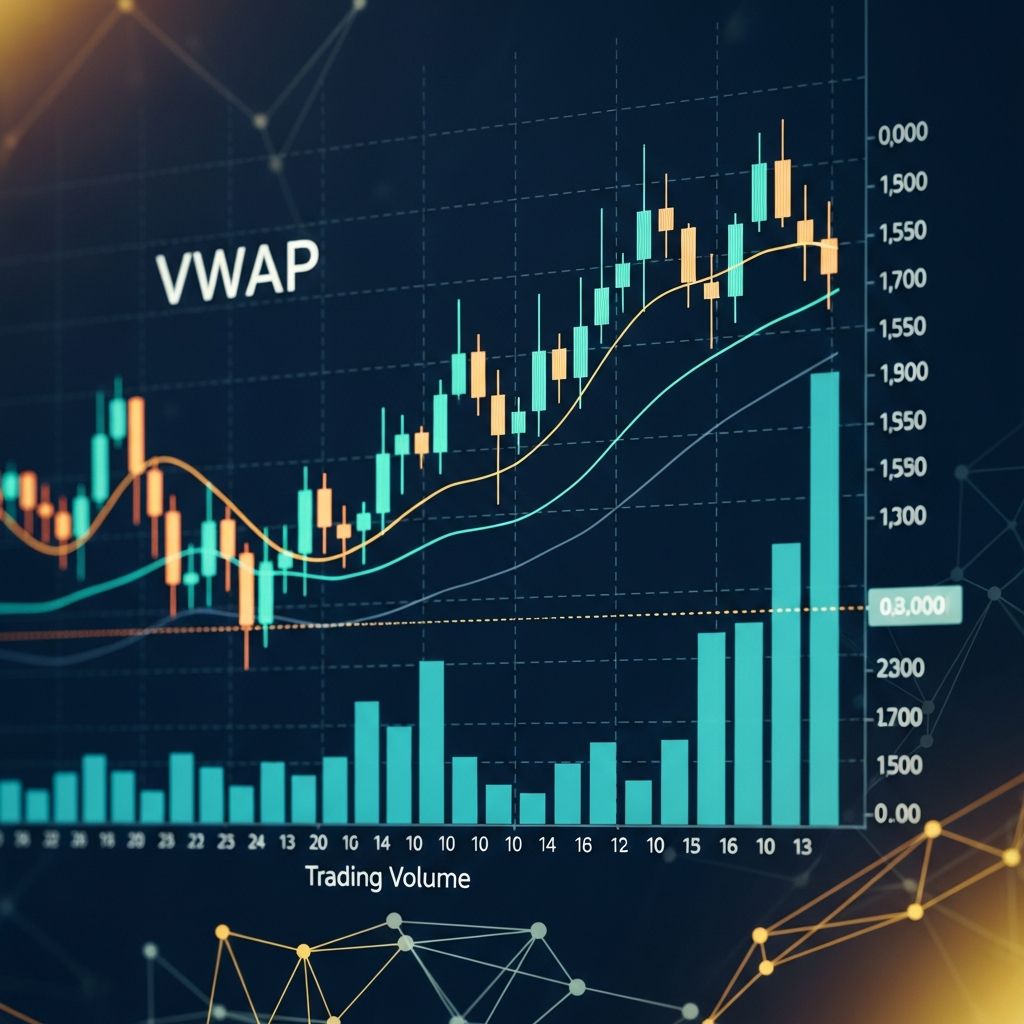
Modern trading platforms have simplified this process considerably. On platforms like thinkorswim, traders can view VWAP directly without manually calculating the formula. By accessing the Charts tab, adding a symbol, and opening an intraday chart, traders can select Studies and add VWAP to visualize how this indicator moves alongside the stock price.
How VWAP Works as a Trading Indicator
VWAP functions as a dynamic indicator that resets each trading day, providing real-time guidance for short-term traders. Understanding how VWAP operates in practice is crucial for effective implementation in trading strategies.
VWAP as a Support and Resistance Indicator
One of the most valuable applications of VWAP is its use as a reference point for support and resistance levels. When a stock price trades above VWAP, it typically reflects bullish sentiment in the market, suggesting that buyers are in control. Conversely, when price trades below VWAP, it generally indicates bearish sentiment with sellers dominating the market action.
Traders often use VWAP to make entry and exit decisions. For example, when a price moves below VWAP but subsequently closes above it within a few trading bars, this could signal that buying activity has picked up. A trader might then consider opening a long position with appropriate stop orders placed below a previous low point. Similarly, if price approaches VWAP from above with declining momentum, it may present an opportunity for initiating short positions.
VWAP Bands and Overbought/Oversold Conditions
Advanced trading platforms offer VWAP bands that extend above and below the primary VWAP line. These bands are typically set at a specified number of standard deviations from the main VWAP, functioning similarly to Bollinger Bands. The upper band may be considered an overbought level, signaling potential pullback opportunities, while the lower band may represent an oversold level, suggesting potential rebound opportunities.
Momentum and Trend Analysis
The slope and direction of VWAP provide valuable information about market momentum. When VWAP slopes upward, it generally indicates that prices are trending upward and market participants are willing to pay higher prices with increased volume. When VWAP slopes downward, prices typically follow suit in a downward trend. This characteristic makes VWAP effective for identifying potential trends and price reversals on daily charts.
Applications of VWAP in Trading
VWAP has become an indispensable tool in modern financial markets, with numerous applications across different trader types and strategies.
Institutional Trading and Passive Execution
VWAP is frequently used as a trading benchmark by institutional investors seeking passive order execution. Many pension funds and mutual funds employ VWAP strategies to ensure that their large orders are executed in line with overall market volume. This approach is specifically designed to minimize transaction costs by reducing market impact costs—the additional expenses incurred when large trades adversely affect a security’s price.
When institutional buyers place massive orders, executing them all at once would likely push the market price significantly against them. By using VWAP strategies, these institutions break down their orders into smaller pieces executed throughout the trading day in proportion to market volume, achieving better average prices than would be possible with large block trades.
Algorithmic Trading and Guaranteed VWAP Execution
VWAP plays a central role in algorithmic trading, where computer programs execute trades automatically based on predetermined parameters. Brokers often guarantee execution of orders at VWAP by deploying sophisticated computer algorithms that enter orders into the market strategically. The broker earns commissions on these trades while creating profit and loss opportunities through their algorithmic execution.
This guaranteed VWAP execution model contrasts with VWAP target execution, where brokers make a best-effort attempt to achieve VWAP pricing. In the target execution model, clients receive lower commissions but potentially experience more dispersion between their intended execution price and the actual realized price.
Volume Participation Algorithms
Trading algorithms that use VWAP as their target belong to a specialized category known as volume participation algorithms. These sophisticated systems continuously adjust order sizes based on current market volume, ensuring that institutional orders remain proportional to the market’s trading activity. This approach helps prevent the large orders from causing significant market disruption.
VWAP Slippage and Broker Performance
VWAP slippage refers to the difference between the intended execution price and the actual realized price. This metric has become a standard measure of broker performance, particularly for institutional clients executing large orders. When a broker achieves execution prices that closely match VWAP, it demonstrates superior execution quality and efficient order handling.
Many buy-side firms now employ an algorithmic wheel system that directs their trading flow to the broker offering the best execution relative to VWAP benchmarks. This competitive approach has incentivized brokers to develop increasingly sophisticated VWAP algorithms and improve their execution quality.
Practical VWAP Trading Strategies
Reading Price Action and VWAP Interaction
One effective approach to analyzing VWAP involves observing price action as it approaches significant levels on the chart. Traders might observe a price consolidation period during which VWAP remains relatively flat with low momentum. When markets open, momentum typically increases, and price often moves either above or below VWAP, potentially approaching the bands.
If price moves below VWAP but closes above it within a few bars, this suggests that buying activity has increased and price could potentially approach the upper band. This setup offers a potential entry point for long positions. A trader might place a stop-loss order below a recent support level and target a previous resistance level or the upper VWAP band.
Combining VWAP with Other Technical Indicators
While VWAP is powerful on its own, it often works most effectively when combined with other technical indicators. Pairing VWAP with the Relative Strength Index (RSI) or moving averages can provide additional confirmation for trading signals. For example, a price breakthrough above VWAP accompanied by an RSI reading above 50 might provide stronger confirmation of uptrend formation than VWAP alone.
Key Characteristics of VWAP
Understanding the unique characteristics of VWAP helps traders use it more effectively in their trading plans:
- Daily Reset: VWAP calculation begins fresh at market open each trading day and resets when trading stops. The next day’s VWAP calculation is entirely independent of the previous day’s data
- Lagging Indicator: Because VWAP is an average, it naturally lags the current price level, meaning it updates based on historical data during the trading day
- Intraday Focus: VWAP is primarily designed for intraday traders and shows price and volume action in real-time at specific points during the trading day
- Volume-Weighted Nature: The indicator inherently reflects market participation by weighting prices according to trading volume
- Universal Application: VWAP can be applied to any security or financial asset where volume data is available
VWAP Advantages and Limitations
Advantages
VWAP offers several significant benefits to traders and institutional investors. It provides an objective benchmark for evaluating execution quality, helps minimize market impact costs for large orders, and offers clear visual reference points on price charts. The volume-weighted nature of the calculation makes it particularly relevant for assessing fair value in active trading environments.
Limitations
Despite its usefulness, VWAP has limitations. As a lagging indicator, it may not provide optimal entry signals for fast-moving markets. The daily reset means it cannot be used for multi-day trend analysis. Additionally, VWAP may be less useful during low-volume trading sessions or for thinly traded securities where volume is insufficient to create reliable signals.
Frequently Asked Questions About VWAP
Q: Who primarily uses VWAP?
A: Both institutional investors and retail traders use VWAP, but for different purposes. Institutional investors use it as a benchmark for large order execution to minimize market impact, while retail traders use it to identify intraday trading opportunities and entry/exit points.
Q: How often does VWAP update during the trading day?
A: VWAP updates continuously throughout the trading session as new trades occur. It incorporates each new trade’s price and volume into the cumulative calculation, providing a real-time measure of the average price.
Q: Can VWAP be used for swing trading or longer-term analysis?
A: VWAP is designed primarily for intraday trading and resets each day, making it less suitable for swing trading or longer-term analysis. However, some traders calculate VWAP over custom time periods for specialized applications.
Q: What does it mean when price is above VWAP?
A: When a stock trades above its VWAP, it typically indicates bullish sentiment with buyers in control. Traders might interpret this as a potential long opportunity, especially if other technical indicators confirm the signal.
Q: How is VWAP different from a simple moving average?
A: VWAP weights prices by trading volume, while a simple moving average treats all prices equally regardless of volume. This makes VWAP more representative of actual market participation and transaction prices.
Q: Can VWAP predict future price movements?
A: VWAP is not a predictive indicator but rather a measure of historical average trading price. However, its slope and price interaction can provide insights into current market momentum and potential support/resistance levels.
Historical Background
The first execution based on VWAP occurred in 1984 for Ford Motor Company, pioneered by James Elkins, who was then head trader at Abel Noser. This milestone marked the beginning of systematic VWAP-based trading, which has since evolved into a standard practice across the financial industry with increasingly sophisticated algorithmic implementations.
Conclusion
Volume-Weighted Average Price has become an essential tool in modern trading and investing. By factoring in both price and volume, VWAP provides traders with a comprehensive gauge of how trading volume affects price movements. Whether used as a one-time measure to assess whether a current price is relatively high or low, or as a dynamic support and resistance line throughout the trading day, VWAP offers valuable insights into market sentiment and fair value.
By understanding how VWAP is calculated, how it functions as a technical indicator, and how to apply it in various trading contexts, both institutional and retail traders can incorporate this powerful tool into their trading strategies to improve execution quality and make more informed trading decisions.
References
- Volume-weighted average price — Wikipedia. Available at https://en.wikipedia.org/wiki/Volume-weighted_average-price
- How to Use Volume-Weighted Indicators in Trading — Charles Schwab. Available at https://www.schwab.com/learn/story/how-to-use-volume-weighted-indicators-trading
Similar Articles








Read full bio of Sneha Tete